
Inbound marketing increases customer engagement by attracting, educating, and delighting audiences through relevant content, SEO, email, and social media — rather than interrupting them with ads. Businesses that adopt inbound strategies consistently see higher engagement, stronger brand loyalty, and better long-term retention.
Most businesses spend enormous energy chasing customers. Cold outreach, paid ads, interruptive campaigns — the assumption being that volume equals results. But the brands building the deepest, most durable relationships with their audiences aren’t chasing anyone. They’re creating value so compelling that customers come to them.
That’s the core idea behind inbound marketing. And when executed well, it doesn’t just generate leads — it transforms the entire relationship a business has with its audience, turning passive visitors into active participants who genuinely care about what the brand does next.
Customer engagement isn’t a vanity metric. It’s a leading indicator of revenue, retention, and referral. Engaged customers buy more frequently, spend more per transaction, and advocate for brands without being asked. According to Gallup research, fully engaged customers represent a 23% premium in share of wallet, profitability, and revenue compared to average customers. That gap is not accidental — it’s the product of deliberate strategy.
This guide covers exactly how inbound marketing builds that kind of engagement. You’ll learn the foundational principles, the key channels, and the specific tactics that turn an ordinary content strategy into a relationship-building engine. Whether you’re new to inbound or looking to sharpen an existing approach, this guide gives you a practical framework to work from.
What Is Inbound Marketing, and Why Does It Drive Deeper Engagement?
Inbound marketing is a methodology that attracts customers by creating helpful, relevant content and experiences tailored to their needs. Rather than pushing messages outward, inbound pulls people in — usually through search engines, social media, email, and educational content.
The philosophy is rooted in a simple truth: people don’t want to be sold to. They want to be helped. When a brand consistently provides that help — answering real questions, solving real problems — trust develops. And trust is the foundation of every meaningful customer relationship.
This is fundamentally different from outbound marketing, which relies on interruption: display ads, cold calls, broadcast commercials. Outbound can generate awareness, but it rarely builds genuine customer engagement. People can skip it, block it, or ignore it altogether.
Inbound, by contrast, earns attention. A well-written blog post that answers a specific question, a helpful email that arrives at exactly the right moment, a social media post that sparks real conversation — these interactions accumulate. Over time, they create a brand perception that’s nearly impossible to replicate through advertising alone.
The Connection Between Inbound Marketing Strategy and Long-Term Engagement

A strong inbound marketing strategy doesn’t treat engagement as an afterthought. It builds for it from the beginning — mapping content and communication to every stage of the customer journey.
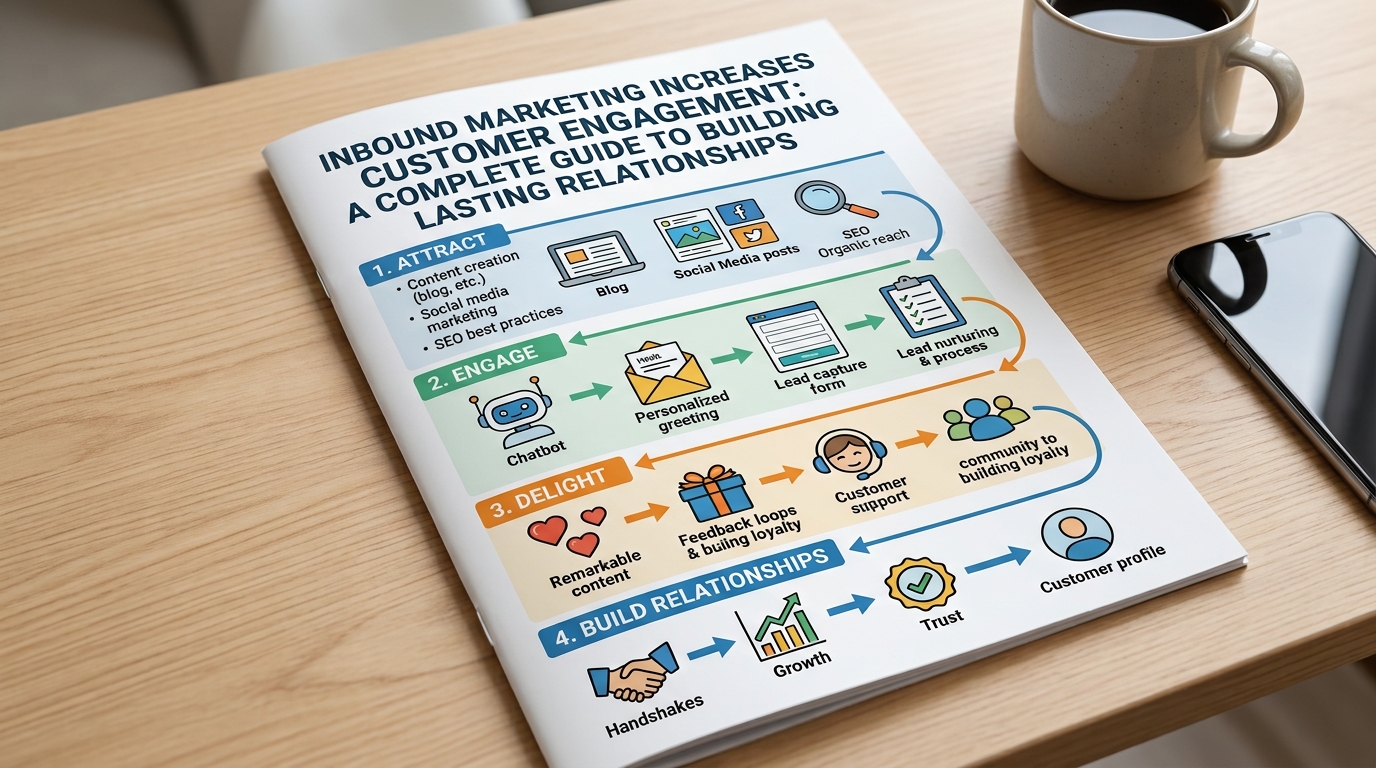
The traditional inbound framework covers three stages:
- Attract: Drawing the right people to your brand through content, SEO, and social media
- Engage: Nurturing those visitors into leads and customers through relevant, personalized communication
- Delight: Continuing to add value after the sale to turn customers into advocates
Each stage creates a different kind of customer engagement. At the top of the funnel, engagement is about attention and interest. In the middle, it’s about trust and consideration. At the bottom and beyond, it’s about loyalty and advocacy. A cohesive inbound strategy addresses all three.
The brands that fail at engagement usually treat it as a single-stage problem — focusing only on acquiring new customers without investing in the relationships that follow. Inbound marketing, when done correctly, closes that gap.
How Content Marketing for Customer Engagement Actually Works
Content is the backbone of every inbound strategy. But not all content drives engagement equally. The difference between content that gets ignored and content that sparks real interaction often comes down to specificity, relevance, and timing.
Content marketing for customer engagement works on a few key principles:
1. Solve Problems Your Audience Is Already Searching For
The most engaging content doesn’t begin with what a brand wants to say. It begins with what the audience needs to know. Keyword research, customer interviews, sales call analysis — these are the inputs that reveal what your audience is genuinely struggling with.
Blog posts, how-to guides, comparison articles, and tutorials built around real questions attract the right people and hold their attention because the content is intrinsically useful. A reader who finds a blog post that solves their exact problem doesn’t just consume it — they bookmark it, share it, and often return to the site that published it.
2. Create Content That Encourages Return Visits
One-off content can generate traffic, but engagement is built through consistency. Editorial calendars that publish regularly, content series that build on each other, and topic clusters that reward deeper exploration all encourage repeat visits.
When visitors return to a site multiple times, they move from strangers to familiar audiences. That familiarity is the precursor to trust — and trust is the precursor to conversion.
3. Match Content Format to the Stage of the Journey
Educational blog posts work well at the top of the funnel. Case studies and comparison guides work better in the middle. Onboarding guides and product tutorials serve customers who’ve already converted. Mapping format to stage ensures that content does the right job at the right moment.
|
Funnel Stage |
Content Format |
Engagement Goal |
|---|---|---|
|
Awareness |
Blog posts, infographics, social content |
Attract and inform |
|
Consideration |
Case studies, webinars, comparison guides |
Build trust and educate |
|
Decision |
Demos, free trials, testimonials |
Convert and reassure |
|
Retention |
Email sequences, tutorials, community |
Delight and retain |
SEO and Inbound Marketing: How Organic Visibility Fuels Engagement
SEO and inbound marketing are deeply intertwined. Organic search is consistently one of the highest-quality traffic sources available — because people who find content through search are actively looking for information. That active intent translates directly into higher engagement rates.
When a brand invests in SEO alongside its inbound strategy, it creates a compounding asset. A well-optimized piece of content can generate qualified traffic — and customer engagement — for years without additional spend.
What SEO Does for Inbound Engagement
- Attracts high-intent visitors: Someone searching for a specific question is far more likely to engage with content that answers it than someone who sees a display ad while browsing unrelated content.
- Builds authority over time: Consistent SEO performance signals expertise to both search engines and audiences, reinforcing the trust that drives engagement.
- Creates entry points across the funnel: A diverse keyword strategy — covering informational, navigational, and transactional queries — means people can discover the brand at any stage of their journey.
Key SEO Practices That Amplify Customer Engagement
Effective on-page SEO — clear headings, readable structure, fast load times — directly improves the user experience. A page that’s easy to navigate keeps visitors engaged longer, reduces bounce rates, and increases the likelihood of conversion.
Internal linking, when done thoughtfully, encourages readers to explore related content. That exploration deepens engagement and builds a more complete picture of the brand’s expertise.
Email Marketing Customer Engagement: The Most Underrated Inbound Channel
Social media gets more attention. SEO gets more investment. But email marketing remains one of the most effective tools for driving genuine customer engagement — and it’s central to any mature inbound strategy.
The average email marketing ROI sits at $36 for every $1 spent, according to Litmus. But ROI tells only part of the story. Email’s real power in an inbound context is its ability to maintain relationships over time — reaching people in a personal, direct channel with content that’s specifically relevant to them.
What Makes Email Marketing Effective for Engagement?
Segmentation: Sending the same email to every contact on a list is one of the fastest ways to destroy engagement. Segmenting by behavior, interest, or stage in the journey allows brands to send messages that feel tailored rather than broadcast.
Personalization: Using a subscriber’s name is table stakes. True personalization means referencing what they’ve downloaded, what they’ve purchased, or what stage of the journey they’re in. That level of relevance dramatically increases open rates, click-through rates, and long-term retention.
Value-first sequencing: Welcome sequences, nurture campaigns, and re-engagement emails all work best when they lead with value — education, resources, exclusive insights — before asking for anything in return. This mirrors the broader inbound philosophy: earn trust before asking for action.
Behavioral triggers: Emails sent in response to specific actions (downloading a guide, abandoning a cart, reaching a usage milestone) are far more relevant than scheduled blasts. Triggered emails typically generate significantly higher engagement because they arrive at precisely the right moment.
Social Media Customer Engagement: Building Community, Not Just Audience
Social media is where many inbound strategies begin — and where a surprising number stall. The issue usually isn’t the platform. It’s the approach. Brands that treat social media as a broadcasting channel — publishing links and promotional content without inviting conversation — rarely build meaningful social media customer engagement.
The brands that do it well think differently. They use social media to listen, respond, and participate — not just publish.
Tactics That Drive Real Social Media Engagement
Ask questions: Posts that invite responses — polls, open-ended questions, opinion prompts — generate comments and start conversations that extend organic reach.
Respond to every comment: Engagement is a two-way exchange. Brands that reply thoughtfully to comments signal that they value their audience. That signal compounds — people are more likely to engage with a brand they know will respond.
Showcase user-generated content: Sharing content created by customers — reviews, photos, testimonials — does two things simultaneously. It provides social proof to new visitors and rewards existing customers with recognition. Both outcomes deepen engagement.
Create content that’s worth sharing: Educational posts, surprising statistics, and genuinely useful frameworks get shared because they reflect well on the person sharing them. Shareability is an engagement multiplier — it extends reach while simultaneously signaling value.
Customer Engagement Strategies That Bridge Online and Relationship
Beyond individual channels, the brands with the highest engagement rates tend to share a set of strategic principles that cut across tactics.
Consistency Across Touchpoints
A customer who reads a blog post, receives an email, and then visits a product page should experience a coherent brand — consistent in tone, message, and value. Inconsistency creates cognitive dissonance that undermines trust and reduces engagement.
Progressive Profiling and Personalization at Scale
As customers interact with more content and channels, they reveal more about their preferences, pain points, and goals. Inbound marketing systems that capture and act on this behavioral data can progressively personalize experiences — serving more relevant content, making better product recommendations, and communicating in ways that feel individual rather than generic.
Community Building
Some of the most engaged audiences in any industry belong to brands that have built communities — forums, Slack groups, LinkedIn communities, in-person events — where customers connect not just with the brand but with each other. Community transforms customer engagement from a bilateral relationship between brand and individual into a network effect that compounds over time.
Feedback Loops
Engagement isn’t just something brands measure — it’s something they respond to. Brands that actively solicit feedback through surveys, reviews, and conversations — and visibly act on that feedback — create a sense of co-ownership that dramatically increases loyalty and engagement.
Measuring Customer Engagement: What Actually Matters
Not all engagement metrics are equally meaningful. Vanity metrics — raw page views, follower counts, total email subscribers — can look impressive without reflecting genuine relationship quality.
The metrics that matter most for inbound engagement include:
|
Metric |
What It Measures |
Why It Matters |
|---|---|---|
|
Time on page |
Content relevance and quality |
High time on page signals genuine interest |
|
Return visitor rate |
Audience loyalty |
Returning visitors are more likely to convert |
|
Email open and click rate |
Communication relevance |
Reflects how well content matches audience needs |
|
Social media comment rate |
Active participation |
Comments signal deeper engagement than likes |
|
Net Promoter Score (NPS) |
Customer advocacy potential |
Engaged customers recommend; disengaged ones don’t |
|
Customer lifetime value (CLV) |
Long-term relationship quality |
The ultimate downstream outcome of sustained engagement |
Tracking these metrics over time — and connecting them to specific inbound initiatives — reveals what’s actually working and where the strategy needs adjustment.
Common Mistakes That Kill Inbound Engagement
Understanding what drives customer engagement is easier when you can see what destroys it. These are the most common inbound missteps:
Publishing without a strategy: Creating content sporadically, without a clear audience persona or topic cluster, produces noise rather than engagement.
Optimizing for traffic instead of relationships: High traffic numbers mean nothing if visitors don’t return, subscribe, or convert. Inbound engagement requires optimizing for depth, not just volume.
Ignoring the post-conversion experience: The inbound journey doesn’t end when someone becomes a customer. Brands that invest exclusively in acquisition and neglect retention miss the highest-value engagement opportunities available.
Treating every channel identically: The content and tone that works on LinkedIn doesn’t work on Instagram. Email subject lines don’t follow the same rules as blog headlines. Channel-specific thinking produces far better engagement outcomes.
Frequently Asked Questions About Inbound Marketing and Customer Engagement
What is the difference between inbound marketing and outbound marketing?
Outbound marketing pushes messages to audiences regardless of their interest — through ads, cold calls, and interruptive tactics. Inbound marketing attracts audiences by providing value — through content, SEO, and personalized communication. Inbound tends to produce higher customer engagement because audiences opt into the relationship rather than being interrupted by it.
How long does it take for inbound marketing to increase customer engagement?
Inbound marketing is a long-term strategy. SEO results typically take three to six months to materialize. Email engagement builds as lists are segmented and sequences are refined. Social media communities develop over consistent months of interaction. Most brands see meaningful engagement improvements within six to twelve months of a sustained inbound effort.
Which inbound marketing channels are most effective for customer engagement?
The most effective channels depend on the audience and industry. Email marketing consistently delivers high engagement because of its direct, personal nature. SEO-driven content generates high-intent traffic. Social media builds community and real-time interaction. A combination of all three — coordinated around a coherent strategy — produces the strongest results.
How does content marketing specifically improve customer engagement?
Content marketing improves customer engagement by providing value before asking for anything in return. Educational content builds trust, answers questions, and positions the brand as a reliable resource. Over time, audiences that find consistent value in a brand’s content are far more likely to engage, subscribe, convert, and advocate.
What metrics should I use to measure inbound marketing engagement?
Key engagement metrics include time on page, return visitor rate, email open and click-through rates, social media comment rate, Net Promoter Score, and customer lifetime value. Together, these metrics provide a more complete picture of relationship quality than surface-level metrics like total traffic or follower count.
Can small businesses use inbound marketing to compete with larger brands on customer engagement?
Yes — and often more effectively. Inbound marketing rewards relevance and authenticity over budget. A small business that knows its audience deeply, publishes consistently helpful content, and engages personally with its community can build stronger customer relationships than a larger competitor running impersonal, high-volume campaigns.
The Inbound Advantage in Customer Engagement
Inbound marketing works because it aligns with how people actually want to engage with brands — on their own terms, driven by genuine value rather than pressure. The methodology’s emphasis on attracting, engaging, and delighting customers at every stage of the journey creates conditions where deep, lasting relationships can form naturally.
The key principles covered in this guide:
- Customer engagement is a strategic outcome, not a random byproduct — and inbound is the system that produces it consistently
- Content marketing, SEO, email, and social media each drive engagement differently, but compound powerfully when coordinated
- The post-conversion experience is where the most valuable engagement opportunities often live
- Metrics should reflect relationship quality, not just traffic volume
- Consistency, personalization, and responsiveness are the hallmarks of brands with the highest engagement rates
Businesses that commit to inbound marketing don’t just generate more leads. They build audiences that trust them, customers that advocate for them, and communities that sustain them through market shifts and competitive pressure. That kind of resilience doesn’t come from a single campaign — it comes from a compounded investment in genuine customer relationships.
The next step is simple: audit your current marketing activity against the inbound framework. Where are you attracting the right people? Where are relationships stalling? Where are you failing to delight customers after conversion? The answers will point directly to your highest-value engagement opportunities.