
Inbound marketing is a business strategy that attracts customers by creating helpful, relevant content rather than interrupting them with ads. It works by drawing people in at different stages of their buying journey—awareness, consideration, and decision—through SEO, content, email, and social media.
Customers have changed. They research before they buy, skip ads when they can, and trust recommendations over sales pitches. This shift has made one thing clear: you can’t push your way to growth anymore. You have to earn attention.
That’s exactly what inbound marketing is built to do. Rather than chasing customers with cold calls or banner ads, inbound marketing draws them to you—through content that answers their questions, solves their problems, and builds genuine trust over time. It flips the traditional marketing script, turning your website, blog, and social channels into tools that work around the clock to attract, engage, and convert the right people.
This guide covers everything you need to know about inbound marketing explained from the ground up. You’ll learn how it works, what makes it different from outbound marketing, what a solid inbound strategy looks like, and how real businesses use it to drive sustainable growth. Whether you’re a marketer looking to sharpen your approach or a business owner trying to understand where to invest, this post is your starting point.
By the end, you’ll have a clear picture of the inbound marketing process, the techniques that make it work, and the steps you can take to get started.
What Is Inbound Marketing?
Inbound marketing is a customer-centered approach that focuses on attracting people to your business through relevant, helpful content and experiences—rather than interrupting them with outbound tactics like cold outreach or paid display advertising.
The concept was popularized by HubSpot co-founders Brian Halligan and Dharmesh Shah around 2006. Their core argument was simple: the internet had fundamentally changed how people make purchasing decisions, and marketing needed to catch up. People were already searching for information online. The brands that showed up with useful answers would win.
At its heart, inbound marketing is about alignment. You create content that matches what your target audience is already looking for. You meet them where they are—on search engines, social media, or email—and you guide them naturally toward your product or service without forcing the conversation.
Inbound vs. Outbound Marketing: What’s the Difference?
To fully grasp the inbound marketing basics, it helps to contrast it with outbound marketing.
|
Factor |
Inbound Marketing |
Outbound Marketing |
|---|---|---|
|
Approach |
Pull — attract customers to you |
Push — reach customers proactively |
|
Channels |
SEO, blogs, email, social media |
TV ads, cold calls, print, display ads |
|
Cost over time |
Lowers as assets compound |
Stops working when budget stops |
|
Audience targeting |
Permission-based, self-selected |
Broad, often untargeted |
|
Trust level |
High — audience chooses to engage |
Lower — audience may feel interrupted |
|
Measurability |
Highly measurable |
Often difficult to track precisely |
Outbound marketing has its place—particularly for brand awareness at scale. But for businesses looking to build long-term relationships and generate consistent leads, inbound marketing delivers compounding value that outbound simply can’t match.
How Does Inbound Marketing Work?
The inbound marketing process is built around a concept known as the flywheel—a model introduced by HubSpot to replace the traditional linear sales funnel. Unlike a funnel, which ends at conversion, the flywheel keeps spinning. Satisfied customers become promoters, feeding momentum back into the cycle.
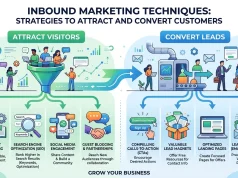
But before the flywheel can spin, inbound marketing moves through three core stages:
Stage 1: Attract
The first step is getting the right people to find you. This is where content marketing and SEO do the heavy lifting. By publishing blog posts, guides, videos, and social media content that addresses real questions your target audience is asking, you make it easier for them to discover your business organically.
Key tactics in the attract stage include:
- Search Engine Optimization (SEO): Optimizing content around keywords that your audience is actively searching for
- Blogging: Publishing educational and informative articles that answer specific questions
- Social media content: Sharing valuable posts that generate organic reach and engagement
- Video marketing: Creating tutorials, explainers, or thought leadership content on platforms like YouTube
The goal here isn’t traffic for traffic’s sake. It’s qualified traffic—visitors who are genuinely interested in what you offer.
Stage 2: Engage
Once someone finds your content, the next step is turning that initial interest into a meaningful relationship. This involves capturing leads, nurturing them with relevant information, and building trust before a sale is ever made.
Engagement tactics include:
- Lead magnets: Offering something valuable (an eBook, checklist, or webinar) in exchange for contact information
- Email marketing: Sending targeted, personalized email sequences that address where a prospect is in their buying journey
- Landing pages: Designing focused pages built to convert visitors into leads or customers
- Live chat and chatbots: Providing real-time answers to questions that might otherwise stop a prospect from moving forward
- CRM integration: Tracking interactions so your sales team has full context when they follow up
Engagement is a long game. Most leads aren’t ready to buy on their first visit. A thoughtful nurture sequence keeps your brand top of mind until they are.
Stage 3: Delight
The inbound journey doesn’t end at the sale. Delighting your customers—making sure they succeed with your product or service—is what turns buyers into brand advocates. And brand advocates are the most powerful marketing asset you can have.
Delight tactics include:
- Onboarding sequences that help new customers get immediate value
- Customer success content like how-to guides, tutorials, and knowledge bases
- Proactive support via email or chat to check in on customer progress
- Loyalty programs or exclusive community access that reward long-term customers
- Requesting reviews and testimonials at moments of peak satisfaction
When customers are delighted, they share their experiences. That word-of-mouth feeds directly back into the attract stage, creating a self-reinforcing cycle.
The Key Components of an Inbound Marketing Strategy

A strong inbound marketing strategy isn’t just about publishing blog posts and hoping for the best. It requires a deliberate architecture—each component serving a specific purpose in the overall system.
Content Marketing
Content is the foundation of every inbound marketing strategy. Without valuable content, there’s nothing to attract visitors, nothing to offer in exchange for contact information, and nothing to nurture leads with over time.
Effective content marketing involves:
- Mapping content to the buyer’s journey (awareness, consideration, decision)
- Creating content in multiple formats (text, video, infographic, podcast)
- Publishing consistently to signal authority to both audiences and search engines
- Repurposing content across channels to maximize reach
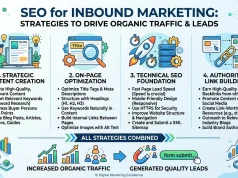
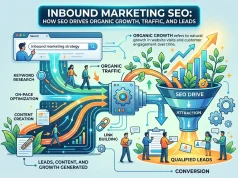
Search Engine Optimization (SEO)
SEO determines whether your content gets found. Without it, even the best articles sit unread on page three of Google.
A solid inbound SEO approach covers:
- Keyword research: Identifying terms your audience actually searches for
- On-page optimization: Using keywords naturally in titles, headings, meta descriptions, and body text
- Technical SEO: Ensuring your site loads fast, is mobile-friendly, and is easy for search engines to crawl
- Link building: Earning backlinks from reputable sites to boost domain authority
Email Marketing and Lead Nurturing
Email remains one of the highest-ROI channels in inbound marketing. According to Litmus (2023), the average return on email marketing investment is $36 for every $1 spent.
Lead nurturing sequences are designed to deliver the right message at the right time. A prospect who just downloaded a beginner’s guide needs different content than someone who has visited your pricing page three times. Segmentation and personalization are what separate effective email marketing from spam.
Social Media Marketing
Social media amplifies your content and builds community around your brand. It’s not just a distribution channel—it’s a place where conversations happen, trust is built, and relationships form before any transaction takes place.
The platforms you prioritize will depend on your audience. B2B brands often find the most traction on LinkedIn and X (formerly Twitter), while B2C brands may see stronger results on Instagram, TikTok, or Facebook.
Marketing Automation and CRM
As your inbound program grows, managing it manually becomes impossible. Marketing automation tools—like HubSpot, Marketo, or ActiveCampaign—allow you to trigger personalized emails, score leads based on behavior, and route prospects to the right sales team members at exactly the right moment.
A CRM (Customer Relationship Management) system ties everything together, giving your entire team a single source of truth on every contact.
Benefits of Inbound Marketing
There are many reasons why businesses across industries are shifting budget toward inbound. Here are the most compelling ones.
1. Cost-Effective Over the Long Term
Traditional advertising requires continuous spend. The moment you pause a paid campaign, the traffic stops. Inbound marketing assets—like a well-optimized blog post or a high-ranking guide—continue generating traffic and leads for months or years after they’re published.
According to HubSpot’s State of Marketing Report (2023), inbound leads cost 61% less than outbound leads on average. For growing businesses with limited budgets, that difference is significant.
2. Builds Credibility and Trust
People trust businesses that educate them. Publishing genuinely useful content positions your brand as an authority in your field. Over time, that credibility translates into faster sales cycles, higher close rates, and stronger customer loyalty.
3. Attracts Higher-Quality Leads
Because inbound draws in people who are actively searching for what you offer, the leads you attract tend to be better qualified than those generated through broad outbound campaigns. They’ve already demonstrated intent by searching for relevant content.
4. Measurable and Scalable
Every aspect of an inbound program—organic traffic, conversion rates, email open rates, lead-to-customer ratios—can be tracked with precision. This makes it easy to identify what’s working, optimize what isn’t, and scale the tactics that deliver the best results.
5. Supports the Entire Customer Lifecycle
Unlike a campaign that runs for six weeks and then ends, inbound marketing supports prospects and customers at every stage—from the moment they first discover your brand to long after they’ve made a purchase.
Inbound Marketing Examples from Real Businesses
Theory is useful. Seeing how inbound marketing works in practice makes it concrete.
HubSpot
HubSpot is arguably the most cited inbound marketing examples in the industry—and for good reason. The company built its entire growth engine on inbound principles. Their blog attracts millions of monthly visitors through SEO-optimized articles on marketing, sales, and customer service. They offer hundreds of free tools, templates, and courses that generate leads while delivering genuine value. Their Academy certifications have been completed by over a million people worldwide.
Canva
Canva uses inbound marketing techniques to attract users through educational content, design tutorials, and free templates. Their blog and resource center target keywords related to design for non-designers, drawing in a massive audience that then converts into free users—and eventually paying customers.
Moz
Moz, the SEO software company, built its reputation almost entirely through inbound marketing. Their Whiteboard Friday video series, their beginner’s guide to SEO, and their ongoing blog have positioned Moz as the go-to resource for marketers learning SEO. That content authority directly supports their software subscriptions.
Shopify
Shopify’s blog is a masterclass in content-led inbound growth. By publishing detailed guides on ecommerce topics—from how to start an online store to how to market products on Instagram—Shopify attracts entrepreneurs at the very beginning of their journey and nurtures them toward a paid plan.
Inbound Marketing Techniques That Drive Results
Not all inbound tactics are created equal. These are the ones that consistently deliver results across industries.
Pillar Pages and Topic Clusters
Instead of publishing individual blog posts on loosely related topics, modern inbound marketing strategy uses a pillar-cluster model. A pillar page covers a broad topic comprehensively (like this post), while cluster pages dive deep into specific subtopics and link back to the pillar. This structure signals expertise to search engines and makes it easier for readers to navigate.
Long-Form, Intent-Matched Content
Content that thoroughly answers a reader’s question outperforms shallow, brief articles in search rankings and engagement metrics. According to Backlinko (2023), long-form content generates an average of 77.2% more backlinks than short articles. The key is matching content depth to search intent—not writing long for the sake of it.
Conversion Rate Optimization (CRO)
Driving traffic is only half the equation. CRO involves systematically testing and improving the elements that turn visitors into leads—things like call-to-action placement, headline copy, form length, and page layout. Even a modest improvement in conversion rate can dramatically increase the output of an inbound program.
Interactive Content
Quizzes, calculators, assessments, and interactive tools engage visitors more deeply than static content. They also tend to generate more social shares and backlinks, amplifying reach. A mortgage calculator on a financial services site, for example, can attract highly qualified traffic while serving as a powerful lead generation tool.
Video SEO
YouTube is the second-largest search engine in the world, and video content is increasingly surfaced in Google search results. Optimizing video content with descriptive titles, transcripts, and relevant tags extends your inbound reach beyond text-based search.
How to Build Your Inbound Marketing Strategy Step by Step

Knowing what inbound marketing is and actually implementing it are two different things. Here’s a practical framework to get started.
Step 1: Define Your Buyer Personas
A buyer persona is a semi-fictional profile of your ideal customer, built from real data and research. It includes demographics, job roles, goals, pain points, and buying behaviors. Every piece of content you create should speak directly to at least one persona.
Step 2: Map the Buyer’s Journey
For each persona, map out the questions they ask and the content they need at each stage:
- Awareness: “I have a problem. What is it?”
- Consideration: “What are my options for solving it?”
- Decision: “Why should I choose this solution?”
Step 3: Conduct Keyword Research
Use tools like Google Keyword Planner, Ahrefs, or Semrush to identify the specific terms your personas are searching for. Prioritize keywords with meaningful search volume and intent that matches your content goals.
Step 4: Build Your Content Calendar
Plan content that covers each stage of the buyer’s journey across multiple formats. Consistency is more important than volume. A sustainable cadence of well-researched content will outperform an unsustainable burst of mediocre posts every time.
Step 5: Set Up Your Lead Generation Infrastructure
Before you can nurture leads, you need a way to capture them. This means:
- A well-designed website with clear calls to action
- Lead magnets that are genuinely valuable to your personas
- Landing pages optimized for conversion
- A CRM to store and manage contact data
Step 6: Launch Your Email Nurture Sequences
Segment your list and build email sequences that deliver relevant content based on where a prospect is in their journey. Automate what you can, but personalize wherever possible.
Step 7: Measure, Analyze, and Optimize
Track your key metrics—organic traffic, conversion rates, lead quality, email engagement, and revenue attributed to inbound. Use the data to double down on what’s working and fix what isn’t. Inbound marketing is iterative by nature.
Common Mistakes to Avoid in Inbound Marketing
Even well-intentioned inbound programs fall short when these mistakes go unchecked.
Creating content without a strategy. Publishing blog posts without keyword research or persona alignment produces traffic that doesn’t convert. Every piece of content should have a clear purpose and a defined audience.
Neglecting lead nurturing. Capturing leads and then never following up is one of the most common—and costly—inbound mistakes. A lead who doesn’t hear from you will forget you exist.
Ignoring conversion optimization. Driving traffic to a poorly designed website is like filling a bucket with holes. Before scaling content production, make sure your site is set up to convert.
Measuring the wrong metrics. Vanity metrics like total page views or social media followers feel good but rarely tell the full story. Focus on metrics tied to business outcomes: qualified leads generated, cost per lead, and revenue attributed to inbound channels.
Giving up too soon. Inbound marketing is a long-term investment. Most businesses see meaningful results within six to twelve months. Those who quit after two months never find out what was possible.
What Does the Future of Inbound Marketing Look Like?
Inbound marketing is evolving quickly, driven by changes in how people search and consume content.
AI-powered personalization is making it possible to deliver hyper-relevant experiences to individual visitors based on their behavior, location, and stage in the buying journey—at scale.
Search generative experience (SGE) and AI-powered answer engines like Google’s AI Overviews and ChatGPT are changing how content gets surfaced. Brands that structure their content to answer specific questions directly—and that demonstrate genuine expertise—will be better positioned in this new landscape.
Video and audio content continue to grow in importance. Podcasts, short-form video, and live streaming are becoming integral parts of mature inbound strategies, particularly for reaching younger audiences.
Zero-click searches are rising, meaning more people get answers directly on the search results page without clicking through to a website. This makes brand visibility and authority more important than ever, even when direct traffic is lower.
The core principle, however, remains unchanged: help people solve their problems, and they’ll trust you with their business.
Wrapping Up: Why Inbound Marketing Matters
Inbound marketing has proven itself not as a trend, but as a durable, scalable approach to sustainable business growth. By attracting the right people with valuable content, engaging them with personalized experiences, and delighting them after the sale, inbound creates a cycle that compounds over time.
The businesses that invest in inbound marketing today—building content libraries, optimizing for search, and nurturing their leads with care—are building assets that will generate returns for years. Those that don’t risk watching their acquisition costs climb as outbound channels become more competitive and less effective.
Start where you are. Pick one persona, one keyword cluster, one content format. Build from there, measure consistently, and let the data guide your next move. Inbound marketing rewards patience, consistency, and genuine helpfulness above all else.
Frequently Asked Questions
1. What is inbound marketing in simple terms?
Inbound marketing is a strategy that attracts customers to your business by creating helpful, relevant content rather than pushing ads at them. The goal is to draw in people who are already looking for what you offer and guide them naturally toward a purchase.
2. How is inbound marketing different from content marketing?
Content marketing is one component of inbound marketing. Inbound marketing is the broader strategy—it encompasses SEO, email marketing, social media, lead nurturing, and more. Content marketing refers specifically to the creation and distribution of valuable content.
3. How long does it take to see results from inbound marketing?
Most businesses begin to see meaningful traction within six to twelve months of consistent effort. SEO-driven results take longer to build than paid campaigns, but they compound over time and continue delivering value without ongoing spend.
4. Is inbound marketing suitable for small businesses?
Yes. Inbound marketing is particularly well-suited to small businesses because it levels the playing field. A small business with a strong content strategy can outrank much larger competitors in organic search and build a loyal audience without a massive advertising budget.
5. What tools are commonly used for inbound marketing?
Popular inbound marketing tools include HubSpot (CRM, email, content management), Ahrefs or Semrush (SEO research), Mailchimp or ActiveCampaign (email marketing), WordPress (content publishing), and Google Analytics (performance tracking).
6. What is the difference between a lead magnet and a call to action?
A call to action (CTA) is a prompt that encourages a visitor to take a specific step—like “Download the Guide” or “Start Your Free Trial.” A lead magnet is the valuable asset offered in exchange for contact information, such as an eBook, checklist, or webinar recording.
7. Can inbound marketing work for B2B businesses?
Inbound marketing is highly effective for B2B businesses. B2B buyers conduct extensive research before making purchasing decisions, which makes educational content particularly powerful. Platforms like LinkedIn and long-form blog content are especially effective in B2B inbound strategies.
8. How do I measure the success of an inbound marketing program?
Key metrics include organic search traffic, conversion rate (visitors to leads), lead-to-customer rate, cost per lead, email open and click rates, and revenue attributed to inbound channels. Tracking these consistently over time reveals both what’s working and where to improve.
9. What is the flywheel model in inbound marketing?
The flywheel is a model developed by HubSpot that replaces the traditional linear sales funnel. Rather than ending at conversion, the flywheel shows how delighted customers feed momentum back into the business by becoming promoters—attracting new prospects through referrals and word of mouth.
10. Do I need a large budget to start inbound marketing?
No. Inbound marketing is accessible at virtually any budget. Starting with a well-optimized blog, a basic email capture form, and a consistent publishing schedule requires more time than money. As results grow, you can reinvest in tools, paid amplification, and additional content formats.