
Inbound marketing contact verification helps businesses confirm the accuracy and usability of prospect information. Through email verification, database validation, automated checks, data quality monitoring, and privacy-conscious practices, marketing teams can reduce errors, improve deliverability, and support more reliable lead nurturing.
Inbound marketing contact verification helps businesses confirm that the contact information collected through websites, landing pages, content downloads, email subscriptions, and other marketing channels is accurate and usable. When prospects interact with a brand, they may provide email addresses, phone numbers, company details, and other information that marketing teams use to personalize communication and support lead nurturing. If these details are incorrect or outdated, even a well-designed inbound marketing strategy can struggle to produce consistent results.
Contact verification is more than checking whether an email address follows the correct format. It involves assessing the accuracy, completeness, validity, and usability of contact records throughout the customer acquisition process. A reliable approach helps organizations reduce delivery failures, avoid duplicate or misleading records, improve segmentation, and provide sales teams with better information about potential customers.
As marketing operations become increasingly data-driven, businesses need dependable contact information to understand prospect behavior and deliver relevant experiences. Implementing a structured verification process helps marketing teams maintain trustworthy records, improve campaign efficiency, and make better decisions throughout the inbound marketing journey.
Understanding Inbound Marketing Contact Verification
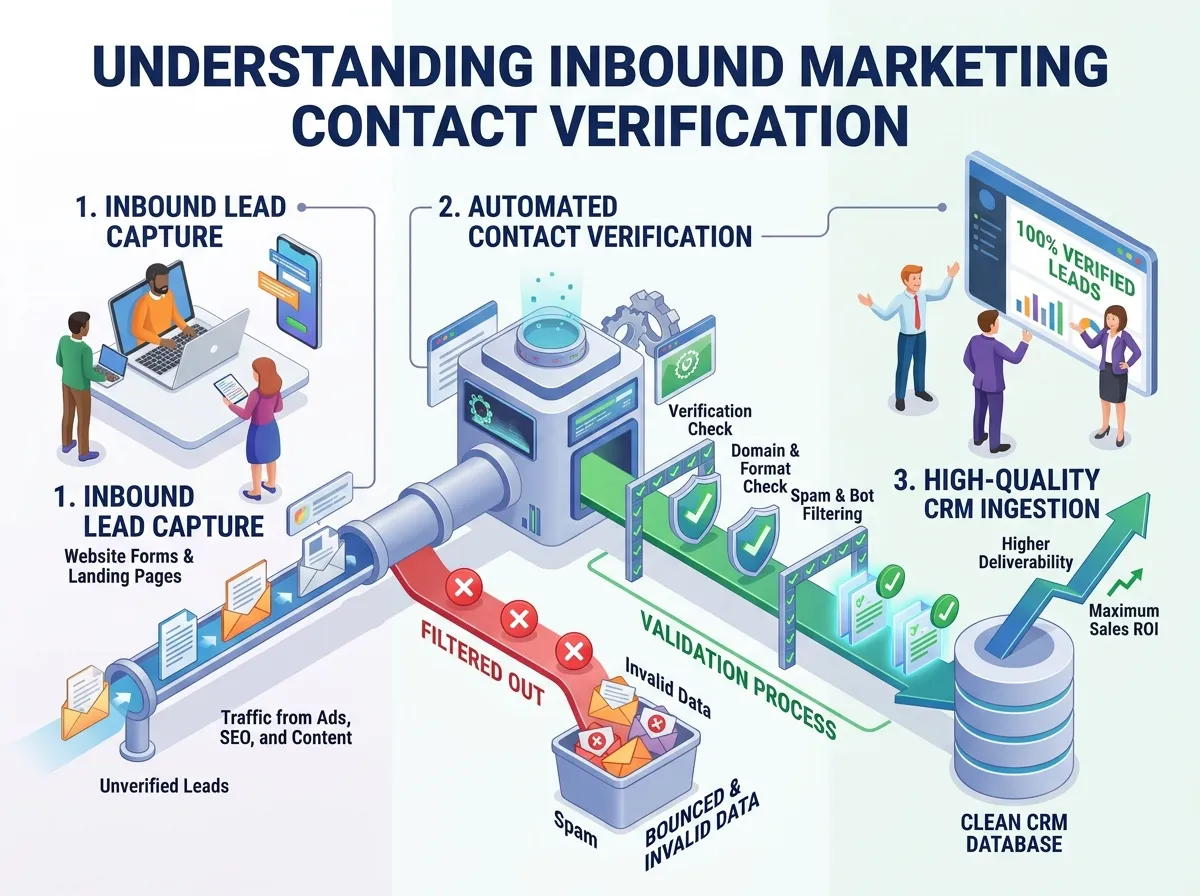
Inbound marketing contact verification is the process of checking whether prospect and customer contact details are accurate, valid, and suitable for business communication. It typically begins when someone submits information through a website form, newsletter subscription, gated resource, webinar registration, or another inbound channel. The collected details are then checked against established validation rules before being used in marketing systems.
The process can involve several different checks. Basic validation determines whether required fields are completed and whether information follows an expected format. Email verification examines whether an address appears technically valid and whether available signals suggest that messages can be delivered. Phone verification may assess formatting, country codes, and number validity. Additional checks can identify duplicate records, inconsistent company information, or outdated contact details.
It is important to distinguish verification from authentication and identity confirmation. A technically valid email address does not necessarily prove that the person submitting it owns the address or has provided accurate personal information. Stronger confirmation may require a verification email, a one-time code, or another appropriate confirmation method.
For inbound marketers, the objective is to build contact records that can support meaningful communication. Verification helps establish confidence in the information, while responsible data collection and ongoing maintenance keep that information useful as prospects move through the buying journey.
Why Contact Data Accuracy Matters for Inbound Marketing
Inbound marketing depends on attracting people who are already interested in a topic, product, or service and then providing relevant information as their needs develop. Contact records connect these interactions with future communications. If the records are inaccurate, businesses may lose opportunities to engage prospects who have demonstrated genuine interest.
Incorrect email addresses can prevent welcome messages, educational resources, and follow-up communications from reaching their intended recipients. Missing or inaccurate company details may also make segmentation less reliable, resulting in messages that do not reflect the prospect’s industry, role, or interests. Over time, these issues can weaken the connection between content engagement and lead nurturing.
Data accuracy also affects reporting. If a database contains duplicates, invalid contacts, or records with inconsistent source information, marketing teams may misinterpret the number of unique prospects generated by a campaign. This can distort conversion rates, campaign comparisons, and assessments of marketing contribution.
Reliable records support better coordination between marketing and sales teams. Sales representatives need current contact details and relevant context to follow up effectively. When information is verified and maintained consistently, teams can spend less time correcting records and more time understanding prospect requirements.
A well-maintained contact database therefore supports the wider inbound marketing process, helping organizations connect initial engagement with nurturing, qualification, and customer retention.
Inbound Marketing Contact Validation at the Point of Collection
The most efficient verification processes begin when information enters the marketing system. Waiting until a campaign fails or a sales representative discovers an incorrect record can create unnecessary work. By applying suitable validation rules to forms and data collection tools, businesses can identify common errors early.
Website forms should clearly indicate which fields are required and explain the expected format when necessary. Email fields can check for basic formatting problems, while phone number fields can use appropriate country-code rules. Dropdown menus and standardized field options may help reduce inconsistent entries, particularly for information such as country, industry, or company size.
However, validation should not make forms unnecessarily difficult to complete. Requiring excessive information can discourage interested visitors from submitting their details. Businesses should collect only the information needed for the stated purpose and use progressive profiling when additional details become useful later in the relationship.
Marketing teams should also avoid assuming that a correctly formatted submission is necessarily accurate. A person can enter a valid-looking but nonexistent email address, use a shared inbox, or submit outdated company information. Additional verification steps should be proportionate to the value and sensitivity of the interaction.
For high-value resources, account-based programs, or important sales inquiries, a confirmation email may provide an additional layer of confidence. For lower-risk interactions, basic validation combined with later monitoring may be sufficient. The right approach balances data quality, user experience, and the cost of verification.
Email Address Verification and Deliverability

Email address verification is a central part of inbound contact management because email is frequently used for newsletters, educational sequences, lead nurturing, and customer communication. Invalid addresses can cause delivery failures, while repeated sending to problematic addresses may negatively affect sender reputation.
An effective process begins with syntax checks to identify obvious formatting errors, such as missing components or invalid characters. Domain checks can help determine whether the domain is configured to receive email. Depending on the verification service and technical conditions, additional checks may provide signals about whether a mailbox appears deliverable.
These checks have limitations. Some mail servers do not disclose whether a particular mailbox exists, and catch-all domains may accept messages for multiple addresses without confirming individual recipients. Verification results should therefore be interpreted as indicators of likely deliverability rather than absolute guarantees.
Businesses should also monitor delivery outcomes after campaigns are sent. Hard bounces, repeated delivery failures, and persistent engagement problems may indicate that records require further review. Email verification should work alongside consent management, suppression lists, unsubscribe processing, and appropriate sending practices.
Verification alone cannot guarantee strong deliverability. Sender authentication, relevant content, consistent sending patterns, and recipient engagement also influence email performance. Nevertheless, maintaining valid contact information reduces avoidable errors and provides a stronger foundation for responsible email communication.
Improving Inbound Lead Verification
Inbound lead verification helps businesses assess whether a newly captured lead contains credible, usable information and is appropriate for the next stage of the marketing process. It can be especially valuable when leads arrive through several channels, including organic search, downloadable resources, webinars, contact forms, and paid campaigns.
A practical process starts by reviewing required fields and checking for obvious inconsistencies. Marketing teams may confirm whether an email address is valid, whether company information follows expected standards, and whether the record duplicates an existing contact. Where appropriate, additional checks can assess whether the submitted information matches the lead’s stated business context.
Verification should not be confused with lead qualification. Verification examines the reliability of the information, while qualification assesses factors such as need, fit, authority, timing, and potential commercial value. A contact may provide accurate information but have little immediate interest in purchasing. Conversely, a promising prospect may submit an incomplete form that requires clarification.
Keeping these processes separate makes lead management more accurate. Verified information can be passed into qualification workflows, where the business determines the prospect’s readiness for further engagement. This distinction helps sales teams avoid treating every technically valid contact as a sales-ready opportunity.
Insights from inbound marketing prospect analysis can then help teams understand how verified contacts interact with content, which questions they are exploring, and what information may be useful during subsequent communications. Combining reliable contact details with engagement context creates a stronger basis for personalized nurturing.
Maintaining Contact Database Validation
Contact database validation is an ongoing responsibility rather than a single cleanup activity. People change jobs, businesses update their domains, email addresses become inactive, and records collected through older campaigns may gradually lose accuracy. A database that was reliable when created can become less useful without regular maintenance.
Businesses should establish consistent rules for storing and updating contact information. Standardized capitalization, country formats, company names, and field definitions can reduce unnecessary variation. Duplicate detection can identify records that appear to represent the same person, while controlled merging procedures help preserve relevant history and prevent valuable engagement data from being lost.
Database maintenance should also consider the source and age of each record. Contacts collected recently through a direct inquiry may require different treatment from records that have not interacted with the business for several years. Review schedules can be based on factors such as contact age, campaign activity, data source, and the importance of the relationship.
When records are updated, organizations should preserve appropriate audit information so that teams can understand what changed and why. Automated corrections should be applied cautiously, especially when two records contain conflicting details. Uncertain matches may require manual review rather than automatic merging.
Businesses should also respect retention policies and applicable privacy requirements. Maintaining data quality does not mean keeping every record indefinitely. Where information is no longer necessary or a person requests deletion, the organization should follow its documented procedures and legal obligations.
Contact Verification Automation and Workflow Integration
Contact verification automation allows businesses to check information consistently without relying entirely on manual reviews. Automated workflows can validate submitted fields, flag suspicious or incomplete records, check for duplicates, and route contacts for additional confirmation when needed.
For example, when a visitor submits a resource request, the marketing platform can first check the required fields and email format. The record may then be compared with existing contacts to identify a possible duplicate. Depending on the result, the system can create a new record, update an existing one, or place the submission into a review queue.
Automation can also support ongoing maintenance. Scheduled workflows may identify contacts with repeated delivery failures, missing company information, or outdated verification results. Marketing teams can then prioritize records that are most likely to affect campaign performance rather than reviewing every entry manually.
Integration quality matters. Verification tools should work reliably with the organization’s customer relationship management system, marketing automation platform, form software, and reporting environment. Poorly designed integrations can create duplicate updates, overwrite correct information, or introduce delays between data collection and campaign activation.
Businesses should test automated workflows before applying them broadly. They should define how uncertain results will be handled, how errors can be corrected, and which records require human approval. Automation is most effective when it follows clear data governance rules and provides visibility into the actions it performs.
Protecting Customer Contact Data and Privacy
Contact verification often involves personal information, making privacy and security essential parts of the process. Businesses should collect contact details for clearly defined purposes, explain how the information will be used, and limit access to authorized employees and service providers.
Verification vendors should be assessed according to their security practices, data handling procedures, retention policies, and ability to support applicable legal obligations. Organizations should understand whether submitted information is stored, shared with third parties, or processed in other jurisdictions. These considerations are particularly important when verification services handle large volumes of customer or prospect records.
Access permissions should follow the principle of least privilege. Employees and external vendors should receive only the access necessary to perform their responsibilities. Marketing teams should also avoid transferring contact lists through unsecured channels or retaining unnecessary copies of verification files.
Privacy requirements vary by jurisdiction and by the nature of the data being processed. Businesses should review the rules that apply to their operations, including relevant consent, notice, access, correction, and deletion requirements. Verification does not automatically establish permission to send marketing messages, and a valid email address should never be treated as proof of consent.
By incorporating privacy safeguards into contact verification, organizations can improve data reliability while maintaining responsible relationships with the people whose information they manage.
Measuring the Effectiveness of Contact Verification
Marketing teams should evaluate contact verification using measures that connect data quality with operational and campaign outcomes. Useful indicators may include the proportion of records passing validation, hard-bounce rates, duplicate-record frequency, the percentage of records with complete required fields, and the time needed to correct data issues.
These measures should be interpreted in context. A high verification pass rate may indicate that a collection process is working well, but it does not necessarily mean that every contact is interested in the company’s products or has consented to marketing communications. Similarly, a lower pass rate may reflect a newly introduced channel with different data characteristics rather than a broad decline in quality.
Businesses should compare results over consistent periods and across comparable sources. If one campaign uses a short form and another collects more information, their completion and validation rates may differ for understandable reasons. Clear definitions help prevent misleading conclusions.
Teams can also examine downstream indicators such as successful follow-up, lead qualification rates, and the proportion of records requiring manual correction. These measures help determine whether verification improves the usability of contact data rather than simply increasing the number of records labeled as valid.
Where possible, organizations should assess whether verification costs are justified by reduced delivery failures, lower administrative effort, and better marketing operations. The goal is not to verify every data field as frequently as possible, but to maintain an appropriate level of accuracy for the intended use.
Connecting Contact Verification With SEO and Inbound Growth
Contact verification supports inbound growth by helping businesses make better use of the interest generated through organic search and educational content. SEO can attract relevant visitors, but the value of that traffic depends partly on whether interested prospects can successfully submit their details and receive the information they requested.
A well-designed SEO strategy for inbound marketing can bring visitors to relevant pages, while clear forms and reliable verification processes help turn appropriate interactions into usable contact records. These activities work together: search visibility supports discovery, helpful content builds interest, and accurate contact information supports continued engagement.
Marketing teams should also examine how contact quality varies by landing page, content topic, search intent, and acquisition source. Some pages may attract broad informational audiences, while others may reach people who are closer to making a purchasing decision. Understanding these differences helps businesses design suitable forms and follow-up experiences without assuming that every visitor has the same needs.
A broader digital marketing strategy can connect SEO, content, email, analytics, and lead management into a consistent process. Contact verification strengthens that process by reducing avoidable data problems between the initial conversion and subsequent marketing activities.
The result is a more dependable connection between audience acquisition and relationship development. Businesses can focus on providing relevant information to interested prospects while maintaining accurate records and respecting their communication preferences.
Common Challenges in Contact Verification
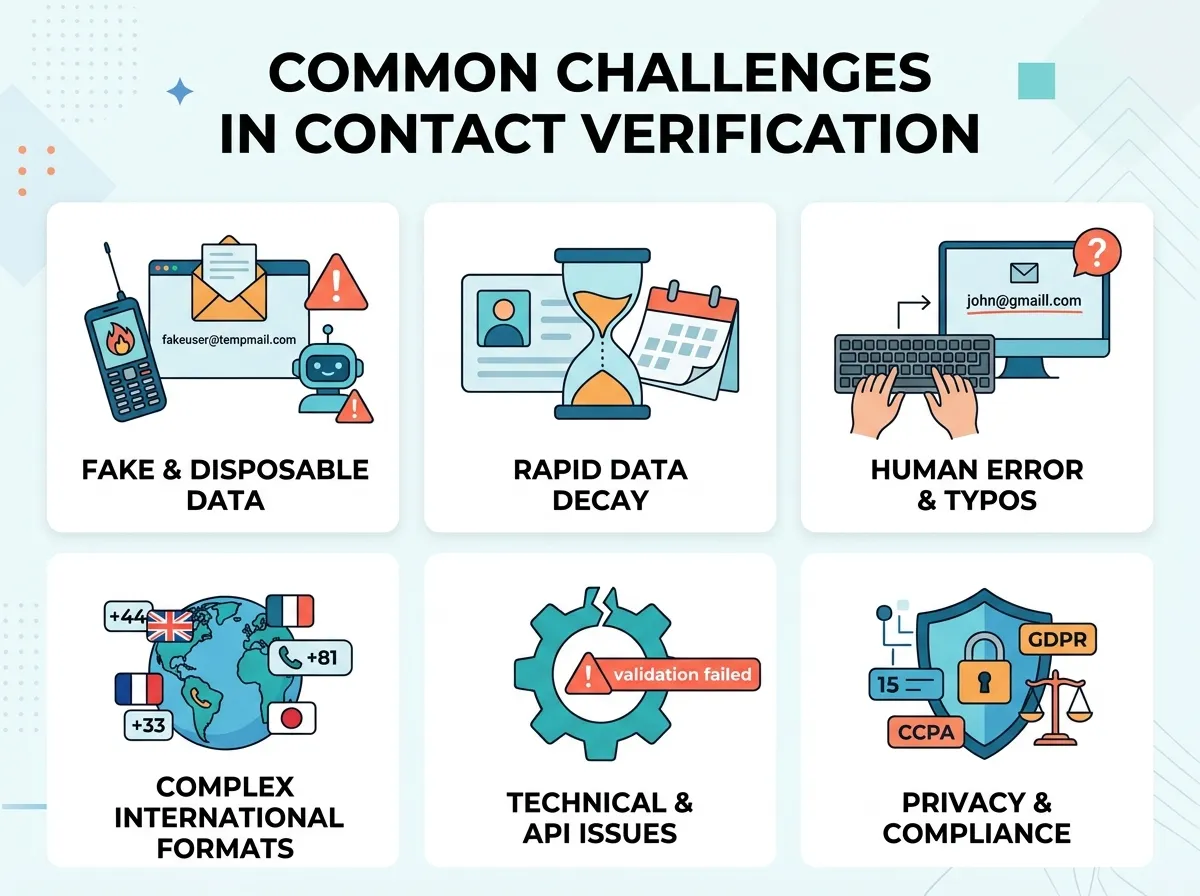
One common challenge is treating verification results as permanent. An address that appears valid today may become inactive later, while company details can change without notice. Verification should therefore be understood as a time-specific assessment that may need to be repeated according to the contact’s age, activity, and intended use.
Another challenge is relying too heavily on automated tools. Verification services can return uncertain results, and different providers may use different methods or confidence levels. Organizations should understand these limitations and establish rules for handling ambiguous cases instead of treating every result as definitive.
Excessive verification can also create unnecessary friction. Requiring confirmation at every stage may interrupt the user experience or delay legitimate inquiries. Businesses should use additional checks when they provide meaningful value and avoid creating barriers that are disproportionate to the risk.
Poor internal data practices can undermine otherwise effective tools. If teams use inconsistent field definitions, upload unreviewed spreadsheets, or allow systems to overwrite records without clear rules, contact quality may deteriorate again. Verification works best when it is supported by consistent data ownership, documented processes, and staff training.
Finally, organizations may focus on the accuracy of contact details while overlooking the quality of the overall relationship. A valid record is only the starting point. Relevant content, respectful communication, useful follow-up, and clear privacy practices remain essential to successful inbound marketing.
Conclusion
Inbound marketing contact verification helps businesses maintain accurate, dependable records throughout the prospect acquisition and nurturing process. By checking contact details at collection, validating email addresses, reviewing lead information, maintaining databases, and automating suitable workflows, organizations can reduce avoidable errors and improve the usability of their marketing data.
The strongest processes combine technical validation with human oversight, consistent data standards, privacy safeguards, and regular performance monitoring. They also distinguish contact verification from lead qualification and marketing consent, ensuring that reliable information is used appropriately.
When contact verification is integrated with SEO, content marketing, and lead management, businesses can build a more dependable inbound marketing operation. Accurate contact records help marketing and sales teams coordinate more effectively, understand prospect engagement, and deliver relevant communication while protecting the trust of their audience.
Frequently Asked Questions
1. What is inbound marketing contact verification?
Inbound marketing contact verification is the process of checking whether prospect and customer contact information is accurate, valid, and suitable for business communication.
2. Why is contact verification important for inbound marketing?
It helps reduce email delivery failures, improve database quality, support accurate segmentation, and provide marketing and sales teams with more reliable information.
3. What is the difference between contact verification and lead qualification?
Contact verification assesses the reliability of contact information. Lead qualification evaluates whether a prospect fits the business’s target audience and is ready for further sales or marketing engagement.
4. How does email address verification work?
Email verification may check address formatting, domain configuration, and available signals about mailbox deliverability. Some checks are inconclusive, so results should not be treated as absolute guarantees.
5. How often should contact databases be validated?
The appropriate frequency depends on record age, activity, data source, and business needs. Ongoing monitoring combined with scheduled reviews helps identify outdated or problematic records.
6. Can contact verification be automated?
Yes. Automation can validate submitted fields, identify duplicates, flag suspicious records, monitor delivery failures, and route uncertain results for manual review.
7. Does a verified email address prove marketing consent?
No. A valid email address does not automatically establish permission to send marketing messages. Consent and communication preferences must be managed separately according to applicable requirements.
8. How can businesses improve contact data quality?
Businesses can use clear form validation, standardized fields, duplicate detection, reliable verification tools, regular database maintenance, and documented data governance procedures.
9. What metrics help measure contact verification performance?
Useful measures include validation pass rates, hard-bounce rates, duplicate frequency, required-field completeness, correction time, and the number of records requiring manual review.
10. How does contact verification support SEO and lead generation?
SEO attracts relevant visitors, while contact verification helps ensure that information submitted through forms is usable. Together, they support more reliable follow-up, lead nurturing, and inbound marketing measurement.