

A content inventory helps businesses organize website pages, evaluate content performance, and identify opportunities for SEO improvement. Through content inventory management, structured spreadsheets, regular audits, and content gap analysis, marketers can maintain accurate information, improve internal linking, and make better use of existing assets. A consistent inventory process supports a more organized website, a stronger user experience, and more effective long-term content management.
Content inventory is an essential part of managing a website’s content effectively. As businesses publish more blog posts, landing pages, guides, and other digital resources, keeping track of every asset becomes increasingly difficult. Without a clear system, valuable content can become outdated, duplicate pages may accumulate, and opportunities to improve search visibility can easily be overlooked.
A well-maintained content inventory provides a structured overview of all existing content, including its purpose, location, performance, and relevance to business objectives. It helps marketers understand what they have already published, identify areas that need improvement, and make better decisions about future content development.
For businesses focused on inbound marketing, content inventory management also supports a more consistent customer journey. It makes it easier to connect relevant resources with audience needs, improve communication between marketing and sales teams, and maintain a website that delivers useful information at every stage of the buying process.
What Is a Content Inventory?
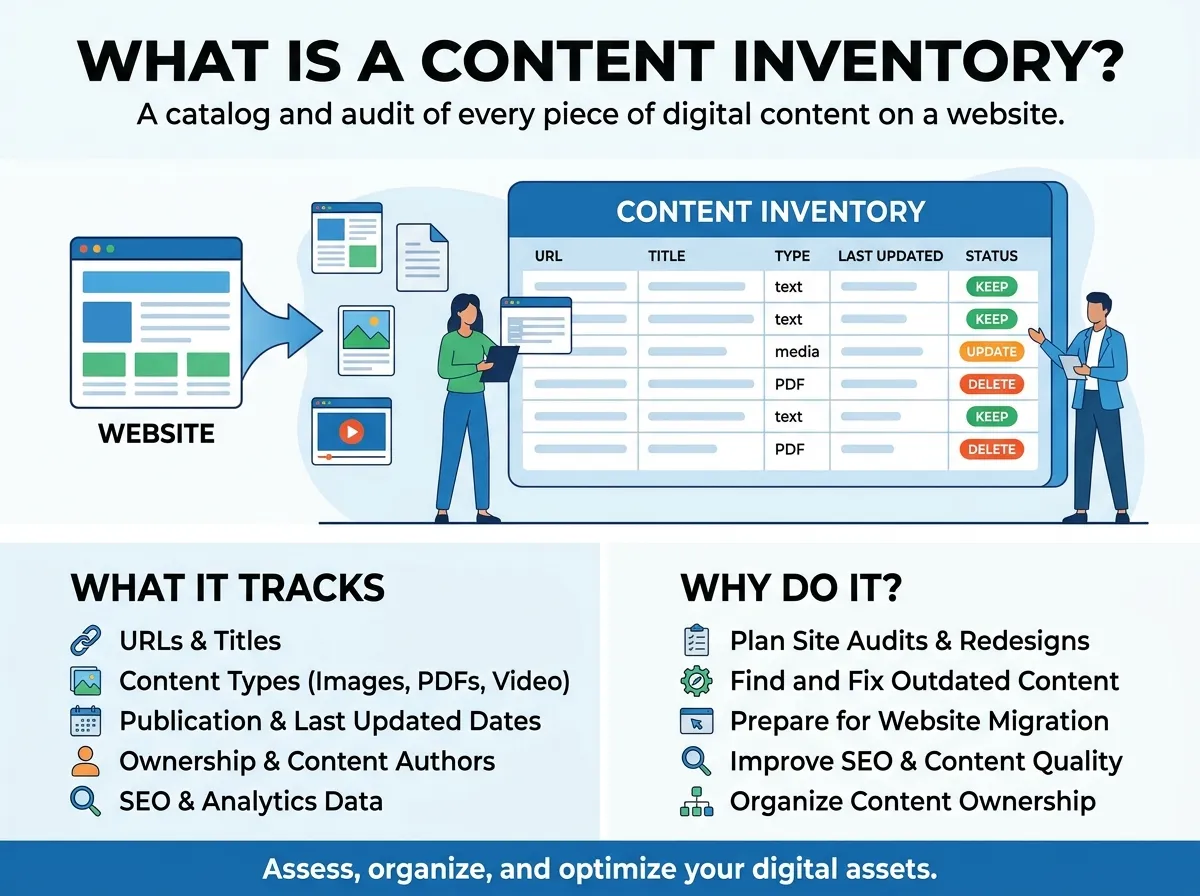
A content inventory is a centralized record of the content published across a website or other digital platforms. It typically includes information such as page URLs, content titles, publication dates, content types, target keywords, traffic data, and current status.
The primary purpose of a content inventory is to create a clear picture of the content a business already owns. Instead of relying on memory or manually browsing through hundreds of website pages, marketers can use a structured record to review their content library more efficiently.
A content inventory can include blog articles, service pages, landing pages, downloadable resources, case studies, product descriptions, and other relevant assets. The exact information collected depends on the website’s size, marketing objectives, and content management requirements.
For example, a business operating a large resource library may need to track publication dates, organic traffic, backlinks, and conversion performance. A smaller website may only require page titles, URLs, content categories, and update dates. In both cases, the objective remains the same: make existing content easier to understand, manage, and improve.
A clear inventory also provides the foundation for more detailed content audits. While an inventory records what exists, an audit evaluates how well that content performs and whether it continues to meet its intended purpose.
Why Content Inventory Management Matters
Content inventory management helps businesses maintain control over their growing content libraries. As websites expand, information can become scattered across categories, old landing pages may remain accessible, and several articles may begin targeting similar search queries. These issues can make content management more complicated and reduce the overall usefulness of a website.
A structured inventory makes these problems easier to identify. Marketers can locate outdated information, recognize duplicate topics, and determine which pages deserve additional attention. This reduces unnecessary content production and allows teams to focus on improving assets that already have potential.
Another important benefit is better coordination between content creation and business objectives. When marketers understand what has already been published, they can make more informed decisions about new topics, supporting resources, and internal linking opportunities.
Content inventory management also improves collaboration. Writers, editors, SEO specialists, and marketing managers can work from the same information instead of maintaining separate records. This shared understanding supports consistent updates and helps prevent important content from being overlooked.
For inbound marketing teams, a reliable inventory can strengthen the relationship between educational content and sales activities. Resources can be reviewed alongside the needs of different buyer stages, helping marketers understand whether prospects have access to the information they need before speaking with a sales representative. This is particularly valuable when developing an effective inbound marketing sales handoff.
How Website Content Inventory Supports SEO
A website content inventory can reveal important opportunities to improve organic search performance. Search engines evaluate individual pages, but the overall quality and organization of a website also influence how effectively its content serves users.
When marketers review their existing pages in one place, they can identify content that receives little traffic, pages that target similar keywords, and articles that no longer reflect current search intent. These findings help teams decide where updates, consolidation, or further research may be necessary.
A website content inventory also makes keyword distribution easier to evaluate. If multiple pages target nearly identical topics, marketers can review their purpose and determine whether each page provides distinct value. Similar topics are not automatically a problem, but unnecessary overlap may create confusion for readers and weaken the clarity of a site’s content structure.
Internal linking is another area that benefits from inventory data. A record of related pages helps writers connect useful resources naturally, allowing readers to explore relevant information without having to search for it independently.
For example, an article about content planning may link to a resource explaining inbound marketing content mapping. This connection gives readers additional context about how content can support different stages of the buying journey.
An inventory also helps marketers identify pages that deserve updated titles, clearer headings, stronger introductions, or more relevant supporting information. These improvements can make existing content more useful without requiring the team to publish an entirely new article.
Content Audit and Inventory: Understanding the Difference
Content inventory and content auditing are closely connected, but they serve different purposes. A content inventory documents the assets a business has, while a content audit examines their quality, relevance, and performance.
The inventory stage establishes the information needed for an informed evaluation. It may record a page’s URL, publication date, content type, target keyword, and current status. The audit stage then uses these details alongside performance data and editorial judgment to determine whether the page is achieving its objectives.
For example, an inventory may show that a website contains several articles about email marketing. A subsequent audit can reveal which articles attract relevant visitors, which contain outdated information, and which overlap enough to justify a closer review.
The audit may also identify pages that should be refreshed, combined, redirected, or removed. However, these decisions should not be based on traffic alone. A page with limited organic visits may still support conversions, answer an important customer question, or provide useful information to existing clients.
Combining content inventory and audit processes gives businesses a more complete understanding of their digital assets. It replaces assumptions with documented information and provides a clearer basis for prioritizing content improvements.
Conducting a Useful Content Inventory Analysis
Content inventory analysis involves examining the collected information to understand the condition and potential value of existing content. Rather than treating every page equally, marketers can evaluate assets according to their purpose, audience, relevance, and performance.
Organic traffic is one useful measurement, particularly for websites that depend on search visibility. However, traffic should be considered alongside engagement, conversions, backlink quality, and the usefulness of the information provided.
A page attracting a modest number of visitors may generate qualified inquiries, while another page with higher traffic may contribute little to the business. Looking at multiple indicators prevents teams from making decisions based on incomplete information.
Content relevance is equally important. Pages containing outdated statistics, discontinued services, inaccurate recommendations, or obsolete terminology may require immediate attention even if their traffic remains relatively strong. Maintaining accurate information helps preserve credibility and improves the reader’s experience.
During analysis, marketers should also consider how each page relates to the broader content library. Some assets provide foundational information, while others answer specific questions or offer deeper insights. Understanding these relationships makes it easier to recognize missing topics and organize supporting resources.
A thoughtful content inventory analysis ultimately helps businesses prioritize meaningful improvements instead of making changes simply to increase the number of published pages.
Creating an Effective Content Inventory Spreadsheet

A content inventory spreadsheet is a practical way to organize website information without investing in specialized software. A spreadsheet can be maintained in a familiar tool and adapted as the content library grows.
The most useful spreadsheets contain consistent fields that make pages easy to compare. Common fields include the page title, URL, content type, primary keyword, publication date, last updated date, target audience, organic traffic, conversion data, and editorial status.
Additional fields can record content owners, priority levels, internal links, and recommended actions. For example, a page might be marked for updating because its information is outdated, while another may need stronger internal links or a clearer search-focused title.
Consistency matters more than the number of columns. Collecting too many unnecessary details can make the spreadsheet difficult to maintain, while recording too little information may limit its usefulness. The best structure reflects the team’s actual workflow and the decisions it needs to make.
Businesses managing larger websites may benefit from connecting spreadsheet records with data from analytics platforms and search performance tools. This can reduce manual work and make regular reviews more reliable.
The spreadsheet should also remain an active working document rather than a one-time record. Whenever content is published, substantially revised, redirected, or retired, the inventory should be updated to reflect the change.
Using a Content Inventory Template to Improve Consistency
A content inventory template provides a repeatable structure for collecting and reviewing information. Instead of creating a new tracking system for every project, teams can use the same fields and evaluation criteria across different sections of a website.
A useful template begins with basic identification details, including the page title, URL, content category, and format. It can then include editorial information, such as the author, publication date, last review date, and content owner.
Performance fields may cover organic traffic, engagement, conversions, and relevant search queries. These measurements help marketers understand how pages contribute to website visibility and business outcomes.
A final section can record observations and next steps. Pages may be marked for updating, further analysis, internal linking, consolidation, or continued monitoring. This makes it easier to turn collected information into practical decisions.
Templates should remain flexible enough to support different content types. A blog article may require keyword and traffic information, while a service page may need additional attention to lead generation, service accuracy, and conversion performance.
A consistent template creates a shared reference point for content teams and makes future reviews easier to repeat.
Content Organization Strategy for a Better User Experience
A strong content organization strategy helps visitors find relevant information quickly. Even high-quality content can become difficult to use when pages are poorly categorized, navigation is confusing, or related resources are disconnected.
An organized website groups content according to meaningful topics and user needs. Categories should reflect how readers understand the subject rather than simply following the internal structure of the marketing department.
Related pages should also support one another through contextual internal links. A foundational article can introduce a subject, while more specialized resources provide additional detail. This structure helps readers move naturally from general questions to more specific information.
Content organization also supports editorial efficiency. When teams understand how existing pages relate to each other, they can avoid unnecessary duplication and identify areas where additional coverage would be valuable.
The same principle applies to inbound marketing. Content should provide appropriate information as potential customers move from initial awareness toward evaluation and decision-making. Understanding what inbound marketing is and how it works can help teams recognize how educational resources contribute to attracting, engaging, and supporting prospective customers.
For businesses publishing content across several marketing channels, an organized inventory can also clarify which assets are suitable for repurposing. A useful article may support an email newsletter, a social media post, or a broader content initiative, provided the adapted material remains relevant to its intended audience. This is also valuable when businesses use content to strengthen affiliate marketing, where useful information can help audiences evaluate products and understand their benefits.
Content Performance Evaluation and Continuous Improvement
Content performance evaluation helps marketers determine whether existing assets continue to meet their objectives. A page may have performed well when it was published but gradually lose relevance as search behavior changes, competitors produce better resources, or business priorities evolve.
Evaluating performance requires a combination of quantitative data and qualitative judgment. Traffic, impressions, click-through rates, conversions, and engagement indicators can reveal how audiences interact with a page. Editorial review helps determine whether the information remains accurate, clear, complete, and useful.
These measurements should be interpreted in context. A decline in traffic does not automatically mean that a page needs rewriting, and a high number of visits does not necessarily indicate success. The appropriate response depends on the page’s purpose and the results it is expected to deliver.
Content inventory records can help establish review priorities. Pages with outdated information, declining performance, important conversion roles, or strong potential for improvement may deserve attention before lower-priority assets.
Regular evaluation also helps teams identify patterns across the website. Several pages may experience similar performance changes, suggesting that the issue relates to broader search demand, changing audience interests, or weaknesses in content organization.
By reviewing performance consistently, marketers can make informed decisions about where to invest editorial time and resources.
Identifying Opportunities Through Content Gap Analysis
Content gap analysis examines whether a website provides sufficient information to address the needs and questions of its intended audience. While content inventory analysis focuses on existing assets, gap analysis helps identify missing topics, incomplete coverage, and opportunities to improve the overall resource library.
The process begins with understanding audience needs and comparing them with the content already available. Marketers can examine customer questions, relevant search queries, sales conversations, and the subjects covered by existing pages.
An inventory makes this comparison more reliable because it reveals what the website already addresses. Without that information, teams may repeatedly create content about familiar subjects while overlooking important questions that remain unanswered.
Content gaps may involve missing topics, insufficient depth, outdated resources, or weak connections between related pages. A website might contain several introductory articles about a subject but lack detailed resources that help readers evaluate their options.
Not every identified gap requires a new article. Sometimes the better solution is to improve an existing page, connect related resources through internal links, or reorganize information to make it easier to find.
Prioritization is essential because not every topic will have equal value. The strongest opportunities generally align audience needs with business objectives, realistic search opportunities, and the website’s ability to provide genuinely useful information.
Content Asset Management for Long-Term Website Value

Content asset management extends beyond tracking individual pages. It focuses on maintaining the usefulness, accuracy, ownership, and accessibility of the information a business has created.
Every content asset requires appropriate attention throughout its lifecycle. New resources need review before publication, established pages may require updates, and outdated material may eventually need to be consolidated or retired.
Clear ownership makes this process easier. When teams know who is responsible for maintaining particular pages, important updates are less likely to be overlooked. Documented review dates and editorial statuses also help establish accountability.
Content asset management can reduce unnecessary production costs by helping marketers recognize opportunities to improve existing resources. Instead of automatically commissioning new articles, teams can evaluate whether an established page can be expanded, refreshed, or repurposed to meet the same need.
This approach is particularly useful for businesses with extensive content libraries, multiple contributors, or several interconnected marketing websites. A reliable inventory provides visibility, while consistent maintenance helps preserve the value of the resources already available.
Conclusion
Content inventory gives businesses a clearer understanding of their existing digital resources and creates a stronger foundation for content management, SEO improvement, and audience engagement. By documenting website pages, evaluating their performance, and identifying opportunities for improvement, marketers can make more informed decisions about their content libraries.
An effective process combines a practical spreadsheet or template with regular analysis, thoughtful organization, and ongoing performance evaluation. It also connects existing content with broader marketing objectives, helping teams improve internal linking, identify content gaps, and maintain accurate information.
Rather than treating content as a collection of isolated pages, businesses can use a structured inventory to manage their resources as a connected and evolving asset. This approach supports more consistent publishing decisions, improves the usefulness of existing content, and helps build a website that serves both its audience and its long-term business goals.
Frequently Asked Questions
1. What is a content inventory?
A content inventory is a structured record of a website’s content assets, including page titles, URLs, content types, publication dates, and performance information. It helps marketers understand what content exists and how it is organized.
2. Why is content inventory management important?
Content inventory management helps teams maintain accurate information, identify outdated pages, reduce unnecessary duplication, and discover opportunities to improve SEO and the user experience.
3. What is the difference between a content inventory and a content audit?
A content inventory records the content a website contains, while a content audit evaluates its quality, relevance, and performance. The inventory provides the information needed to conduct a more informed audit.
4. How does a content inventory improve SEO?
It helps marketers identify outdated content, overlapping topics, missing internal links, and pages that may benefit from optimization. These insights support better content organization and more relevant search-focused improvements.
5. What should a content inventory spreadsheet include?
A spreadsheet commonly includes page titles, URLs, content types, target keywords, publication dates, last updated dates, performance metrics, content owners, and recommended actions.
6. How often should a content inventory be updated?
The inventory should be updated whenever meaningful content changes occur. A regular review schedule, such as monthly or quarterly, can help ensure that records remain accurate and useful.
7. What is a content inventory template?
A content inventory template is a reusable structure for recording and evaluating website content. It standardizes information collection and makes it easier for teams to review pages consistently.
8. How does content inventory analysis work?
Content inventory analysis examines existing pages using information such as traffic, engagement, conversions, relevance, and editorial quality. The findings help marketers prioritize improvements and identify content that needs further review.
9. What is the relationship between content inventory and content gap analysis?
A content inventory shows what content already exists, while content gap analysis identifies topics or audience needs that are not adequately covered. Together, they help businesses improve existing resources and plan useful new content.
10. Can a small business benefit from a content inventory?
Yes. A small business can use a simple spreadsheet to track website pages, review outdated information, improve internal links, and identify useful content opportunities without requiring specialized software.