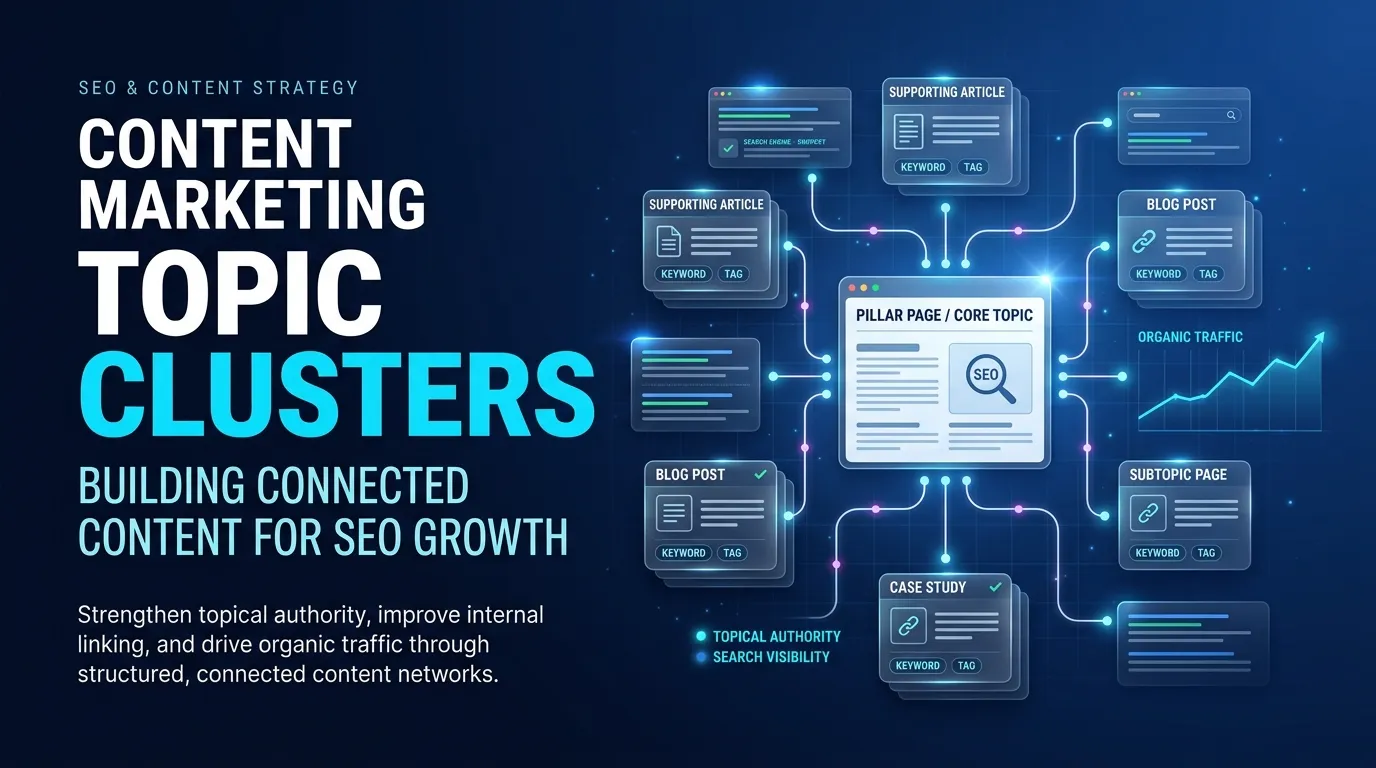
Content Marketing Topic Clusters organize related articles around a central topic to create a connected and meaningful website structure. Using content pillar pages, supporting articles, keyword clustering, and strategic internal links, businesses can cover important subjects in greater depth. A well-planned topic cluster strategy improves content discoverability, supports SEO performance, reduces content overlap, and helps readers find relevant information throughout their journey.
Content Marketing Topic Clusters help businesses organize related content around a central subject, making it easier for readers to explore useful information and for search engines to understand the relationships between pages. By connecting pillar pages with relevant supporting articles through strategic internal linking, businesses can strengthen topical relevance, improve website navigation, and build a more consistent organic search presence.
Understanding Content Marketing Topic Clusters
Publishing high-quality articles is important, but the way those articles connect can also influence a website’s effectiveness. When content is created without a clear structure, related information may become scattered across different pages. Readers can struggle to find answers to related questions, while search engines may have difficulty understanding how individual pages relate to a broader subject.
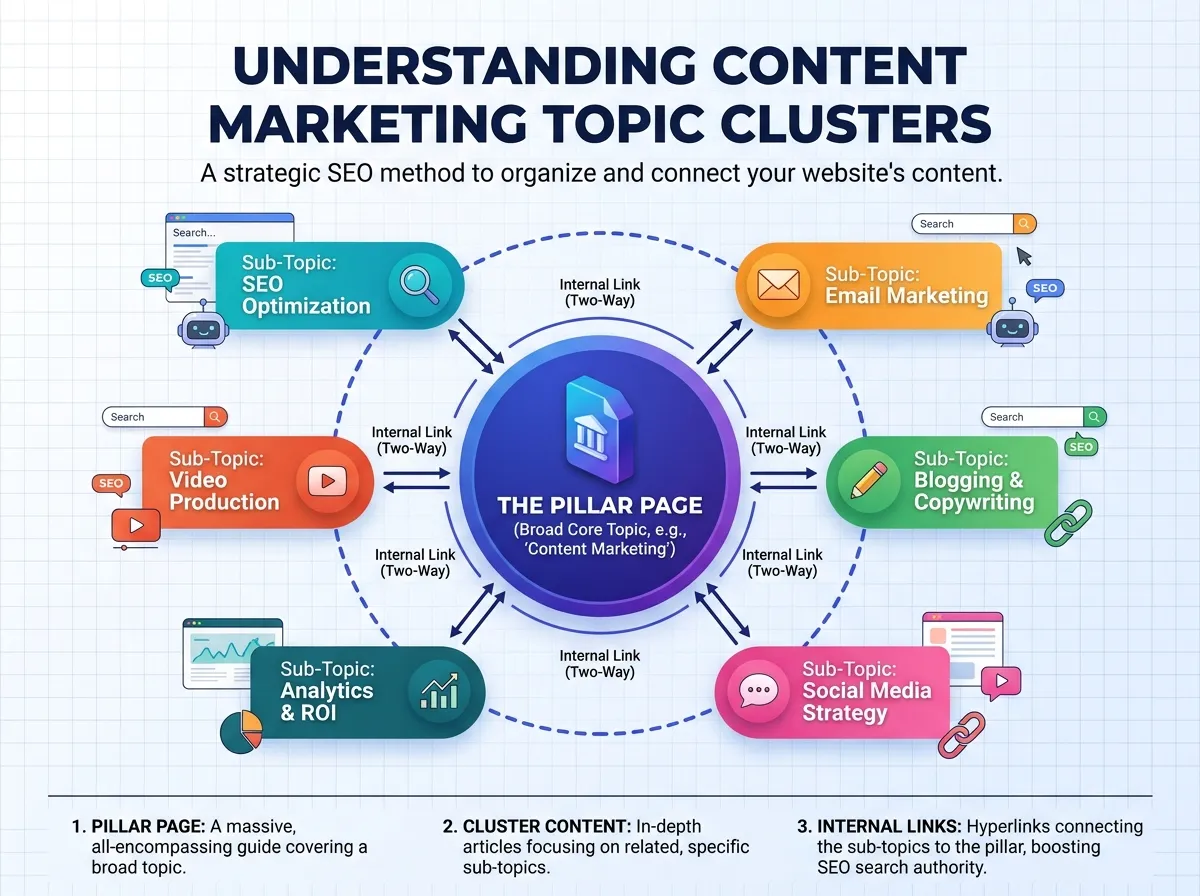
Content Marketing Topic Clusters address this challenge by organizing content around a central theme. The structure typically includes a comprehensive main page, known as a pillar page, and several supporting articles that explore specific aspects of that theme in greater detail. Internal links connect these pages and help readers move naturally between related topics.
For example, a marketing website covering content marketing might create a central page about content marketing strategy. Supporting articles could explore editorial planning, content distribution, audience research, content performance, and content repurposing. Each article answers a more focused question while contributing to the broader subject.
This structure creates a more connected content experience. Instead of treating every blog post as an independent asset, businesses build a collection of resources that work together to demonstrate knowledge and address different user needs.
Topic clusters are not a guarantee of higher rankings, but they can support better content organization, discoverability, and internal navigation when the information is genuinely useful and well connected.
Developing a Content Topic Clustering Strategy
A successful Content Topic Clustering Strategy begins with a clear understanding of the audience, the business’s expertise, and the questions potential customers are trying to answer. Choosing topics simply because they contain popular keywords can lead to disconnected articles that offer little value as a collection.
Businesses should first identify the main subjects that relate to their products, services, and audience interests. These subjects become potential content pillars. Each pillar can then be expanded into narrower topics that address specific questions, challenges, comparisons, and practical considerations.
For example, a business focused on digital marketing might select content marketing as a primary subject. Supporting topics could include audience research, editorial calendars, content distribution, content optimization, and performance measurement. These subjects are related, but each offers a distinct opportunity to provide useful information.
Audience research can help determine which supporting topics deserve priority. Search queries, customer questions, sales conversations, competitor content, and website search data can reveal information gaps worth addressing.
Businesses should also consider search intent. Someone searching for a definition needs a different answer from someone comparing software or evaluating a service. A strong cluster accommodates these different needs without forcing every page to target the same audience question.
A clear strategy ensures that every supporting article has a purpose, contributes to the main subject, and offers information that is not already covered adequately elsewhere.
SEO Topic Clusters and Search Visibility
SEO Topic Clusters create a structured way to cover related subjects and connect pages through meaningful internal links. Rather than relying on isolated articles, businesses can develop a deeper collection of resources around the topics most relevant to their audience.
Search engines use multiple signals to understand website content, including page text, links, and the relationships between information. A well-organized cluster can help search engines discover supporting pages and understand how those pages fit within a broader subject area.
For instance, a pillar page about content marketing may link to articles covering content distribution, editorial planning, audience segmentation, and content performance. These supporting pages can link back to the pillar when it provides useful broader context.
However, topic clusters should not be created solely to increase the number of internal links. Every page needs a clear purpose, accurate information, and a meaningful relationship with the other pages in the cluster. Adding unrelated articles or repeating similar content across multiple URLs can weaken the overall experience.
SEO performance also depends on factors such as content quality, technical accessibility, competition, page experience, and the relevance of the information to the searcher’s needs.
A thoughtful cluster structure gives businesses a practical foundation for expanding their content libraries while maintaining clear topical relationships and a coherent website architecture.
Content Pillar Pages as the Foundation of a Cluster
Content Pillar Pages provide a central overview of a broad subject. They introduce the main concepts, explain why the topic matters, and direct readers toward supporting articles that offer more detailed information.
A strong pillar page should be comprehensive without attempting to answer every possible question in full. Its purpose is to establish context and help readers identify the information most relevant to their needs.
For example, a pillar page about content marketing could introduce content planning, content formats, distribution channels, audience research, and performance evaluation. Each section could link to a dedicated article that explores the subject in greater detail.
This approach prevents the pillar page from becoming unnecessarily long while allowing the website to provide substantial coverage of the broader topic.
The pillar should also have a clear structure, descriptive headings, relevant examples, and an intuitive navigation experience. Readers should understand the central subject quickly and be able to move to more specific information without searching through unrelated material.
When developing a pillar page, businesses can use their existing Content Inventory to identify relevant articles, evaluate existing coverage, and determine which resources can support the new structure. Reviewing existing content before publishing helps reduce duplication and makes it easier to connect useful pages that may already exist.
Topic Cluster Content Planning for Consistent Publishing

Topic Cluster Content Planning helps businesses decide which articles to create, update, or connect before they begin publishing. Without a structured plan, teams may repeatedly cover familiar subjects while overlooking important questions that their audiences still need answered.
The planning process starts by defining the primary subject and identifying the supporting topics that contribute to it. Each proposed article should have a distinct focus, a clear audience, and a specific search intent.
A content calendar can then organize these topics according to priority, available resources, and business objectives. Articles that address major information gaps may deserve attention before minor supporting subjects. Similarly, existing high-quality content may be updated before entirely new pages are created.
Businesses should also plan internal links during the content development stage rather than treating them as an afterthought. Identifying the relevant pillar and supporting pages in advance makes it easier to create natural connections within the article.
A useful content plan should remain flexible. Search trends, customer questions, product developments, and performance data may reveal new opportunities that were not apparent during the initial research.
When topic planning is connected to business objectives and audience needs, the result is a more consistent publishing process that builds meaningful subject coverage over time.
Building a Strong Content Cluster Strategy
An effective Content Cluster Strategy balances comprehensive subject coverage with a clear distinction between individual pages. Each article should contribute something specific to the cluster rather than repeating the same general explanation.
One supporting article might focus on developing an editorial calendar, while another explores methods for distributing content across relevant channels. Both belong within a broader content marketing cluster, but their primary purposes differ.
This distinction matters because overlapping pages can compete for the same search intent. If several articles answer essentially the same question, readers may struggle to identify the most useful resource, and search engines may have difficulty determining which page should serve as the primary result.
A consistent planning process can help prevent this problem. Before creating a new article, businesses should review existing pages to determine whether the proposed subject requires a separate resource or would be better addressed by improving an existing page.
A documented Content Marketing Strategy Framework can support this process by connecting topic selection, audience requirements, publishing priorities, and business goals. When topic clusters are developed within a broader strategy, individual articles become part of a coordinated content system instead of isolated publishing activities.
The strongest clusters grow according to real information needs. They become more useful as new content fills genuine gaps, while outdated or redundant material is revised, consolidated, or removed when appropriate.
Topic-Based Content Organization and Website Structure
Topic-Based Content Organization helps readers navigate related information without needing to return to search results for every new question. It also gives content teams a clearer view of how different subjects fit within the website.
A logical structure often places broad categories above individual topic clusters, with pillar pages acting as central resources for specific subjects. Supporting articles sit within the relevant category and link to related resources where those connections benefit readers.
For example, a website covering marketing might organize its content into broad categories such as content marketing, search optimization, social media, and email marketing. Within content marketing, a pillar page could connect articles about planning, production, distribution, and evaluation.
The website’s navigation, category structure, and internal links should work together rather than create competing organizational systems. Descriptive page titles, readable URLs, and consistent categories can further improve usability.
Businesses should avoid creating excessive categories or deeply nested structures that make useful articles difficult to reach. A well-organized website helps users understand where they are, what information is available, and which resource they should explore next.
Topic-based organization also simplifies maintenance. When related pages are grouped logically, teams can identify outdated information, discover missing subjects, and review the overall quality of a content area more efficiently.
The Pillar and Cluster Content Model in Practice
The Pillar and Cluster Content Model connects one broad resource with multiple focused supporting pages. Although the structure is straightforward, its effectiveness depends on the relevance of the supporting articles and the quality of the connections between them.
The pillar provides an overview of the main topic, while cluster articles answer narrower questions in depth. Internal links connect the resources in ways that help readers move between general explanations and more specific information.
Consider a cluster built around SEO content strategy. Its pillar might explain how content supports organic visibility, audience relevance, and long-term business objectives. Supporting articles could examine keyword research, content optimization, editorial planning, search intent, and content auditing.
Each supporting page should contribute a distinct perspective and link to the pillar when readers would benefit from the broader explanation. It may also connect to other supporting pages when the relationship is directly relevant.
A useful SEO Content Strategy can help businesses align these resources with audience needs, organic search opportunities, and content quality. This alignment ensures that the cluster is built around meaningful information rather than an arbitrary collection of keyword variations.
Not every supporting article needs to link to every other article. Selective, contextually relevant linking creates a clearer experience and prevents pages from becoming cluttered with unnecessary links.
Content Marketing Content Hubs and Their Business Value

Content Marketing Content Hubs bring related resources together in a central location, making it easier for readers to explore a subject in an organized way. A hub may take the form of a pillar page, a dedicated resource center, or a category page that highlights important articles.
A useful content hub does more than list links. It provides context about each resource, groups related subjects, and helps visitors choose the next article based on their interests or level of knowledge.
For example, a content marketing hub could feature resources for planning a strategy, developing an editorial calendar, improving search visibility, and measuring content performance. Visitors could start with an overview and continue into more specialized subjects as their needs become clearer.
Content hubs can also support business goals by connecting educational resources with relevant services, case studies, or product information. These connections should be helpful rather than overly promotional, allowing readers to explore solutions when they are ready.
Maintaining a hub requires regular review. Broken links, outdated recommendations, and redundant pages can make the resource less useful over time. Reviewing the hub alongside its supporting articles, including relevant resources on local SEO location pages, helps preserve accuracy and ensures that important content remains easy to discover.
When designed around audience needs, a content hub becomes a lasting resource that supports discovery, learning, and deeper engagement with a brand.
Keyword Clustering for Content Marketing
Keyword Clustering for Content Marketing involves grouping search terms according to their meaning, relevance, and underlying search intent. It helps businesses determine which keywords belong on the same page and which deserve separate articles.
For example, searches related to content topic clusters, topic cluster planning, and organizing related content may share a similar intent. Depending on the search results and the depth of information required, these terms might be addressed within one comprehensive article.
By contrast, a keyword about measuring content marketing performance may represent a different information need and deserve a separate page.
Keyword grouping should therefore go beyond superficial wording similarities. Two phrases may contain similar terms but represent different questions, while phrases with different wording may express nearly identical needs.
Businesses can use keyword research tools, search result comparisons, audience questions, and existing page performance to evaluate these relationships. Search intent should guide the final decision rather than a rigid rule about how many keywords each article must target.
This approach also helps prevent keyword cannibalization, which can occur when multiple pages compete for the same search intent. Instead of creating a new article for every keyword variation, teams can build stronger resources that address closely related questions in one place.
The result is a more efficient content library with clearer page purposes and a stronger connection between keyword research and editorial planning.
Internal Linking for Topic Clusters
Internal Linking for Topic Clusters connects pillar pages and supporting articles through relevant, descriptive links. These links help readers discover related information and help search engines find and understand other pages on the website.
Anchor text should explain what the destination page offers. For example, a paragraph discussing keyword research could naturally link to an article about search intent or content optimization when that resource expands on the topic.
Links should appear where they provide genuine value. A supporting article can link to its pillar when readers need broader context, while the pillar can direct visitors to detailed resources that explain specific concepts. Related supporting pages can also link to one another when the connection is useful.
The surrounding sentence matters. Links should fit naturally into the explanation rather than appear as forced keyword insertions. Repeating identical anchor text excessively or adding long lists of unrelated links can make content less readable.
Internal linking also needs ongoing maintenance. When pages are updated, merged, or removed, teams should check whether important links still point to relevant destinations. New articles should be connected to suitable existing resources so they become part of the website’s broader structure.
A thoughtful internal linking approach creates a smoother reading experience while making the relationships between related resources clearer.
Measuring and Improving Content Marketing Topic Clusters
Content Marketing Topic Clusters should be evaluated according to how well they serve readers and support business objectives. The number of published articles alone does not reveal whether a cluster is useful or effective.
Organic impressions and clicks can indicate whether pages are appearing in search results and attracting visitors. Rankings for relevant queries can provide additional context, although individual positions fluctuate and should not be treated as the only measure of success.
Engagement measures, such as relevant internal link clicks and navigation between related articles, can help reveal whether visitors are discovering more of the website’s content. Conversion activity may show whether the cluster contributes to inquiries, subscriptions, or other meaningful business outcomes.
Content audits can reveal pages that attract little relevant traffic, overlap with other articles, or contain outdated information. Some may benefit from improved examples and clearer explanations, while others may be better consolidated into a stronger resource.
Seasonal changes and differences in search demand should also be considered when evaluating performance. A decline in traffic does not always mean the cluster structure is ineffective.
Regular reviews allow businesses to strengthen successful pages, fill genuine information gaps, and maintain useful connections between resources. Over time, this process helps keep the content library organized, relevant, and aligned with audience expectations.
Conclusion
Content Marketing Topic Clusters provide a practical way to organize related information, strengthen internal connections, and create a more useful website experience. By combining content pillar pages, supporting articles, keyword clustering, and relevant internal links, businesses can develop a structured library that addresses a broad subject from multiple perspectives.
The most effective approach begins with audience needs and a clear content strategy. Each page should have a distinct purpose, contribute meaningful information, and connect naturally with relevant resources. Regular reviews then help businesses maintain accuracy, reduce duplication, and identify new opportunities for useful content.
When topic clusters are developed with quality, relevance, and consistency in mind, they can support long-term content development, improve discoverability, and create a stronger foundation for organic search growth.
Frequently Asked Questions About Content Marketing Topic Clusters
1. What are Content Marketing Topic Clusters?
Content Marketing Topic Clusters are groups of related web pages organized around a central subject. They typically include a pillar page that covers the main topic and supporting articles that explore specific subtopics. Internal links connect these pages, helping readers discover related information and giving search engines additional context about the website’s content.
2. How do topic clusters improve SEO?
Topic clusters can support SEO by improving content organization, internal linking, page discovery, and coverage of related search queries. They also help businesses identify content gaps and reduce unnecessary duplication. However, rankings depend on several factors, including content quality, search intent, competition, and technical SEO.
3. What is a content pillar page?
A content pillar page is a central resource that provides a broad overview of a particular subject. It introduces important concepts and links to supporting articles that explore individual areas in greater detail. A strong pillar page helps readers understand the topic and navigate to the information most relevant to them.
4. How many articles should a topic cluster contain?
There is no fixed number of articles required for an effective topic cluster. A small cluster may contain a pillar page and a few supporting resources, while a broad subject may require many more. The appropriate size depends on audience needs, topic complexity, and the amount of useful information available.
5. What is the difference between a topic cluster and a content hub?
A topic cluster is a content organization model that connects a central page with related supporting articles. A content hub is a central location where users can discover and explore related resources. A content hub can serve as the pillar page of a topic cluster, but the two concepts are not identical.
6. How do you choose topics for a content cluster?
Start by identifying the main subject relevant to your audience and business. Research related search queries, customer questions, search intent, competitor coverage, and existing website content. Choose supporting topics that address distinct information needs and contribute meaningfully to the central subject.
7. How does keyword clustering support content marketing?
Keyword clustering groups related search terms according to meaning and search intent. It helps content teams determine which keywords can be targeted naturally within one article and which require separate pages. This approach can reduce overlapping content and create a more organized editorial plan.
8. Why is internal linking important for topic clusters?
Internal linking connects the pillar page with supporting articles and other relevant resources. It helps visitors navigate related information, supports the discovery of important pages, and provides search engines with additional context about relationships between pages. Links should be descriptive, relevant, and useful to readers.
9. Can existing blog posts be used in a topic cluster?
Yes. Existing blog posts can become supporting articles if they are relevant, accurate, and sufficiently distinct from other pages in the cluster. Businesses can review their content inventory, update useful resources, improve internal links, and create new articles only when important information gaps remain.
10. How often should content marketing topic clusters be updated?
Topic clusters should be reviewed regularly, with the frequency depending on the subject, publishing activity, and changes in audience needs. Reviews can identify outdated information, broken links, keyword overlap, and missing topics. Updating content when meaningful improvements are needed helps keep the cluster useful and aligned with business objectives.