
A Content Inventory provides a structured view of the content a business owns across its website and digital channels, including blogs, landing pages, product pages, videos, images, and downloadable resources. A well-maintained inventory helps businesses understand what content exists, how it performs, and whether it supports current marketing goals. Combined with content audits and effective organization, it can improve content quality, search visibility, user experience, and marketing efficiency.
Understanding Content Inventory
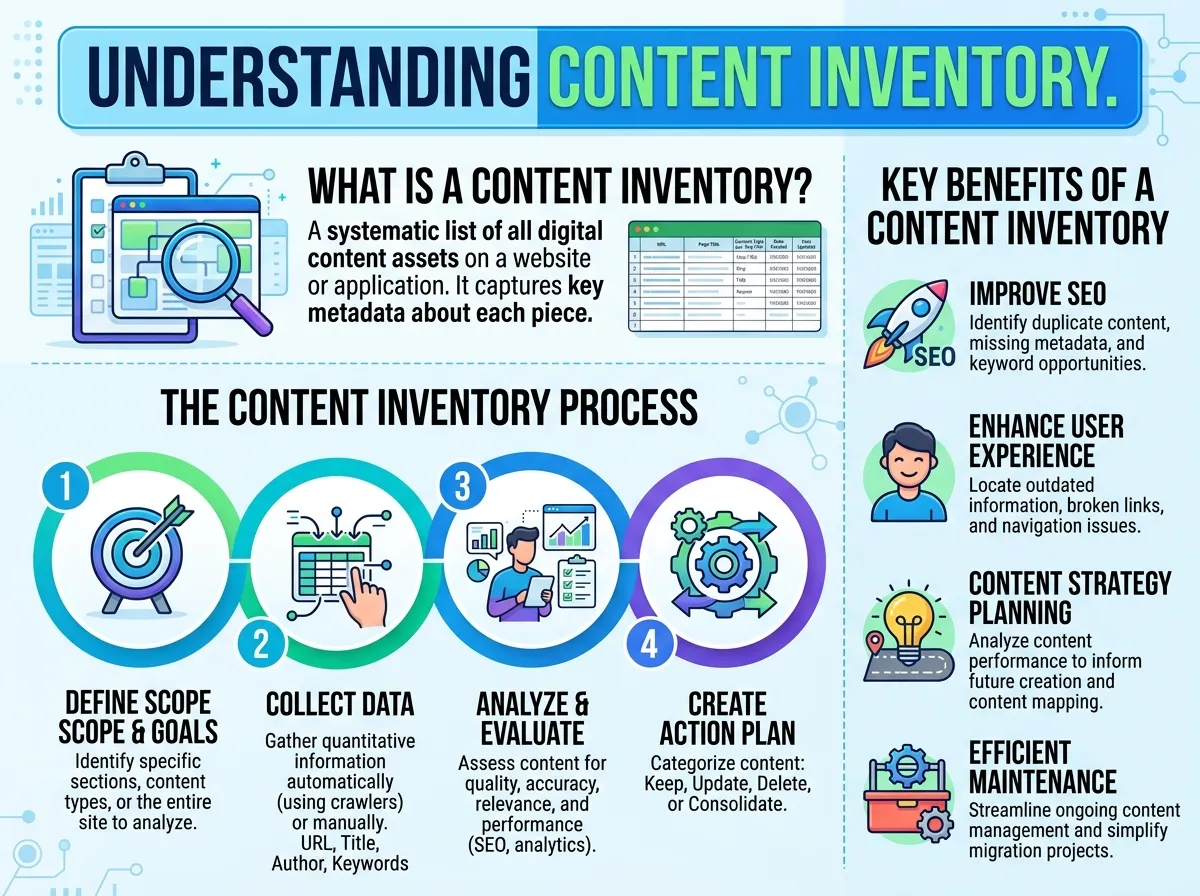
A Content Inventory is a structured record of the content published or stored by an organization. It provides an overview of the digital materials a business has created and helps teams understand the size, location, type, and purpose of their content library.
A content inventory can include website pages, blog articles, landing pages, product descriptions, case studies, ebooks, videos, infographics, images, downloadable documents, email resources, and other digital assets. Depending on the organization, the inventory may cover a single website or extend across several domains and digital platforms.
As businesses produce more content over time, it becomes increasingly difficult to remember what has been published, where it is located, and whether it remains useful. Older pages may continue attracting visitors, while others may contain outdated information, duplicate topics, weak optimization, or obsolete messaging. A content inventory creates a clearer picture of the existing content landscape.
Rather than treating content as a collection of individual pages, businesses can view their entire content library as an organized business asset. This perspective makes it easier to identify opportunities for optimization, consolidation, repurposing, and strategic improvement.
Content Inventory Management
Content Inventory Management involves maintaining accurate information about a business’s content assets throughout their lifecycle. It connects content creation, publication, optimization, maintenance, and eventual removal or replacement.
Effective management becomes particularly important for businesses with large websites. As new articles and pages are published, older content can easily become difficult to track. A centralized inventory gives content teams a consistent source of information about what exists and how different assets relate to one another.
Management can include information such as content title, URL, content type, publication date, update date, author, topic, target keyword, category, traffic, conversions, backlinks, status, and ownership. The exact information depends on the needs of the organization.
A well-maintained inventory can also improve collaboration. Marketing teams, SEO specialists, writers, designers, and business stakeholders can understand which assets exist and who is responsible for maintaining them. This reduces unnecessary duplication and makes content planning more coordinated.
Website Content Inventory
A Website Content Inventory focuses specifically on the content available across a website. It can provide an overview of the pages that make up the site’s information architecture and help identify areas that require attention.
Website inventories may include homepage content, service pages, product pages, category pages, blog posts, resource pages, landing pages, FAQs, and other important sections. For larger websites, the inventory can contain hundreds or thousands of URLs.
One of the main benefits of a website content inventory is visibility. Businesses can see how much content they have and how that content is distributed across different topics and page types. This can reveal sections with extensive coverage as well as areas where important subjects have little or no supporting content.
A website inventory can also support SEO analysis. When URLs, keywords, organic traffic, rankings, and content topics are connected within the inventory, teams can identify pages competing for similar search terms or pages that may require stronger optimization.
Content Inventory Audit
A Content Inventory Audit combines the structured information in an inventory with a deeper evaluation of individual content assets. While an inventory primarily records what exists, an audit examines whether those assets are effective, relevant, accurate, and aligned with business objectives.
The audit may consider content quality, search performance, user engagement, conversions, topical relevance, internal linking, backlinks, technical SEO, and freshness. This makes the inventory a valuable foundation for broader content evaluation.
For example, a business might discover through its inventory that it has several articles covering closely related topics. An audit can then determine whether those articles should remain separate, be consolidated, or be repositioned around different search intents.
A detailed Content Marketing Content Audit can provide additional context for evaluating content performance and identifying opportunities to improve the overall content strategy.
Content Asset Inventory
A Content Asset Inventory extends beyond traditional website pages. It records the broader collection of materials a business creates and uses for marketing, communication, sales, and customer engagement.
These assets can include ebooks, whitepapers, case studies, videos, podcasts, presentations, social media graphics, research reports, templates, product images, webinars, and downloadable resources.
Understanding these assets can help businesses avoid unnecessary content production. An organization may already have a valuable report or presentation that could be updated and repurposed into several new formats. Without an inventory, teams may overlook these existing resources and spend additional time creating similar material from scratch.
Content asset inventories are also useful for maintaining consistency. When teams can easily locate approved materials, they are more likely to use current brand messaging, visuals, statistics, and product information.
Digital Content Inventory

A Digital Content Inventory provides an organized view of content across digital channels. Depending on the business, this can include websites, blogs, social platforms, email campaigns, video channels, resource libraries, and other online environments.
Digital content can become fragmented when different teams manage separate platforms. Marketing may maintain blog content, social teams may manage visual assets, and sales teams may have their own presentations and resources. Without centralized visibility, valuable assets can become difficult to find.
A digital inventory creates a common reference point. It can help businesses understand where content is published, which teams own it, and how different assets support broader marketing objectives.
This becomes particularly useful for organizations operating across multiple markets or languages. Content may need to be adapted for different audiences while maintaining consistent messaging and brand positioning.
For companies operating internationally, Global Marketing Localization provides relevant context around adapting marketing content and communication for different markets and audiences.
Content Inventory Process
The Content Inventory Process involves collecting, organizing, categorizing, and maintaining information about content assets. The process can vary depending on the size of a website and the complexity of a business’s content ecosystem.
For a small website, a relatively simple spreadsheet may provide sufficient visibility. Larger organizations may use content management platforms, databases, digital asset management systems, or specialized content operations software.
Information commonly associated with each asset can include its title, URL or storage location, format, topic, publication date, update date, owner, audience, target keyword, performance information, and current status.
The purpose is not simply to create a large database. The inventory should make content easier to understand and manage. If information is difficult to maintain or rarely used, the inventory itself can become another source of unnecessary complexity.
A useful content inventory therefore needs to reflect the organization’s actual workflows. It should help teams make decisions about content rather than simply record information.
Content Inventory Template
A Content Inventory Template can provide a consistent structure for recording content information. The fields used in a template should depend on the organization’s goals and the amount of information required for analysis.
Common fields can include content title, URL, content type, category, topic, target audience, primary keyword, author, publication date, last updated date, organic traffic, engagement, conversion data, content status, and responsible team member.
Additional fields may be useful for SEO-focused teams, such as keyword rankings, backlinks, internal links, indexed status, search impressions, and optimization notes.
The template should remain practical. Including too many fields can make content management difficult and reduce the likelihood that teams will keep the inventory updated. A smaller set of meaningful fields is often easier to maintain consistently.
As the content library grows, the template can evolve. New fields can be added when they provide meaningful value for content planning, reporting, or optimization.
Content Asset Management
Content Asset Management focuses on organizing, storing, maintaining, and distributing digital marketing assets. While content inventory provides visibility into what exists, asset management supports the practical handling of those materials.
This distinction is important for organizations with large collections of images, videos, documents, presentations, and other files. Without clear organization, teams can spend considerable time searching for the correct version of an asset.
Content asset management can establish clearer ownership and improve access to approved materials. It can also help reduce the risk of outdated or incorrect assets being reused.
When inventory and asset management work together, businesses gain both visibility and control. Teams can understand which assets exist while also having a more organized system for accessing and maintaining them.
Content Organization Strategy
A strong Content Organization Strategy makes it easier to understand how individual assets fit into broader business and marketing objectives. Organization can be based on topics, audiences, customer journey stages, content formats, products, services, locations, or other meaningful categories.
For SEO, topical organization can be particularly useful. Related pages can support broader subject areas and create stronger relationships between content assets. Internal linking can then help users and search engines discover related information.
Content organization also affects user experience. When website information is logically structured, visitors can move between related pages more easily. This can increase engagement and help users find information without repeatedly returning to search results.
A well-organized content library can also make editorial planning more efficient. Teams can identify existing coverage before commissioning new content, reducing the risk of creating repetitive material.
Content Audit and Inventory
Content Audit and Inventory work best when treated as complementary activities. The inventory establishes what exists, while the audit evaluates the effectiveness and relevance of those assets.
The inventory may show that a website contains hundreds of articles. The audit can then examine which articles attract organic traffic, generate conversions, earn backlinks, support important topics, or provide value to users.
This combination can uncover several different opportunities. High-performing content may deserve regular updates and additional internal links. Useful but underperforming content may require optimization. Outdated content may need substantial revision, consolidation, or removal.
The relationship between inventory and audit can also strengthen long-term content planning. Instead of continuously creating new pages, businesses can use existing performance information to determine where additional investment is likely to provide value.
Content Inventory and SEO Content Strategy
Content inventory has a strong relationship with SEO because search performance depends on the quality, relevance, organization, and technical condition of website content.
An inventory can help identify keyword overlap, outdated pages, missing topics, thin content, duplicate subjects, and opportunities for stronger internal linking. It can also make it easier to connect individual pages with broader search objectives.
A well-structured SEO Content Strategy can build on this information by connecting content topics with search intent, audience needs, organic visibility, and business objectives.
The inventory itself does not automatically improve search rankings. Its value comes from the decisions it enables. By understanding what already exists, SEO and content teams can make more informed choices about optimization, consolidation, updating, and new content creation.
Content Inventory and Customer Engagement

Content plays an important role throughout the customer journey. Prospects may discover a business through an article, learn about a service through a landing page, compare options through a case study, and eventually become customers after interacting with several different resources.
A content inventory can help businesses understand how these assets work together. It can identify whether important customer questions are addressed and whether relevant content exists for different stages of the buying process.
This is particularly useful when evaluating content engagement. A page with high traffic but low engagement may require a different approach from a page with lower traffic but strong conversion performance.
The connection between content and engagement is explored further in How Inbound Marketing Increases Customer Engagement, which provides broader context around using inbound content to create meaningful interactions with potential customers.
Why Content Inventory Matters for Long-Term Content Management
Content libraries rarely remain static. New pages are published, existing articles are updated, campaigns end, products change, and customer expectations evolve. Without ongoing visibility, content can gradually become inconsistent and difficult to manage.
A content inventory provides a foundation for maintaining that visibility. It helps businesses understand what they have before they create something new and provides useful context when existing content needs to be updated.
It can also reduce content duplication. When writers and marketers can see existing assets, they are less likely to unknowingly create multiple pages targeting nearly identical topics.
Over time, the inventory becomes a record of the organization’s digital content ecosystem. It can support SEO, content marketing, brand management, customer experience, and broader digital strategy.
Final Thoughts
A Content Inventory gives businesses a clearer understanding of their digital content and how individual assets contribute to broader marketing objectives. From Website Content Inventory and Content Asset Inventory to Content Inventory Management, Content Inventory Audit, and Content Organization Strategy, each element contributes to better visibility and control.
The value of an inventory is not simply in documenting content. Its real value comes from helping teams make better decisions about what to maintain, optimize, update, consolidate, repurpose, or create.
When a content inventory is combined with regular audits, effective asset management, SEO planning, and customer-focused content strategies, businesses can create a more organized and useful digital ecosystem. This makes content easier to manage while creating stronger opportunities for search visibility, engagement, and long-term marketing performance.
Frequently Asked Questions
What is a Content Inventory?
A Content Inventory is an organized record of the content and digital assets owned or published by a business. It can include website pages, blog posts, videos, images, downloadable resources, landing pages, and other marketing materials.
Why is Content Inventory important?
Content inventory provides visibility into what content exists, where it is located, who owns it, and how it performs. This information can support content planning, SEO, optimization, maintenance, and better resource management.
What is included in a Website Content Inventory?
A Website Content Inventory can include URLs, page titles, content types, categories, publication dates, update dates, target keywords, traffic, conversions, backlinks, and content status. The exact fields can vary based on business requirements.
What is the difference between a content inventory and a content audit?
A content inventory primarily documents what content exists, while a content audit evaluates the quality, relevance, performance, and effectiveness of that content. Using both together provides a more complete view of a content library.
What is a Content Asset Inventory?
A Content Asset Inventory records a broader collection of digital assets, including ebooks, videos, images, presentations, case studies, reports, templates, and other resources used by marketing or sales teams.
What is a Digital Content Inventory?
A Digital Content Inventory provides an organized overview of content distributed across digital channels such as websites, blogs, social media, email platforms, video channels, and online resource libraries.
What should a Content Inventory Template include?
A Content Inventory Template can include fields such as title, URL, content type, topic, audience, keyword, author, publication date, update date, traffic, conversions, status, and content owner. Additional fields can be added for SEO and performance analysis.
How does Content Inventory support SEO?
A content inventory can help identify duplicate topics, outdated pages, keyword overlap, missing content opportunities, and internal linking possibilities. It provides information that SEO teams can use when making optimization and content planning decisions.
How often should a Content Inventory be updated?
The appropriate frequency depends on the size and publishing activity of the organization. Websites with frequent content updates may benefit from regular maintenance, while smaller sites may require less frequent updates. The important factor is keeping the inventory sufficiently current to support content decisions.
Can Content Inventory improve content marketing performance?
Content inventory can support better performance by making existing assets easier to understand and manage. It can help teams identify high-performing content, outdated resources, content gaps, duplication, and opportunities for optimization or repurposing.