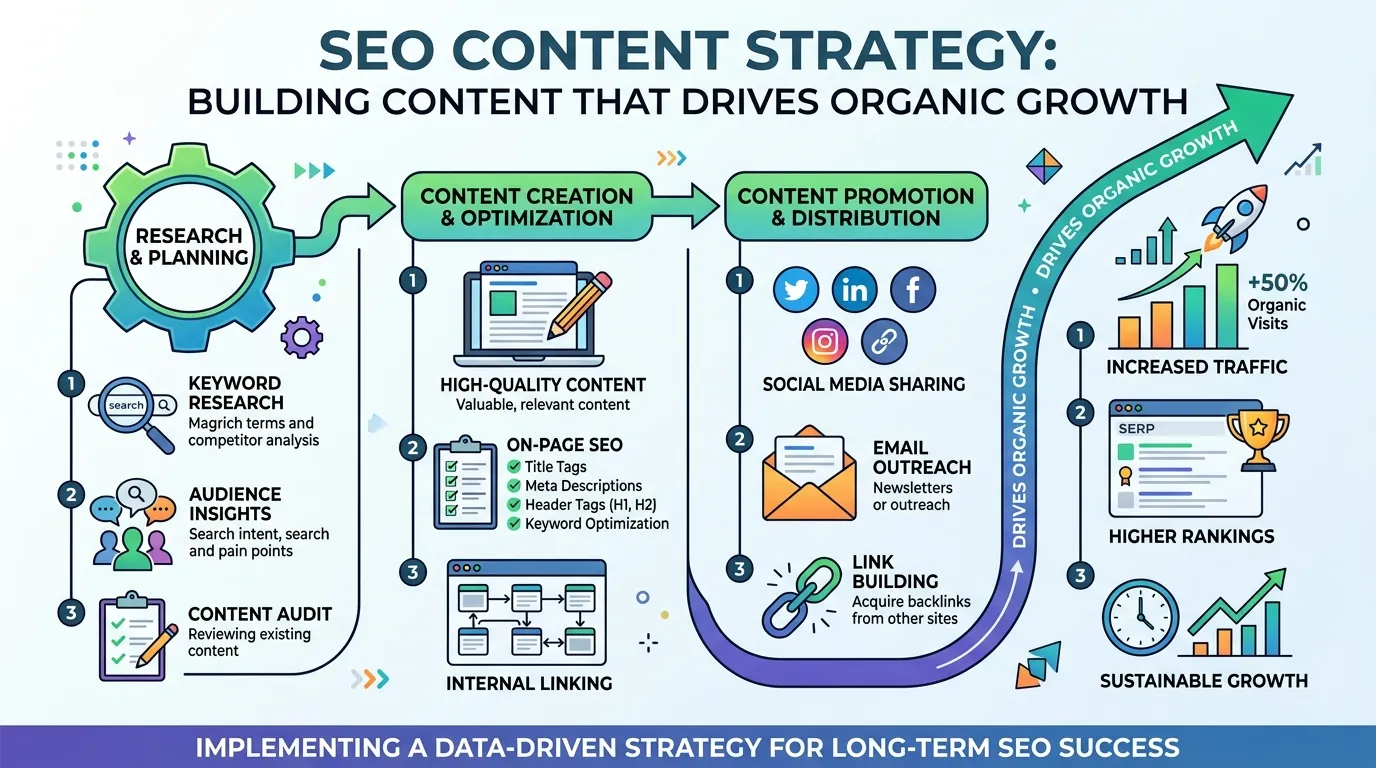
An SEO content strategy helps businesses create, optimize, and manage content that attracts relevant organic traffic and supports long-term growth. By combining keyword research, search intent, content planning, optimization, internal linking, and continuous improvement, businesses can build useful content that performs better in search engines and provides greater value to their audiences.
A strong online presence depends on more than publishing articles regularly. Businesses need content that answers real questions, reaches the right audience, and performs well in search engines. This is where an effective SEO content strategy becomes important.
An SEO-focused approach connects content creation with keyword research, search intent, optimization, internal linking, user experience, and long-term organic growth. Instead of producing content simply to fill a blog, businesses can create useful resources that attract relevant visitors and support broader marketing goals.
What Is an SEO Content Strategy?

An SEO content strategy is a planned approach to creating, optimizing, publishing, and improving content so it can gain visibility in search engines and attract relevant organic traffic. It combines traditional content marketing with search engine optimization.
The purpose is not simply to include keywords in an article. A successful strategy considers what people are searching for, why they are searching, what type of information they need, and how a website can provide a better answer than competing pages.
An effective strategy can include blog posts, landing pages, service pages, comparison content, educational resources, case studies, and other formats. Each piece should have a clear purpose and contribute to the overall visibility and authority of the website.
When content is planned properly, individual pages can support one another and create a stronger search presence over time.
Why SEO Content Strategy Matters
Search engines are an important source of information for customers researching products, services, brands, and solutions. If a website consistently produces useful and well-optimized content, it has more opportunities to appear for relevant searches.
However, publishing large amounts of content does not automatically create organic growth. A website can have hundreds of articles and still struggle to attract visitors if those pages do not match search intent or provide meaningful value.
An SEO content strategy helps businesses focus their resources on topics that are relevant to their audience and business objectives. It also creates consistency in content production and optimization.
Instead of choosing topics randomly, marketers can build a connected content ecosystem around important subjects. This makes it easier for search engines and users to understand what the website specializes in.
SEO Content Marketing Strategy and Business Goals
An SEO content marketing strategy should connect search visibility with broader business objectives. Traffic alone is not always the goal. Businesses need to consider whether their content attracts the right people and moves them toward meaningful actions.
For example, a software company may create educational content around problems its product solves. A local business may publish content answering questions about its services and location. A B2B company may develop detailed resources that help potential buyers understand complex solutions.
The content should support the customer journey while still providing genuine value.
This relationship between content and marketing goals can make SEO more sustainable. Instead of chasing keywords that generate traffic but little business value, marketers can prioritize topics that have both search potential and commercial relevance.
Understanding Search Intent Before Creating Content
Search intent is one of the most important elements of an SEO content strategy. Before creating an article, marketers should understand what the searcher actually wants.
Someone searching for a definition may want a simple explanation. Someone comparing two solutions may need detailed differences, advantages, and limitations. A person searching for a specific service may be closer to making a purchase decision.
Creating the wrong type of content for a keyword can make ranking difficult even when the page is technically optimized.
This is why content strategy for SEO should begin with the audience and the purpose behind a search rather than focusing only on keyword volume.
When content satisfies search intent, visitors are more likely to stay engaged and find the page useful.
SEO Content Planning
SEO content planning provides structure for the entire publishing process. It helps marketers decide which subjects to cover, which keywords to target, how topics relate to each other, and when content should be published or updated.
A content plan can begin with broad topics that are closely connected to the website’s products, services, and expertise. These subjects can then be expanded into more specific questions and related searches.
For example, a website focused on digital marketing might build content around SEO, content marketing, email marketing, local search, social media, and analytics. Each main topic can contain several supporting articles.
This creates opportunities for internal linking and helps establish topical depth.
Planning also prevents repetitive content. When marketers maintain a clear record of existing and planned topics, they can avoid publishing several pages that target nearly identical search queries.
Building a Keyword-Focused Content Strategy

A keyword-focused content strategy uses relevant search terms to guide content development. Keywords help marketers understand the language people use when searching for information.
However, modern SEO requires more than repeating an exact keyword throughout a page. Content should naturally cover related concepts, questions, entities, and variations.
The main keyword can provide the central topic, while related terms help create a more complete resource. For example, an article targeting an SEO content strategy may naturally discuss content optimization, organic traffic, keyword research, search intent, content creation, internal linking, and content performance.
This creates a richer page that can potentially satisfy several related searches without keyword stuffing.
The goal should always be natural language first and optimization second.
Creating Search Engine Optimized Content
Search engine optimized content should be useful to readers while also making it easy for search engines to understand the page.
A well-optimized article generally has a clear structure, descriptive headings, relevant terminology, useful information, and a logical flow. The main topic should be clear from the title and introduction, while supporting concepts should be developed naturally throughout the content.
Optimization can also involve the page title, meta description, URL, images, internal links, and other technical elements.
But optimization should never make the content difficult to read. Excessive keyword repetition, awkward sentences, and unnecessary headings can create a poor experience for visitors.
The strongest content balances search visibility with readability.
Content Optimization Strategy
A content optimization strategy should continue after an article is published. Search performance can change over time, and older content may become outdated.
Businesses can review pages that receive impressions but few clicks, pages that rank near the top but fail to attract traffic, and pages that have lost visibility. These patterns can reveal opportunities for improvement.
Content may benefit from clearer headings, updated information, stronger examples, better internal links, improved introductions, or more complete answers.
Optimization can also involve combining overlapping pages when several articles compete for similar searches. In other cases, expanding a thin page into a more comprehensive resource may improve its usefulness.
This makes SEO a continuous process rather than a one-time publishing task.
The Importance of Internal Linking
Internal links help users discover related content while helping search engines understand the relationships between pages.
For example, an article about SEO content planning could naturally connect to another resource about broader inbound marketing strategies. A page discussing customer acquisition could link to supporting content about content marketing or conversion optimization.
Internal linking becomes especially useful when a website has several articles covering related topics. Strong connections between these pages can help create topical clusters and guide visitors through the website.
It is important that internal links use descriptive anchor text and appear naturally within relevant paragraphs. Links should help readers understand what additional information they can find rather than simply being added for SEO purposes.
Connecting SEO Content With Inbound Marketing
Content is an important part of inbound marketing because useful information can attract people who are actively researching a problem or opportunity.
A well-planned content-driven SEO strategy can support this process by creating resources that answer questions at different stages of the customer journey.
Businesses can also use relationship-focused approaches alongside content. An Inbound Marketing Relationship Marketing Framework can complement an SEO content strategy by connecting useful content with longer-term customer relationships.
This combination helps move beyond simple traffic generation. The objective becomes attracting relevant visitors, providing value, building trust, and creating opportunities for continued engagement.
SEO Content Creation
SEO content creation should begin with a clear understanding of the audience. Before writing, marketers should know who the content is for, what problem it addresses, what information the reader expects, and how the content supports the website’s broader topic.
The writing itself should be clear and natural. Shorter sentences can improve readability, while meaningful headings help readers scan longer articles.
Good SEO content should also provide original value. Repeating information that already exists across many websites is unlikely to create a strong reason for users to choose one page over another.
Examples, explanations, practical context, research, unique observations, and useful comparisons can make content more valuable.
The objective is to create something worth reading, sharing, referencing, and returning to.
Using Different Content Formats
Not every search deserves the same content format. Blog articles are useful for educational topics, but other searches may be better served by landing pages, comparison pages, case studies, videos, research reports, or product-focused resources.
Understanding the audience and search intent can help determine the appropriate format.
For example, someone researching a complex marketing concept may benefit from a detailed article, while someone comparing solutions may prefer a comparison page. A potential customer looking for a service may need a clear service page instead of a long educational article.
An effective SEO content strategy considers these differences instead of forcing every topic into the same format.
Organic Traffic Content Strategy
An organic traffic content strategy focuses on building sustainable visibility through useful content rather than depending entirely on paid promotion.
Organic traffic often develops gradually. New content may take time to gain visibility, while established pages can continue attracting visitors long after publication.
This long-term potential makes SEO content valuable for businesses that want to build an ongoing acquisition channel.
However, organic growth requires patience. Search performance can be influenced by competition, content quality, website authority, technical SEO, search behavior, and many other factors.
Consistent publishing combined with regular optimization can create a stronger foundation over time.
Using Emerging Channels With SEO Content

SEO content does not have to exist separately from other marketing channels. Businesses can extend the reach of useful content through email, social media, influencers, communities, and conversational experiences.
For example, Chat Commerce in Inbound Marketing demonstrates how conversational experiences can become part of a broader inbound marketing approach. Content can provide the information customers need, while conversational channels can help them continue the interaction.
Similarly, businesses can use micro-influencers in inbound marketing to introduce useful content to relevant niche audiences.
These channels can complement SEO rather than replace it.
The Role of Automation in Content Strategy
Technology can also support the content process. Businesses may use automation to organize content workflows, analyze performance, personalize communication, or engage visitors.
Marketing automation should not replace the strategic thinking behind content. Instead, it can help teams manage repetitive processes more efficiently.
For example, marketing bots for small business can support customer engagement and communication while content continues to attract and educate users through organic search.
The strongest approach combines technology with useful content and a clear understanding of customer needs.
Measuring SEO Content Performance
A successful SEO content strategy needs measurable objectives. Businesses should monitor more than page views because high traffic does not always indicate meaningful performance.
Useful measurements can include organic impressions, clicks, rankings, engagement, conversions, leads, assisted conversions, and returning visitors.
The most important metrics depend on the purpose of the content. An awareness article may focus on organic visibility and engagement, while a commercial landing page may be measured more heavily through leads or sales.
Performance data can also help identify which topics deserve additional investment.
If several pages around a particular subject consistently attract relevant visitors and generate conversions, that topic may deserve deeper content coverage.
Updating and Improving Existing Content
Creating new content is only one part of SEO. Existing pages can become valuable optimization opportunities.
Older articles may contain outdated statistics, broken links, weak introductions, or information that no longer reflects current customer needs. Updating these pages can improve their usefulness while preserving the authority and history they have already developed.
Content updates can also strengthen internal linking and connect older pages with newer resources.
Regular content reviews help prevent a website from becoming filled with outdated information.
Building a Sustainable Content-Driven SEO Strategy
A content-driven SEO strategy works best when content creation, optimization, internal linking, audience research, and performance analysis operate together.
The process begins with understanding the audience and identifying meaningful topics. Keyword research can then help shape those topics around real search behavior. Content is created to satisfy search intent, optimized for readability and search visibility, connected through internal links, and reviewed after publication.
Over time, the data from existing content can influence future planning.
This creates a cycle where every published article contributes insights that can improve the next stage of the strategy. Instead of treating content as isolated pieces, businesses can build a connected library of useful resources.
Conclusion
An effective SEO content strategy combines search optimization with valuable, audience-focused content. It helps businesses move beyond random publishing and create resources that have a clear purpose.
From SEO content planning and keyword research to content creation, optimization, internal linking, and performance measurement, every part of the process can contribute to stronger organic visibility.
The most successful strategy is not necessarily the one that publishes the most content. It is the one that consistently creates useful information, matches search intent, supports customer needs, and improves over time.
When businesses combine quality content with a thoughtful SEO approach, they can build a stronger organic presence, attract relevant visitors, and create a foundation for sustainable digital growth.
10 FAQs About SEO Content Strategy
1. What is an SEO content strategy?
An SEO content strategy is a planned approach to creating, optimizing, publishing, and improving website content to increase search visibility and attract relevant organic traffic.
2. Why is an SEO content strategy important?
It helps businesses create content with a clear purpose instead of publishing random topics. A strong strategy can improve organic visibility, attract relevant visitors, support customer journeys, and contribute to long-term growth.
3. What is SEO content planning?
SEO content planning involves deciding which topics, keywords, content formats, and search intents a website should target. It creates a structured approach to publishing and helps prevent duplicate or unrelated content.
4. How does keyword research support SEO content?
Keyword research shows how people search for information, products, and services. These insights can help marketers select relevant topics and naturally incorporate important search terms into useful content.
5. What is content optimization?
Content optimization involves improving existing or new content so that it is useful for readers and easier for search engines to understand. It can include improving headings, keywords, internal links, readability, metadata, structure, and outdated information.
6. How often should SEO content be updated?
There is no universal schedule. Content should be reviewed when information becomes outdated, search performance declines, new information becomes available, or competitors provide more useful resources.
7. What makes content SEO-friendly?
SEO-friendly content has a clear topic, satisfies search intent, uses relevant keywords naturally, provides useful information, has a logical structure, is easy to read, and includes appropriate internal links and metadata.
8. Can SEO content generate leads?
Yes. Content can attract people who are actively researching problems or solutions. When educational content connects naturally with relevant products, services, landing pages, or conversion opportunities, it can contribute to lead generation.
9. What is a content-driven SEO strategy?
A content-driven SEO strategy uses valuable content as a central part of organic search growth. It focuses on creating connected resources that answer audience questions, build topical relevance, attract organic traffic, and support broader business goals.
10. How do you measure SEO content performance?
SEO content can be measured through organic impressions, clicks, rankings, engagement, conversions, leads, returning visitors, and other relevant metrics. The most useful measurements depend on the purpose of each piece of content.