
Inbound marketing contact data governance helps businesses maintain accurate, secure, and reliable contact information throughout the customer journey. By establishing clear data ownership, consistent management procedures, appropriate access controls, and privacy standards, organizations can improve personalization, strengthen customer trust, and support more effective marketing campaigns. A structured governance approach also helps marketing and sales teams work with dependable information while reducing duplication, outdated records, and unnecessary data exposure.
Inbound marketing depends on understanding people, responding to their interests, and delivering relevant information at the right stage of their buying journey. Every interaction, from downloading a resource to subscribing to a newsletter or registering for a webinar, can generate contact information that helps businesses understand their audiences. However, collecting information is only one part of the process. Organizations must also ensure that the data remains accurate, protected, accessible to the right people, and managed according to appropriate privacy requirements.
This is where inbound marketing contact data governance becomes essential. It establishes the policies, responsibilities, standards, and procedures that guide how contact information is collected, stored, updated, accessed, and used. Without a structured approach, businesses may struggle with duplicate records, inconsistent customer details, unclear permissions, and unreliable campaign reporting.
Effective governance connects marketing operations with responsible data management. It enables teams to use contact information confidently while protecting customer interests. Rather than treating governance as a purely technical responsibility, businesses can make it part of their broader inbound marketing strategy, helping them build stronger relationships and make better decisions throughout the customer lifecycle.
Understanding Contact Data Governance in Inbound Marketing
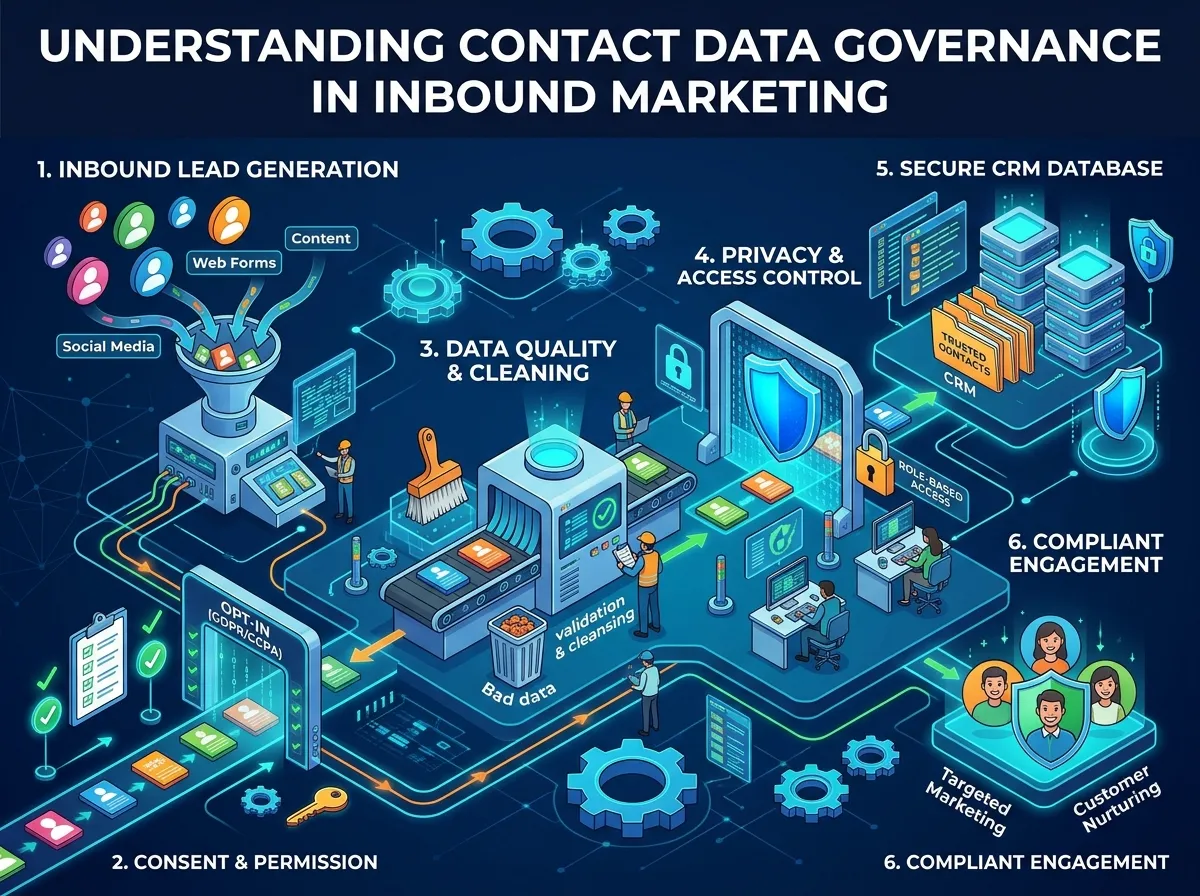
Contact data governance defines how an organization manages the information associated with prospects, leads, customers, subscribers, and other marketing contacts. This information may include names, email addresses, company details, communication preferences, engagement history, and records of interactions with marketing materials.
A governance framework determines who can collect and update these details, which information should be retained, how data quality is measured, and what safeguards are required to protect it. It also establishes expectations for using contact information responsibly across marketing platforms, customer relationship management systems, automation tools, and analytics solutions.
The need for governance grows as businesses expand their inbound marketing activities. A small organization may initially manage contacts through a basic email platform, but its information requirements become more complex as it introduces lead forms, content downloads, landing pages, automated email sequences, and sales handoff processes. Without shared standards, each system may contain slightly different versions of the same contact record.
A reliable approach to inbound marketing data governance creates consistency across these environments. Teams can understand where information originates, whether it is suitable for a particular use, and how changes should be reflected across connected systems. This consistency supports more relevant communication and reduces the operational problems caused by fragmented information.
Governance should also evolve with the business. New marketing channels, customer expectations, technologies, and regulatory requirements can change how contact data needs to be handled. Regular reviews help organizations keep their policies useful and aligned with their actual marketing practices.
Why Reliable Contact Information Matters
Contact information influences nearly every stage of inbound marketing. Businesses use it to segment audiences, personalize communications, measure engagement, identify promising leads, and coordinate follow-up activities. When contact records are incomplete or outdated, these processes become less reliable.
An incorrect email address can prevent a useful resource from reaching its intended recipient. An outdated job title can cause a business-to-business campaign to target someone who no longer has purchasing responsibility. Duplicate records may result in repeated messages, disconnected engagement histories, or conflicting lead scores. These issues can weaken customer experiences even when the content itself is valuable.
Strong governance helps address these problems by defining standards for contact creation, updates, verification, and record maintenance. It also clarifies how marketing teams should respond when information is missing, contradictory, or no longer relevant.
This work supports better campaign decisions. Marketers can interpret engagement data more confidently when they know that contact records follow consistent rules. Sales teams can also receive clearer information about a prospect’s interests and previous interactions, making it easier to continue conversations without asking customers to repeat information unnecessarily.
For organizations investing in organic acquisition, reliable contact records complement their broader Inbound Marketing SEO efforts. Search visibility can attract relevant visitors, but dependable contact information helps businesses maintain useful relationships after those visitors engage with forms, subscriptions, or other conversion opportunities.
Establishing Clear Contact Data Management Standards
Contact data management becomes more effective when every team follows the same basic standards. These standards should define which fields are necessary, how values should be formatted, when information should be updated, and which records require additional review.
For example, an organization may establish a consistent format for names, company names, phone numbers, and geographic details. It may also define how contacts should be categorized by lifecycle stage, industry, or communication preference. Consistent definitions reduce confusion when different departments use the same database for different purposes.
The process should begin when contact information enters the system. Forms and integrations should collect only the information needed for a legitimate business purpose. Field validation can reduce common mistakes, while clear form labels help people understand what they are being asked to provide. When information is imported from external sources, teams should check its origin, relevance, and suitability before adding it to active marketing records.
Ongoing maintenance is equally important. Contact details can change as people move between organizations, update their email addresses, or revise their communication preferences. Businesses should define how often records are reviewed and how outdated information is corrected, restricted, or removed according to applicable policies.
Effective contact data management also requires ownership. A designated team or responsible individual should oversee data standards, while marketing, sales, and operations teams should understand their responsibilities when creating or modifying records. Shared accountability prevents governance from becoming a policy that exists only in documentation.
Protecting Contact Information Across Marketing Systems
As inbound marketing platforms become more connected, contact information may move between customer relationship management systems, email services, analytics tools, webinar platforms, and automation software. Each connection can create additional opportunities for useful collaboration, but it can also introduce security and consistency risks.
Inbound contact data security requires organizations to understand where contact information is stored, which systems receive it, and how it is transferred. Businesses should evaluate integrations before enabling them, confirm that connected platforms meet internal security expectations, and remove unnecessary connections when they are no longer required.
Access permissions are another essential safeguard. Employees should only be able to view or modify the information necessary for their responsibilities. A content creator may need access to audience segments and campaign performance, while an operations specialist may require broader permissions to maintain database structures. These responsibilities should not automatically grant everyone unrestricted access to every contact record.
Organizations should also use appropriate authentication, secure data transmission, reliable backups, and documented incident-response procedures. Access reviews can identify former employees, outdated accounts, or unnecessary privileges that may expose contact information.
The objective is not to prevent teams from using data. It is to make legitimate access reliable while reducing the possibility of accidental exposure, unauthorized changes, or misuse. Security controls should support normal marketing operations without introducing unnecessary friction into routine work.
Privacy Compliance and Responsible Data Collection
Contact data governance must account for the expectations and rights of the people whose information is being collected. Visitors may share details to receive a newsletter, download a guide, request a consultation, or register for an event. That interaction does not automatically mean they expect every possible marketing message or use of their information.
Contact data privacy compliance involves understanding the legal requirements that apply to the organization, its audience, its location, and its processing activities. Depending on the circumstances, relevant obligations may include transparency about data collection, a lawful basis for processing, consent management, restrictions on particular uses, retention requirements, and processes for responding to individual rights requests.
Businesses should explain why information is requested and how it will be used. Privacy notices should be clear enough for people to understand, while marketing subscription choices should not be hidden within unrelated language. Where consent is required, organizations need an appropriate method of recording and respecting it. They should also maintain reliable records of communication preferences and ensure that opt-outs are applied across relevant systems.
Privacy management should extend beyond the initial collection point. When contact information is shared with another platform or service provider, businesses should understand the purpose of the transfer and the responsibilities of each party. Data should not be retained indefinitely simply because storage is inexpensive.
Legal obligations differ across jurisdictions and business contexts, so a general policy cannot replace an assessment of applicable requirements. Involving qualified privacy or legal professionals when necessary helps organizations translate their obligations into practical marketing procedures.
Improving Marketing Contact Data Quality
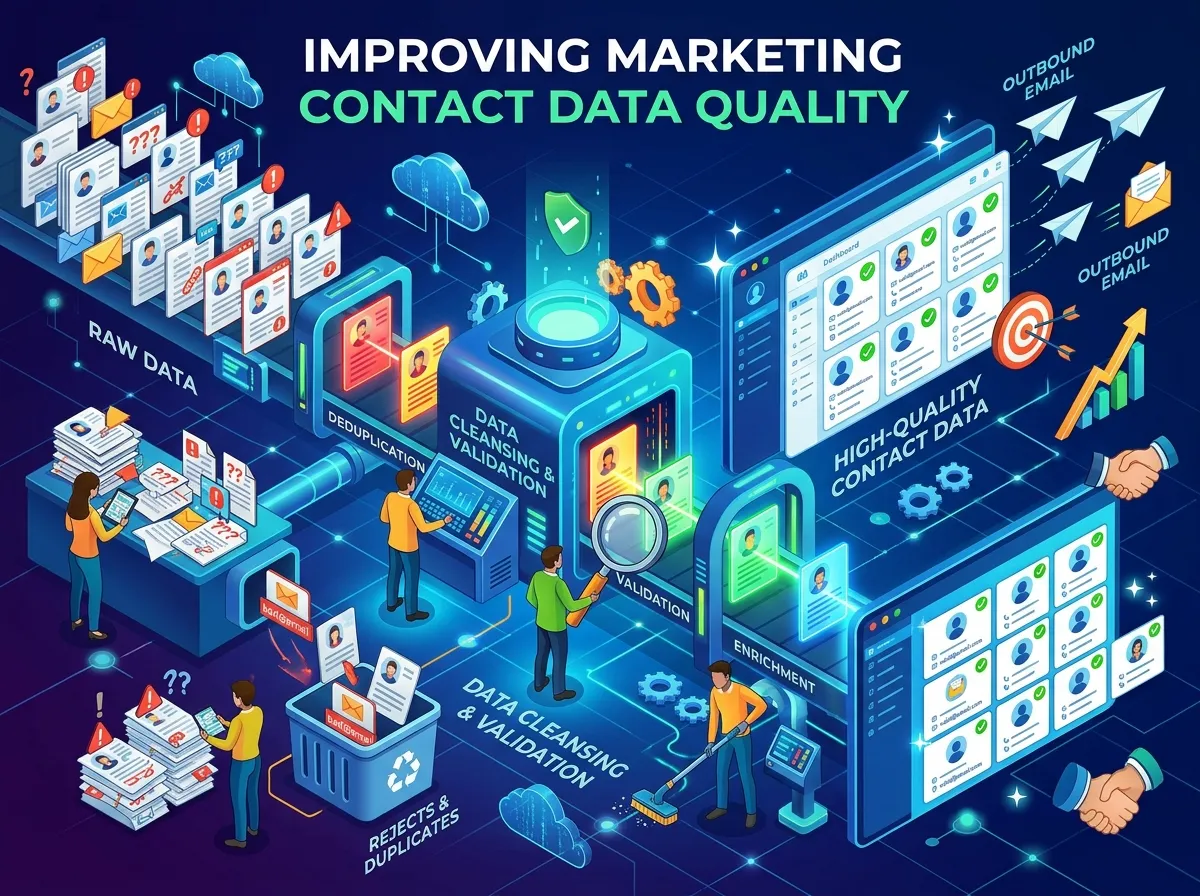
Marketing contact data quality describes how well records meet the standards needed for reliable business use. Important characteristics include accuracy, completeness, consistency, timeliness, and relevance. A database can contain thousands of contacts and still provide limited value if the records are outdated or unsuitable for the campaigns being planned.
Organizations should define what quality means for their own operations. An email marketing team may prioritize valid email addresses, subscription status, and engagement history. A business-to-business team may also depend on accurate company names, job roles, and account relationships. These differences should be reflected in appropriate validation rules rather than forcing every department to use identical criteria for every field.
Regular quality checks can identify duplicate contacts, invalid addresses, incomplete records, inconsistent formats, and values that no longer match current business definitions. Automated tools can help detect common problems, but human review remains useful when information is ambiguous or when a change could affect an important customer relationship.
It is also important to distinguish missing information from incorrect information. A blank field is not always a data quality failure. If a contact has not provided a phone number and the organization does not need it, leaving the field empty may be preferable to collecting unnecessary details. Governance should encourage useful, proportionate information rather than maximum data collection.
Reliable contact data accuracy improves segmentation and personalization. When the underlying information is trustworthy, marketers can make more relevant content recommendations, coordinate follow-up activities, and evaluate campaign performance with greater confidence. Quality metrics should therefore be reviewed as part of routine marketing operations, not only when a campaign produces unexpected results.
Connecting Customer Data Governance With the Buyer Journey
Inbound marketing data rarely serves a single team or purpose. Information collected during an initial website visit may later support email nurturing, lead qualification, sales conversations, customer onboarding, and retention campaigns. A shared governance framework helps ensure that information remains useful as a contact progresses through these stages.
Customer data governance establishes the principles for managing customer and prospect information across departments. It clarifies how lifecycle stages are defined, how records are transferred between teams, which data can be used for specific activities, and how changes should be documented.
For instance, a contact who downloads an educational resource may initially be classified as a new lead. After engaging with additional content or requesting a consultation, that person may become a more qualified prospect. Governance standards help teams record these changes consistently and avoid situations in which different systems assign conflicting lifecycle statuses.
This coordination becomes especially valuable when marketing automation is involved. Businesses can use Inbound Marketing Automation to trigger relevant communications, update contact fields, and route leads according to established criteria. However, automation is only as reliable as the rules and information supporting it. Inaccurate fields or unclear definitions can cause inappropriate messages and incorrect workflow decisions.
A strong governance framework therefore establishes which data fields drive automation, who can change those fields, and how workflows should respond when information is missing or outdated. Teams should also test important automation paths and review unexpected behavior rather than assuming that automated processes will remain correct indefinitely.
Managing Contact Databases as a Shared Resource
A contact database is more than a storage location. It is a shared operational resource that supports audience understanding, campaign delivery, reporting, and customer relationships. When departments manage their own disconnected records, information becomes harder to maintain and business decisions become less consistent.
Effective contact database management begins with a clear understanding of the systems an organization uses. Teams should document the primary source for important fields, identify duplicate or overlapping databases, and establish rules for synchronizing information. If two systems contain different values for the same field, employees should know which source takes priority and how discrepancies are resolved.
Record matching is an important part of this process. A single person may interact with a business through several forms, devices, or communication channels. Without appropriate matching rules, each interaction may create another contact record. Organizations should define how potential duplicates are identified and merged while preserving relevant history and communication preferences.
Database structure also influences governance. Field definitions, lifecycle stages, tagging conventions, and required values should be documented and reviewed when business needs change. Removing unused fields and consolidating redundant categories can make records easier to maintain.
Importing data requires particular attention. Before a large import, teams should check formatting, identify duplicates, confirm permitted use, and establish how imported records will be handled. A technically successful import is not necessarily a responsible one if the source is unreliable or the intended marketing use is inappropriate.
Regular database reviews help keep the system manageable. Instead of treating cleanup as an occasional emergency, organizations can incorporate maintenance into their normal marketing operations and assign clear responsibility for resolving recurring issues.
Strengthening Inbound Marketing Data Protection
Data protection includes the technical and organizational measures used to prevent information from being lost, exposed, altered, or used inappropriately. For inbound marketers, protection should be built into everyday workflows rather than considered only after a security incident.
Inbound marketing data protection starts with understanding the sensitivity and purpose of the information being collected. Most marketing databases do not need every possible personal detail. Limiting collection to relevant information reduces exposure and simplifies storage, access, and retention responsibilities.
Organizations should establish retention schedules that explain when records need to be reviewed and when information should be deleted, anonymized, or restricted, subject to applicable legal obligations and legitimate business requirements. They should also define how employees handle exported contact lists, downloaded reports, and temporary spreadsheets, since these copies can remain outside the main platform’s controls.
Training is another essential safeguard. Employees should understand how to recognize suspicious requests, share contact information appropriately, manage access credentials, and report potential incidents. Policies are more effective when staff understand the practical reasons behind them and know what to do when a problem occurs.
Businesses should prepare for incidents before they happen. A response plan can specify who investigates, who makes decisions about containment, how affected systems are reviewed, and when internal or external notifications may be required. Timely action can reduce harm and support a more organized response.
Protection should also be evaluated whenever new marketing technology is introduced. Before adopting a platform, organizations should consider its security capabilities, data handling practices, integration requirements, and contractual responsibilities. The goal is to ensure that growth in marketing technology does not create unmanaged risks.
Applying Marketing Data Access Control
Marketing data access control determines who can view, create, export, modify, or delete contact information. It is a practical part of governance because even well-maintained records can be exposed or damaged if access is too broad.
A role-based approach can help align permissions with business responsibilities. Marketing specialists may need access to relevant audience segments, while database administrators may require additional capabilities to manage fields and integrations. External contractors should receive only the access necessary for their agreed tasks, with a defined process for removing access when the work ends.
Access permissions should be reviewed regularly. Employees change roles, agencies finish projects, and temporary campaigns come to an end. If permissions remain unchanged, people may continue to access information they no longer need. Organizations can reduce this risk by incorporating permission reviews into employee onboarding, role changes, and offboarding procedures.
Export permissions deserve special attention because downloaded contact lists can be difficult to control once they leave a marketing platform. Businesses should limit exports where appropriate, provide secure methods for approved transfers, and establish rules for storing and deleting exported files. Logging important administrative actions can also help teams investigate unexpected changes.
Well-designed access control should not depend entirely on trust or informal arrangements. Documented permissions and review procedures create a consistent standard that protects contact information while allowing authorized employees to complete their work efficiently.
Measuring Governance Performance and Marketing Outcomes
A governance framework should be evaluated by its practical results. Having written policies is useful, but organizations also need to understand whether those policies improve the quality, security, and usability of contact information.
Useful measures may include duplicate-record rates, invalid email rates, incomplete critical fields, outdated contact records, unresolved data-quality issues, and the time required to correct errors. Businesses can also monitor access-review completion, the removal of unnecessary permissions, and the handling of privacy requests according to applicable requirements.
These measures should have clear definitions. For example, an organization must decide which fields count as essential before it can meaningfully measure record completeness. Similarly, duplicate rates are difficult to compare over time if the method used to identify duplicates changes without documentation.
Governance performance should also be considered alongside marketing outcomes. More reliable contact data can support better segmentation, more relevant follow-up, and clearer reporting. However, campaign improvements are influenced by many factors, including content quality, audience needs, offer relevance, and channel performance. Businesses should avoid assuming that every improvement in conversion or engagement results directly from governance changes.
When evaluating campaign results, teams can connect data quality initiatives with Inbound Marketing Conversion Rate Improvement. Reliable contact records help businesses understand where leads originate, how they interact with content, and which follow-up activities may support further engagement. The purpose is to use trustworthy information to make better decisions, not to collect unnecessary details simply because they might be measurable.
Governance reviews should lead to practical action. If the same data errors appear repeatedly, the organization may need to improve form validation, revise an integration, clarify ownership, or train employees on a specific procedure. Addressing the underlying cause is usually more sustainable than repeatedly correcting the same records.
Keeping Data Governance Practical as Marketing Expands

Governance can become difficult to maintain when policies are too complicated, responsibilities are unclear, or processes require excessive manual work. A practical framework should be proportionate to the organization’s size, data use, and level of risk.
Smaller marketing teams can begin by documenting their main contact sources, identifying the systems that store records, assigning an owner for data quality, and reviewing access permissions. They can then introduce more detailed procedures as their databases and marketing operations grow.
Larger organizations may need formal governance roles, documented data definitions, cross-department review processes, and more comprehensive controls for integrations and reporting. Even so, the core principles remain similar: collect information for clear purposes, maintain reliable records, protect access, respect privacy preferences, and review processes regularly.
It is helpful to distinguish essential controls from optional complexity. A policy that employees cannot understand or follow is unlikely to improve data practices. Clear responsibilities, manageable procedures, and consistent communication are often more effective than a large collection of disconnected rules.
Organizations should also make governance part of campaign planning. Before launching a new form, automation workflow, or event promotion, teams can confirm which information is necessary, how it will be used, who can access it, and how long it should be retained. For webinar-related campaigns, the same approach can support a more consistent attendee experience and complement the broader work of Webinar Audience Retention.
As the business changes, governance standards should be reviewed rather than treated as permanent documents. Feedback from marketing, sales, operations, security, and privacy stakeholders can reveal where procedures are unclear or no longer match actual workflows. Continuous improvement helps the framework remain useful without making routine marketing activities unnecessarily complicated.
Conclusion
Inbound marketing contact data governance helps organizations turn contact information into a reliable resource for communication, analysis, and customer relationship development. By defining data ownership, maintaining accurate records, protecting sensitive information, and controlling access, businesses can reduce avoidable errors while creating a stronger foundation for inbound marketing activities.
Effective governance also brings marketing, sales, and operations teams closer together. Shared data standards make it easier to understand contact histories, coordinate follow-up, and use automation responsibly. At the same time, privacy-aware collection and clear communication practices help organizations respect the people behind the records.
The most successful approach is practical, measurable, and adaptable. Businesses should establish standards that fit their needs, review data quality consistently, and improve procedures as technology and customer expectations evolve. With reliable governance in place, contact information can support more relevant marketing, better-informed decisions, and lasting customer trust.
Frequently Asked Questions
1. What is inbound marketing contact data governance?
Inbound marketing contact data governance is the framework of policies, responsibilities, standards, and procedures used to manage contact information throughout marketing activities. It covers how data is collected, maintained, accessed, protected, and used.
2. Why is contact data governance important for inbound marketing?
It helps businesses maintain accurate records, respect communication preferences, reduce duplicate contacts, protect personal information, and support more reliable campaign segmentation and reporting.
3. How does data governance improve contact data quality?
Governance establishes consistent field definitions, validation rules, record-update procedures, and quality checks. These practices help identify inaccurate, incomplete, outdated, or duplicate information.
4. What is the difference between data governance and data management?
Data governance defines the rules, responsibilities, and standards for handling information. Data management involves the operational activities used to collect, store, organize, maintain, and process that information.
5. How can businesses protect inbound marketing contact data?
Businesses can use role-based permissions, secure authentication, appropriate encryption, controlled exports, regular access reviews, staff training, and documented incident-response procedures.
6. What does contact data privacy compliance involve?
It involves following applicable privacy and marketing requirements, providing clear information about data use, managing consent where required, respecting communication preferences, and responding appropriately to individual rights requests.
7. How often should contact databases be reviewed?
The frequency depends on data volume, business needs, and risk. Organizations should monitor important quality issues continuously where possible and schedule regular reviews of duplicates, outdated records, permissions, and retention practices.
8. Who should be responsible for contact data governance?
Responsibility is usually shared across marketing, sales, operations, IT, security, and privacy functions. A designated data owner or governance lead should coordinate standards and ensure that responsibilities are clearly defined.
9. How does data governance support marketing automation?
It ensures that automation workflows use consistent, reliable, and appropriately managed contact information. This reduces the likelihood of incorrect segmentation, unsuitable messages, and workflow errors caused by inaccurate records.
10. How can a business measure the success of contact data governance?
Businesses can track duplicate rates, invalid contact details, completeness of essential fields, unresolved data issues, access-review completion, and the timely handling of privacy requests. They can also assess whether improved data reliability supports better marketing decisions and customer experiences.