A Content Marketing Strategy Framework helps businesses plan, create, distribute, and measure content effectively. It connects audience needs with business goals to improve engagement, lead generation, and long-term growth.
A strong framework also makes content marketing more consistent. It helps marketing teams understand who they are targeting, what topics they should cover, which channels they should use, and how they can measure results. When these elements work together, content becomes more useful for the audience and more valuable for the business.
What Is a Content Marketing Strategy Framework?
A Content Marketing Strategy Framework is a structured approach that explains how a business will use content to attract, educate, engage, and convert its target audience. It brings different parts of content marketing strategy into one organized process.
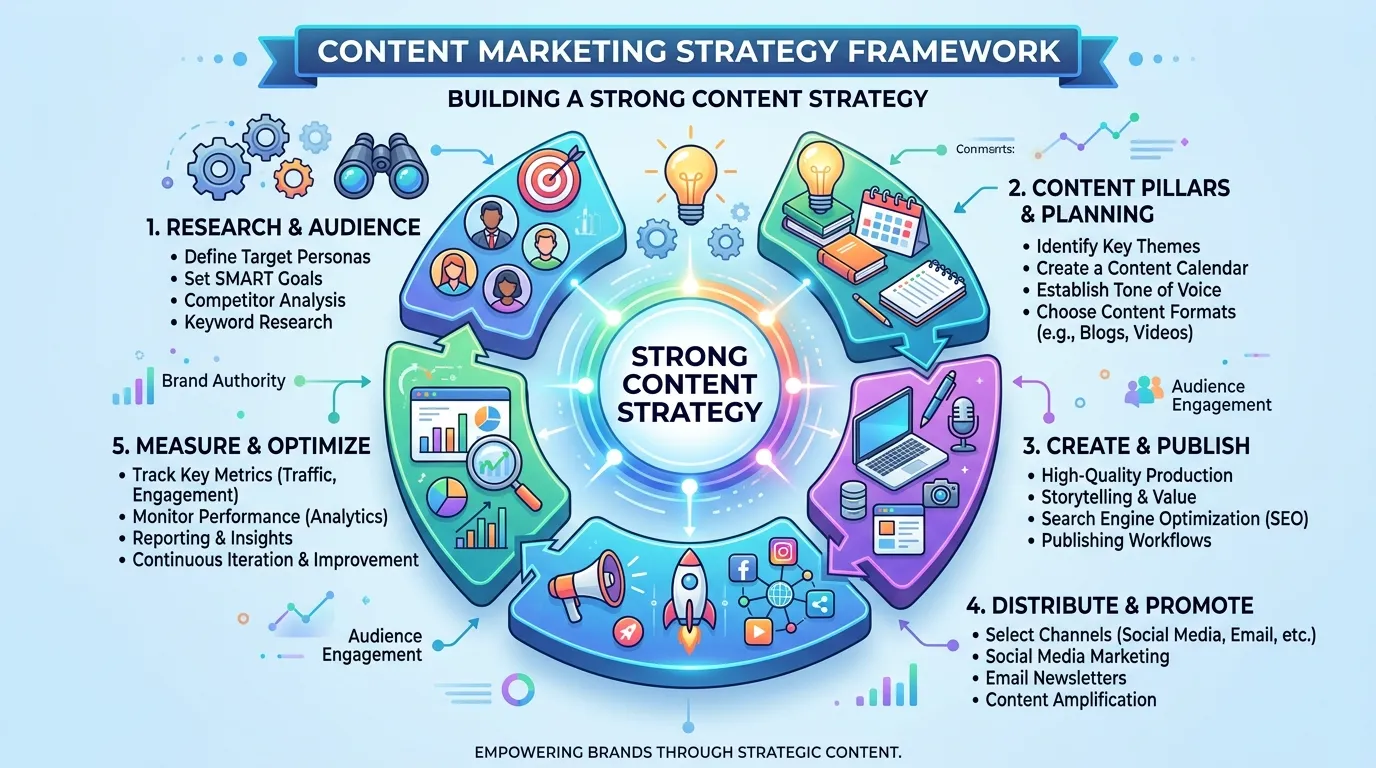
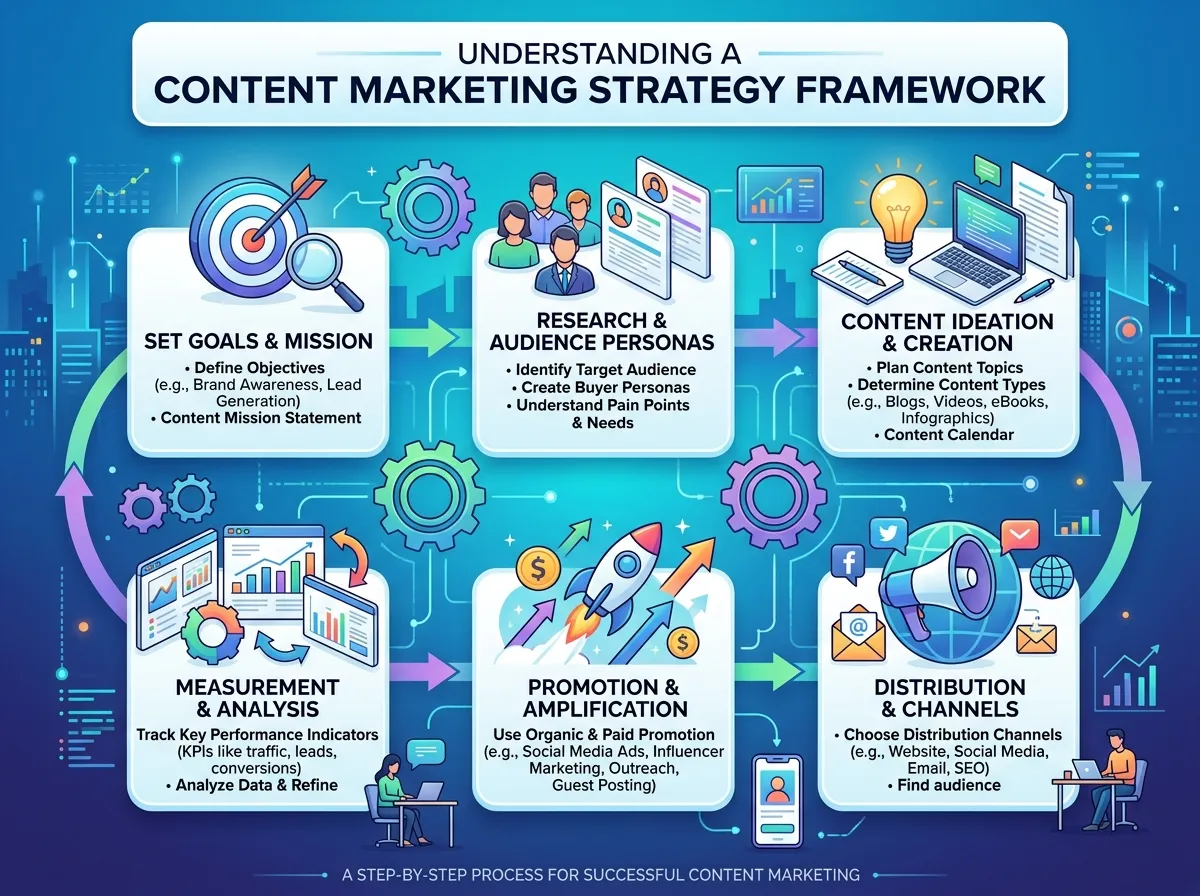
The framework can include audience research, goal setting, content planning, topic selection, content creation, distribution, performance measurement, and ongoing optimization. Each stage supports the next, creating a repeatable content marketing system.
Without a framework, businesses may publish content based on trends or random ideas. This can result in inconsistent messaging, overlapping topics, weak engagement, and difficulty measuring business impact. A structured approach makes content decisions more intentional.
Businesses can also strengthen their framework by combining content with other marketing activities. For example, understanding inbound marketing tools and techniques can help marketers connect content with broader strategies for attracting and converting potential customers.
Why a Content Strategy Framework Matters
Content marketing works best when every activity has a purpose. A content strategy framework provides that purpose by connecting content with audience needs and business objectives.
One major benefit is consistency. When teams have clear processes, they can maintain a steady publishing schedule and create content that follows the same brand voice. Consistency helps audiences understand what they can expect from a business.
A framework also improves efficiency. Instead of starting from scratch every time a new article or campaign is needed, marketers can follow an established process. This saves time and reduces unnecessary work.
Another important advantage is better decision-making. Performance data can show which topics, formats, and channels produce the strongest results. Teams can then improve their approach instead of relying entirely on assumptions.
Content can also support different stages of the customer journey. Educational content may attract new visitors, detailed resources can help prospects evaluate solutions, and case studies or product-focused content can support purchasing decisions.
Set Clear Content Marketing Goals
The first stage of an effective framework is defining content marketing goals. Content should not be created simply because a company needs something new to publish. Each major content activity should support a measurable business or marketing objective.
Common goals include increasing organic traffic, improving brand awareness, generating leads, supporting sales, increasing customer engagement, and strengthening customer retention.
For example, a business focused on organic growth may prioritize search-focused blog content. A company trying to generate leads may create downloadable resources, webinars, or educational landing pages. A brand focused on awareness may invest more heavily in videos, social media content, and thought leadership.
Goals should be specific enough to measure. Instead of saying “increase traffic,” a team could aim to increase organic visits to selected content categories over a defined period. Clear goals make it easier to evaluate whether the strategy is working.
It is also useful to avoid setting too many goals at once. A small number of well-defined priorities can help teams focus their resources and produce better results.
Understand the Target Audience
A successful content marketing strategy starts with understanding the people the content is intended to reach. Audience research helps marketers identify problems, questions, interests, preferences, and buying motivations.
Businesses can use customer conversations, surveys, website analytics, search behavior, sales feedback, and social media interactions to collect useful insights.
Audience research should answer questions such as:
Who is the ideal customer? What problems are they trying to solve? What information do they search for? What objections may prevent them from purchasing? Which formats and platforms do they prefer?
These insights can influence everything from topic selection to content tone.
For example, beginners may need simple educational explanations, while experienced professionals may prefer detailed analysis, comparisons, research, and practical examples.
Understanding the audience also helps businesses create content that addresses real needs instead of focusing only on what the company wants to promote.
Build a Content Marketing Plan
Once goals and audience needs are clear, marketers can create a content marketing plan. This plan translates the overall strategy into specific activities.
A content plan may include target topics, keywords, content formats, publishing frequency, responsible team members, distribution channels, deadlines, and performance indicators.
The plan should also consider the customer journey. Content can be organized around awareness, consideration, conversion, and retention.
For example, awareness content may include educational blog posts and introductory videos. Consideration content could include comparisons, detailed guides, webinars, or case studies. Conversion-focused content may include product pages, demonstrations, testimonials, and sales resources.
A well-organized plan prevents content gaps and helps teams maintain a balanced publishing schedule.
Develop a Strong Content Creation Strategy
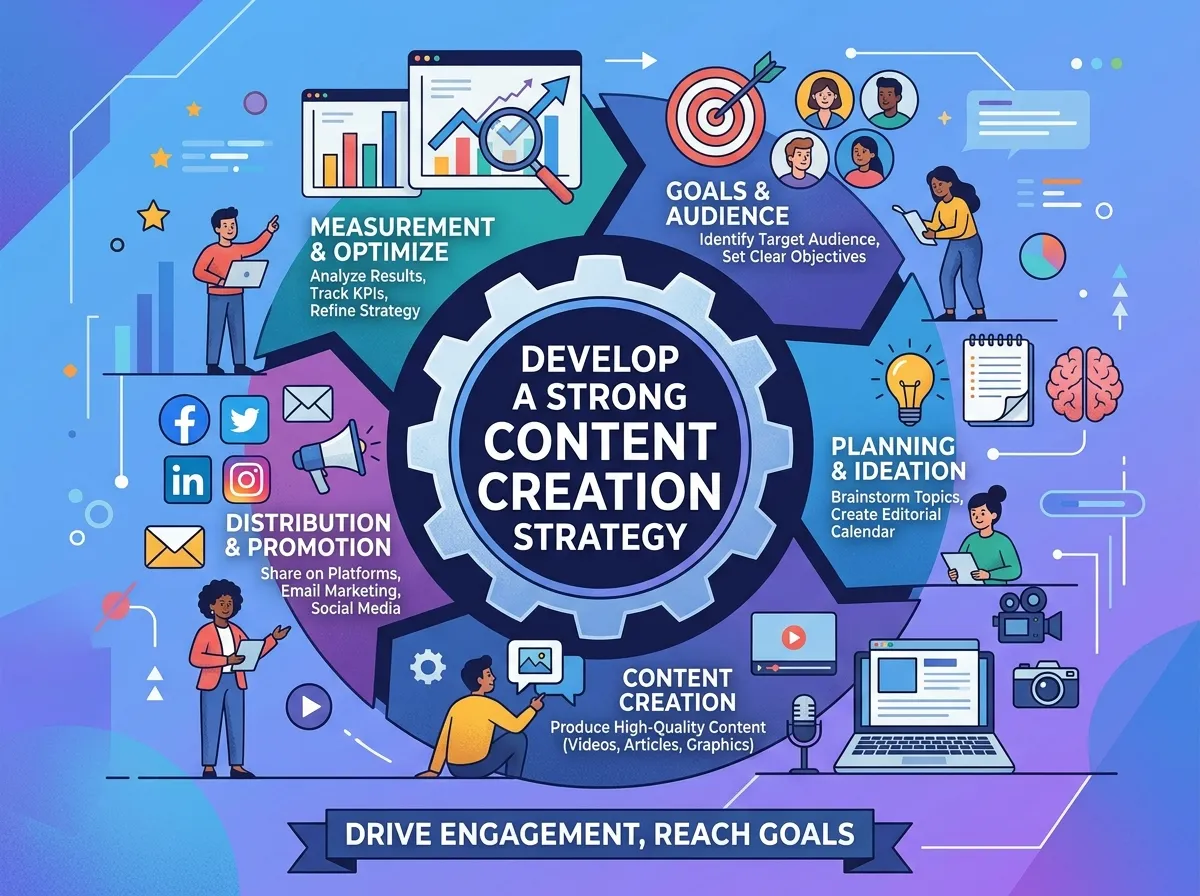
A content creation strategy determines how ideas become useful and high-quality content. It should cover research, outlining, writing or production, editing, optimization, publishing, and review.
Keyword research can help identify topics people are actively searching for. However, keywords should be used naturally. Content should primarily answer the reader’s question and provide genuine value.
Quality is equally important. Well-researched content should be accurate, easy to understand, logically structured, and relevant to the intended audience.
Different formats can serve different purposes. Blog posts are useful for detailed educational topics, videos can demonstrate concepts visually, infographics can simplify information, and case studies can provide evidence of real-world results.
Repurposing can make content creation more efficient. A detailed article might become several social posts, a short video, an email topic, or a downloadable resource.
Organize the Content Marketing Workflow
A defined content marketing workflow helps teams move content from idea to publication without unnecessary delays.
A typical workflow may begin with topic research and keyword selection. The next steps can include outlining, content creation, editing, SEO optimization, fact-checking, visual preparation, approval, publishing, and promotion.
Responsibilities should be clear at every stage. Writers, editors, SEO specialists, designers, and marketing managers should understand what they are responsible for and when their work needs to be completed.
A content calendar can make this process easier. It provides visibility into upcoming topics, formats, publishing dates, campaigns, and promotional activities.
A consistent workflow also makes quality control easier. Content can be checked for accuracy, readability, search optimization, brand consistency, links, calls to action, and formatting before publication.
Create a Content Distribution Strategy
Publishing excellent content is only part of the process. A content distribution strategy determines how that content reaches the intended audience.
Organic search is an important distribution channel for many businesses. SEO-optimized content can attract people who are actively searching for information related to a company’s products, services, or industry.
Social media can extend the reach of published content. Businesses can share articles, videos, graphics, statistics, and other resources across the platforms where their audience is active.
Email marketing can help businesses distribute new content directly to subscribers. Existing customers and leads may be particularly interested in educational resources, industry insights, product updates, and useful guides.
Web push notifications can also support content distribution by bringing users back to important updates or newly published resources. Businesses interested in this approach can explore web push notifications for inbound marketing as part of a broader distribution strategy.
Content distribution should match audience behavior. A business does not need to publish on every available platform. It is generally more effective to focus on channels that provide meaningful opportunities to reach the target audience.
Connect Content With the Customer Journey
A strong framework considers what the audience needs at different stages of the buying process.
At the awareness stage, people may not know much about the company or its solution. Educational articles, videos, social content, and introductory resources can help attract their attention.
During consideration, prospects usually want more detailed information. Comparison articles, case studies, webinars, expert opinions, and detailed resources can help them evaluate their options.
At the decision stage, content should reduce uncertainty. Product information, demonstrations, testimonials, FAQs, pricing information, and success stories can help prospects make informed decisions.
After conversion, content can support customer retention. Tutorials, onboarding resources, product education, newsletters, and helpful updates can improve the customer experience.
This approach prevents content from becoming disconnected from the broader marketing process.
It is also useful to understand how inbound approaches differ from more traditional promotional methods. The comparison between inbound marketing and outbound marketing can help businesses decide how content should fit into their wider acquisition strategy.
Measure Content Performance
Content performance measurement is essential for understanding whether the strategy is producing meaningful results.
Different metrics can be used depending on the goal. Organic traffic, impressions, rankings, clicks, engagement, time on page, leads, conversions, and revenue can all provide useful information.
Traffic alone does not always indicate success. A page may receive thousands of visitors but generate very few qualified leads. Another page may receive less traffic but attract highly relevant prospects who eventually become customers.
For this reason, marketers should connect metrics with the original objective.
If the goal is awareness, reach and impressions may be useful. If the goal is organic growth, search visibility and qualified traffic may matter more. If the goal is lead generation, form submissions and conversion rates become important.
Regular reporting allows teams to identify successful content and underperforming pages. Successful topics can be expanded, updated, or repurposed, while weaker content can be improved or consolidated.
Review and Improve the Framework
A Content Marketing Strategy Framework should not remain unchanged forever. Audience behavior, search trends, business priorities, and competitive conditions can change.
Regular content audits can reveal outdated information, declining traffic, broken links, duplicate topics, and opportunities for improvement.
Content can also be refreshed when new information becomes available. Updating statistics, improving explanations, adding relevant examples, and strengthening internal links can increase the usefulness of existing pages.
Performance data should influence future planning. If a particular topic consistently attracts qualified visitors, the business may create additional content around related questions. If a format performs poorly, the team can test another approach.
The goal is continuous improvement rather than simply producing more content.
Common Mistakes to Avoid

One common mistake is creating content without a defined audience. Even well-written content may perform poorly if it does not address a specific audience need.
Another problem is focusing only on keywords. SEO is important, but content should not feel unnatural or repetitive. Businesses should also understand how AI content generation transforms content marketing while ensuring that search optimization supports useful information rather than replacing genuine value.
Inconsistent publishing can also weaken results. Businesses do not necessarily need to publish every day, but they should maintain a realistic schedule they can sustain.
Ignoring distribution is another frequent issue. Publishing a valuable article does not guarantee that people will find it. Promotion and distribution should be part of the process from the beginning.
Finally, businesses should avoid measuring success only through page views. Content marketing should ultimately support meaningful business outcomes.
Final Thoughts
A Content Marketing Strategy Framework gives businesses a practical structure for turning content into a consistent marketing asset. By defining goals, understanding the audience, developing a clear content strategy framework, creating useful content, distributing it through relevant channels, and measuring performance, businesses can build a more effective content operation.
The strongest approach is not simply to create more content. It is to create the right content for the right audience, deliver it through appropriate channels, and continually improve it based on real performance data.
When these elements work together, content marketing can support visibility, audience engagement, lead generation, customer relationships, and long-term business growth.
Frequently Asked Questions
1. What is a Content Marketing Strategy Framework?
A Content Marketing Strategy Framework is a structured system for planning, creating, distributing, and measuring content. It connects content activities with audience needs and business goals.
2. Why is a content strategy framework important?
A content strategy framework helps businesses maintain consistency, improve efficiency, organize content activities, and measure whether their marketing efforts are achieving meaningful results.
3. What should a content marketing plan include?
A content marketing plan can include target audiences, content topics, keywords, formats, publishing schedules, distribution channels, responsibilities, and performance metrics.
4. How do you create a content creation strategy?
Start by understanding the audience and defining goals. Then research topics, select appropriate formats, establish production processes, optimize content for search, and create a consistent review and publishing workflow.
5. What are common content marketing goals?
Common goals include increasing organic traffic, building brand awareness, generating qualified leads, improving engagement, supporting sales, educating customers, and increasing customer retention.
6. What is a content marketing workflow?
A content marketing workflow is the process content follows from initial research and planning through creation, editing, optimization, approval, publishing, promotion, and performance review.
7. How can businesses improve content distribution?
Businesses can use relevant channels such as search engines, social media, email marketing, websites, communities, and web push notifications. The best channels depend on where the target audience spends time.
8. How should content performance be measured?
Performance should be measured according to the original goal. Useful metrics can include organic traffic, search impressions, clicks, engagement, leads, conversion rates, and revenue.
9. How often should a content marketing strategy be reviewed?
A strategy should be reviewed regularly, such as quarterly, while individual content pieces can be monitored continuously. Major changes in audience behavior, business goals, or search performance may require an earlier review.
10. What makes a content marketing strategy successful?
A successful strategy combines clear goals, audience research, valuable content, effective distribution, consistent execution, and ongoing performance measurement. Continuous optimization is also important for long-term results.