
Content Marketing Editorial Planning creates a structured approach to managing content ideas, topics, publishing schedules, SEO priorities, and editorial workflows. It brings together an editorial content strategy and practical content calendar management so businesses can maintain consistency while producing content that supports visibility, engagement, leads, and long-term growth.
Content Marketing Editorial Planning is the process of organizing content ideas, publishing priorities, topics, schedules, workflows, and marketing goals into a clear editorial structure. It helps businesses create content with purpose instead of publishing articles, social posts, videos, or other resources without a consistent direction.
A strong editorial planning process connects content creation with broader business objectives. Rather than treating every piece of content as an individual task, marketers can use editorial planning to understand what should be published, when it should be published, who it should reach, and how it should support the customer journey.
As content marketing becomes increasingly competitive, consistency and relevance are essential. Search engines, customers, and prospects all respond better when a brand regularly produces useful and focused content. However, publishing frequently without a clear strategy can create duplicate topics, inconsistent messaging, missed opportunities, and unnecessary workload. Content Marketing Editorial Planning provides the structure needed to avoid these problems while keeping content aligned with audience needs and business goals.
What Is Content Marketing Editorial Planning?
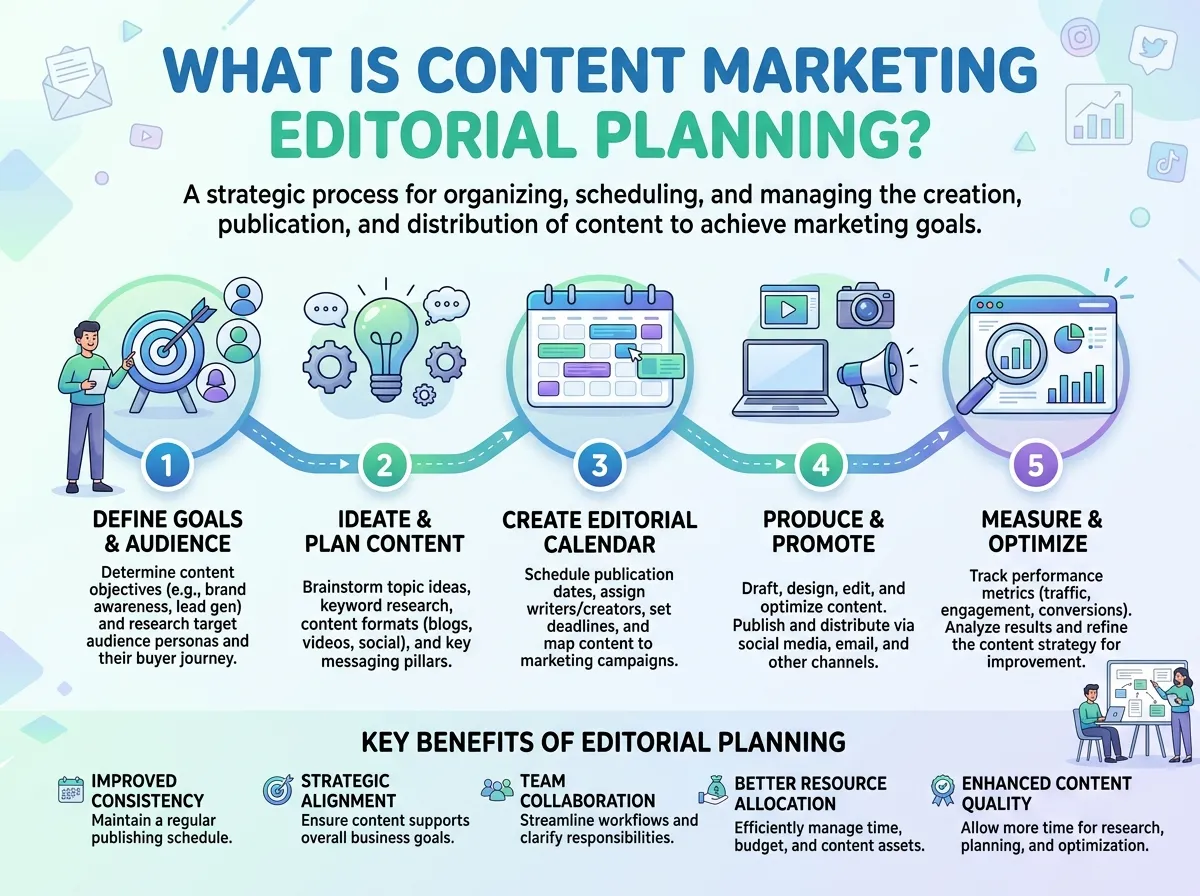
Content Marketing Editorial Planning is the organized process of deciding what content a business should create and how that content should move from an initial idea to publication and promotion. It can cover blog articles, landing pages, email content, social media posts, case studies, videos, ebooks, webinars, and other forms of marketing content.
The main purpose is not simply to fill a publishing calendar. Effective planning creates a relationship between content topics and the needs of a specific audience. A business may have hundreds of potential topics, but not every topic deserves the same level of attention. Editorial planning helps marketers prioritize subjects based on relevance, search demand, customer questions, business objectives, seasonal opportunities, and existing content.
This makes content production more intentional. Writers and marketers can work from a shared direction, while editors can maintain consistency in tone, quality, messaging, and publishing standards.
Why Content Marketing Editorial Planning Matters
Content marketing often involves several people working on different parts of the same publishing process. Writers may develop articles, SEO professionals may research keywords, editors may review drafts, designers may create visuals, and marketing teams may handle distribution. Without coordination, even good content can become difficult to manage.
A well-developed Content Editorial Calendar provides a central view of upcoming content. It can show topics, target keywords, content formats, publication dates, responsible team members, campaign relationships, and status. This visibility makes it easier to identify gaps and prevent multiple people from unknowingly working on similar subjects.
Editorial planning also supports consistency. A brand that publishes randomly may struggle to establish recognizable themes or maintain a predictable publishing rhythm. A structured editorial approach makes it easier to develop topic clusters and maintain a balanced content portfolio.
It can also reduce last-minute pressure. When topics and deadlines are planned in advance, writers have more time to research, create useful material, revise drafts, and improve content quality before publication.
Connecting Editorial Planning With a Content Marketing Planning Strategy
Content should support a larger marketing purpose. This is where a Content Marketing Planning Strategy becomes important. Instead of choosing topics only because they appear popular, marketers can connect editorial decisions to specific business objectives.
For example, a company trying to increase organic search visibility may prioritize informational topics related to its products and services. A business focused on lead generation may develop educational content that answers questions prospects commonly have before contacting the company. Another organization may focus on customer retention and publish content that helps existing customers get greater value from its products.
The editorial plan therefore becomes an extension of the overall marketing strategy. Each topic has a reason for being included, whether that reason is attracting search traffic, strengthening brand authority, supporting a campaign, answering customer questions, or helping prospects move toward a purchase decision.
A strong planning strategy also considers different stages of the customer journey. Awareness content can introduce a problem, consideration content can explore potential solutions, and decision-oriented content can help readers evaluate specific products or services.
Building an Effective Editorial Content Strategy
An Editorial Content Strategy provides the broader direction behind a publishing calendar. It determines the themes, audiences, formats, tone, and objectives that influence content decisions.
For example, a B2B technology company may focus its editorial strategy on educational articles, industry insights, product comparisons, case studies, and expert commentary. A local service business may focus more heavily on location-based content, customer questions, service explanations, and community topics.
The strategy should also establish content themes that can be developed over time. Rather than creating unrelated articles, businesses can build connected groups of content around important subjects. This creates stronger topical relevance and gives readers opportunities to explore related information.
Content should also reflect the brand’s voice. Whether the desired tone is professional, conversational, educational, or technical, consistency helps create a recognizable experience across different channels.
Editorial planning works best when strategy and execution remain connected. The strategy provides direction, while the calendar turns that direction into a manageable publishing schedule.
Developing a Content Planning Framework

A Content Planning Framework gives marketers a consistent structure for evaluating and organizing content opportunities. It can bring together audience needs, business objectives, search opportunities, content formats, publishing priorities, and performance considerations.
One important element is understanding what content already exists. Before developing a large number of new articles, marketers should evaluate existing pages to identify strong performers, outdated information, content gaps, overlapping subjects, and opportunities for improvement.
A detailed Content Marketing Content Audit can help uncover these opportunities. Reviewing existing content gives editorial teams a clearer understanding of what should be updated, expanded, consolidated, or developed as a new topic.
This is particularly useful for established websites with hundreds of published pages. Creating more content does not always solve a content problem. Sometimes the best opportunity is improving existing resources so they become more useful, current, and competitive.
A planning framework can therefore balance new content with content maintenance. This creates a healthier publishing ecosystem and prevents the website from becoming overloaded with pages that receive little attention.
The Role of Content Calendar Management
Content Calendar Management keeps the editorial plan organized as ideas move toward publication. A calendar is most useful when it provides enough information for everyone involved in content production to understand what is happening and what comes next.
The calendar may include the content title, primary keyword, supporting keywords, target audience, content type, author, editor, status, deadline, publication date, and promotion information. Depending on the size of the organization, it may also include campaign details, internal links, visual requirements, and performance notes.
Good calendar management does not mean every publishing date must remain fixed. Marketing priorities can change, new industry developments can emerge, and customer needs can shift. A flexible calendar allows teams to adjust priorities without losing the overall editorial direction.
This flexibility is particularly valuable when content marketing is connected to seasonal campaigns, product launches, events, or changing search trends.
SEO Content Planning and Search Visibility
SEO Content Planning connects editorial decisions with search behavior. Search engine optimization should not be treated as something added after an article has already been written. It can influence topic selection, content structure, search intent, internal linking, and opportunities for building topical authority.
Keyword research can reveal questions and subjects that audiences are actively searching for. However, keyword volume alone should not determine editorial priorities. Search intent, relevance, competition, business value, and the ability to provide genuinely useful information are also important.
SEO planning can also help prevent keyword cannibalization. When several pages target extremely similar search intent, they may compete for visibility rather than strengthening the website’s overall topical coverage. An editorial calendar makes it easier to see planned and existing topics together, reducing unnecessary overlap.
Internal linking is another important part of SEO content planning. Related articles can naturally reference one another, helping readers discover additional information while creating stronger connections between relevant pages.
For example, content planning discussions can naturally connect with a broader Content Marketing Strategy Framework when marketers need to understand how individual editorial decisions fit into a wider content strategy.
Creating a Sustainable Content Publishing Schedule
A Content Publishing Schedule should reflect the resources available to the organization. Publishing more frequently does not automatically produce better results. Quality, relevance, consistency, and strategic alignment are more important than simply increasing the number of posts.
A small marketing team may publish one high-quality article each week, while a larger organization may publish several pieces across multiple formats. The right frequency depends on the team’s capacity, audience expectations, industry, content type, and marketing objectives.
A sustainable schedule also allows enough time for research, writing, editing, SEO optimization, design, approval, publication, and promotion. If deadlines are too aggressive, quality can suffer and the editorial process can become stressful.
Consistency is valuable because it creates predictable production habits. When teams understand their publishing rhythm, they can plan resources more effectively and maintain momentum over the long term.
Creating an Efficient Editorial Workflow Strategy
An Editorial Workflow Strategy defines how content moves through the organization from idea development to publication. It is particularly important when multiple people participate in content production.
A typical workflow may involve topic research, content briefing, writing, editing, SEO review, fact checking, design, approval, publication, and promotion. The exact process can vary depending on the organization and the type of content being produced.
Clear responsibilities reduce confusion. Writers should understand the intended audience and purpose of an assignment, while editors should have clear quality standards. SEO teams need enough information to optimize the content effectively, and publishing teams need approved assets before a page goes live.
An effective workflow should also include communication between these roles. When SEO research happens separately from editorial planning, valuable opportunities may be missed. Bringing these functions together creates a more coordinated content operation.
The Inbound Marketing Process is another useful related concept because content often plays a role beyond initial discovery. Content can attract visitors, support engagement, nurture prospects, and contribute to customer retention.
Content Topic Planning for Long-Term Growth
Content Topic Planning helps businesses move beyond individual article ideas and think in terms of broader subject coverage. Instead of asking only what should be published next, marketers can consider which important topics deserve sustained attention.
Topic planning can identify core subjects, supporting questions, related subtopics, and opportunities to expand existing resources. This approach makes it easier to create content that works together rather than producing disconnected pages.
It can also reveal gaps in the customer journey. A website might have plenty of introductory content but very little material addressing product evaluation or implementation questions. Another website might have strong commercial pages but lack educational resources that attract users earlier in the buying process.
When topic planning is connected with performance analysis, editorial teams can continuously refine their priorities. High-performing subjects can be expanded, while weak or outdated areas can be reconsidered.
Managing a Complete Content Marketing Workflow
A Content Marketing Workflow brings planning, production, publishing, promotion, and measurement into one connected process. It helps ensure that content does not stop being useful once an article is published.
Promotion is an important part of this process. A well-researched article may reach a relatively small audience if nobody distributes it effectively. Depending on the content and audience, promotion can involve email marketing, social media, internal linking, partnerships, community engagement, or other appropriate channels.
Content should also be measured against its original purpose. Organic traffic, engagement, rankings, conversions, assisted conversions, leads, and returning visitors can provide useful signals, although the most appropriate metrics depend on the content’s role.
Content marketing can contribute directly to lead generation when educational resources address problems that prospects are actively researching. For example, How Content Marketing Generates Leads explores the relationship between useful content and lead-generation opportunities.
This connection demonstrates why editorial planning should not operate separately from other marketing functions. Content can contribute to search visibility, audience education, lead generation, brand awareness, customer relationships, and retention at different stages.
Keeping Editorial Planning Flexible
A successful editorial plan should provide structure without becoming restrictive. Search trends change, customer questions evolve, competitors publish new material, and business priorities can shift.
For this reason, editorial calendars should be reviewed regularly. A topic that seemed highly relevant several months ago may need to be adjusted, while a new opportunity may suddenly become more valuable.
Flexibility also makes it easier to respond to timely industry developments. However, reactive content should still fit the brand’s audience and overall editorial direction. Publishing something simply because it is trending can create short-term activity without meaningful long-term value.
The strongest editorial systems combine planned evergreen content with carefully selected timely opportunities.
Measuring the Value of Content Marketing Editorial Planning
The effectiveness of Content Marketing Editorial Planning can be evaluated by examining whether the publishing operation is becoming more organized and whether the content is supporting its intended marketing objectives.
Operational improvements may include fewer missed deadlines, better collaboration, clearer responsibilities, less duplicated work, and more predictable publishing. Marketing outcomes may include stronger organic visibility, increased engagement, improved lead generation, and better customer retention.
Content performance should also influence future planning. If certain topics consistently attract qualified visitors or generate meaningful engagement, they may deserve additional coverage. If some content receives little attention despite substantial production effort, marketers can investigate whether the problem relates to topic selection, search intent, quality, promotion, or audience relevance.
This creates a continuous relationship between planning and learning. Editorial planning determines what is created, while performance data helps determine what should be created next.
Final Thoughts on Content Marketing Editorial Planning

Content Marketing Editorial Planning provides the structure needed to turn content production into a coordinated marketing activity. By combining editorial strategy, topic planning, SEO considerations, calendar management, publishing schedules, and clear workflows, businesses can create content more consistently while keeping it connected to meaningful objectives.
The most effective editorial systems are not simply lists of future article titles. They represent an understanding of the audience, the brand, the customer journey, search behavior, existing content, and long-term marketing priorities.
When planning becomes part of the wider content marketing process, every new article has an opportunity to contribute to a larger body of useful information. This creates stronger consistency, better organization, and a more sustainable approach to content creation.
Conclusion
Content Marketing Editorial Planning creates a practical connection between content ideas and long-term marketing objectives. With a strong editorial content strategy, organized content calendar management, thoughtful SEO content planning, and a sustainable publishing schedule, businesses can produce content that remains consistent, relevant, and useful.
Rather than treating content as a series of isolated publications, editorial planning creates a connected system where research, creation, optimization, publishing, promotion, and measurement work together. This approach gives businesses a stronger foundation for building an effective and sustainable content marketing presence.
Frequently Asked Questions
1. What is Content Marketing Editorial Planning?
Content Marketing Editorial Planning is the process of organizing content topics, formats, publishing dates, SEO priorities, workflows, and marketing objectives into a coordinated editorial system. It helps businesses create relevant content consistently while keeping individual pieces connected to broader marketing goals.
2. Why is an editorial calendar important for content marketing?
An editorial calendar provides visibility into upcoming content and helps teams coordinate topics, deadlines, authors, keywords, and publishing dates. It can also reduce duplicate topics and make it easier to maintain a consistent publishing rhythm.
3. How does editorial planning support SEO?
Editorial planning supports SEO by helping marketers organize keyword opportunities, search intent, topic clusters, internal linking opportunities, and content updates. It can also reduce overlapping topics and make it easier to build comprehensive coverage around important subjects.
4. What should a content editorial calendar include?
A content editorial calendar can include topics, target keywords, content formats, audiences, authors, editors, deadlines, publication dates, status, campaigns, and promotion details. The exact information depends on the organization’s editorial process.
5. How often should a business publish content?
There is no universal publishing frequency that works for every business. The appropriate schedule depends on available resources, audience expectations, industry requirements, content quality, and marketing objectives. A consistent and sustainable schedule is generally more practical than an aggressive schedule that reduces quality.
6. What is the difference between content strategy and editorial planning?
Content strategy establishes the broader purpose, audience, themes, formats, and objectives for content marketing. Editorial planning translates that strategy into specific topics, publishing priorities, schedules, and workflows.
7. How can content planning prevent duplicate topics?
A centralized editorial calendar allows marketers to compare planned subjects with previously published and upcoming content. This makes overlapping topics easier to identify and gives teams opportunities to combine, differentiate, update, or redirect similar content.
8. How does content planning help lead generation?
Content planning can support lead generation by identifying topics that answer questions prospects have during the buying journey. Educational and problem-focused content can attract relevant audiences and guide interested visitors toward additional resources, services, or conversion opportunities.
9. Should old content be included in an editorial plan?
Yes. An editorial plan can include content updates alongside new publications. Reviewing older content can reveal opportunities to refresh outdated information, improve SEO, strengthen internal links, expand useful sections, or consolidate overlapping pages.
10. How can businesses improve their content marketing workflow?
Businesses can improve their workflow by defining clear responsibilities, creating consistent editorial standards, coordinating SEO and content teams, establishing realistic deadlines, and reviewing content performance regularly. A well-organized workflow should make content production easier without sacrificing quality or strategic relevance.