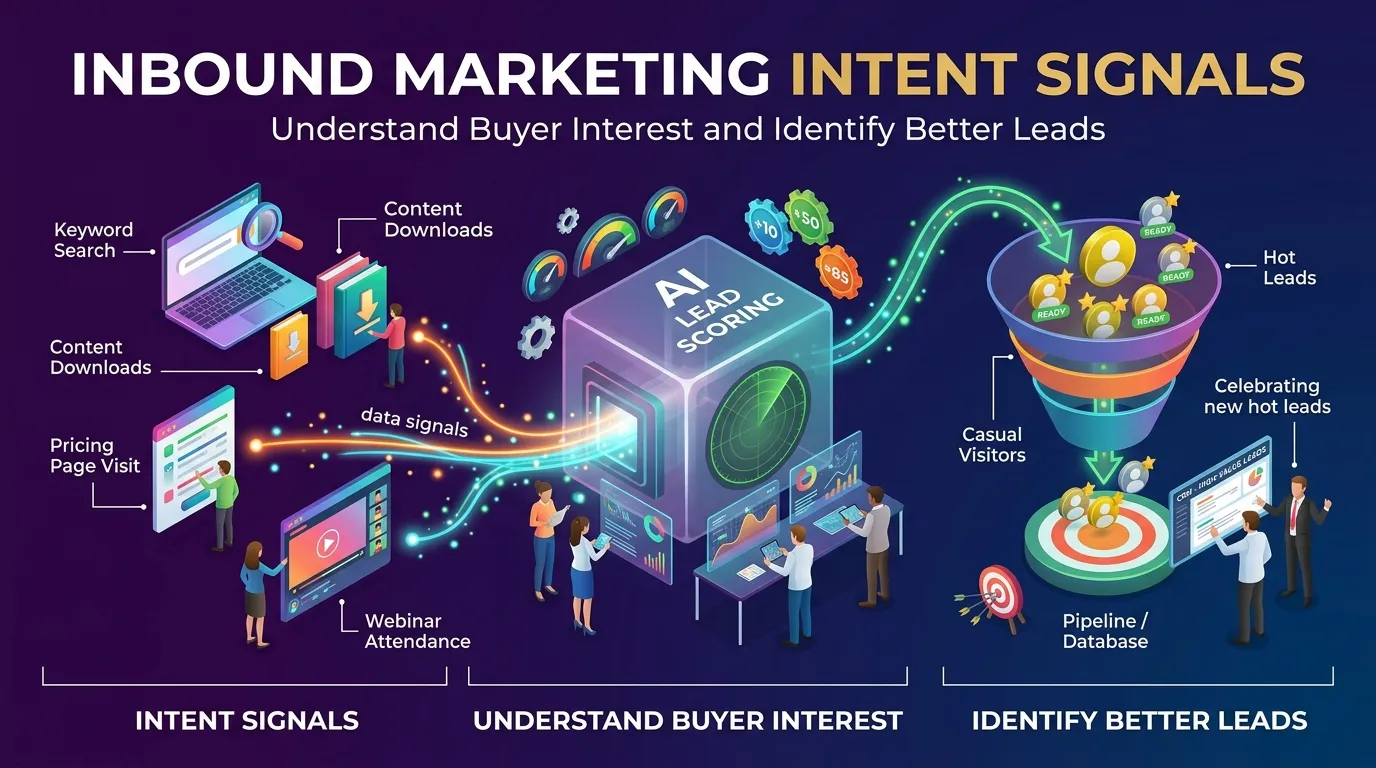
Inbound Marketing Intent Signals help businesses understand prospect interests, identify potential buying opportunities, and improve lead qualification. By analyzing customer behavior, engagement patterns, and marketing intent data, companies can deliver relevant content and prioritize promising leads. Combining intent analysis with marketing automation and responsible data practices helps improve customer experiences, strengthen sales alignment, and support sustainable growth.
Understanding what potential customers want is essential for building meaningful relationships and generating qualified leads. People rarely make purchasing decisions after a single interaction. They usually research solutions, compare providers, explore educational content, and evaluate whether a product or service meets their needs. Throughout this process, they leave valuable clues about their interests and readiness to buy. These clues are known as Inbound Marketing Intent Signals.
Inbound marketing intent signals help businesses understand what prospects are looking for and how close they may be to making a purchase. These signals can include repeated visits to product pages, downloads of relevant resources, searches for specific solutions, email interactions, and requests for additional information. By understanding these behaviors, marketers can deliver more relevant content and help potential customers move naturally toward a purchasing decision.
Instead of relying entirely on assumptions, businesses can use customer interactions to understand buying preferences and identify meaningful opportunities. This approach makes marketing more relevant, improves lead qualification, and helps sales teams focus on prospects who demonstrate genuine interest. When intent signals are interpreted carefully, they can also strengthen customer relationships by ensuring that communication matches each prospect’s needs.
Understanding Inbound Marketing Intent Signals
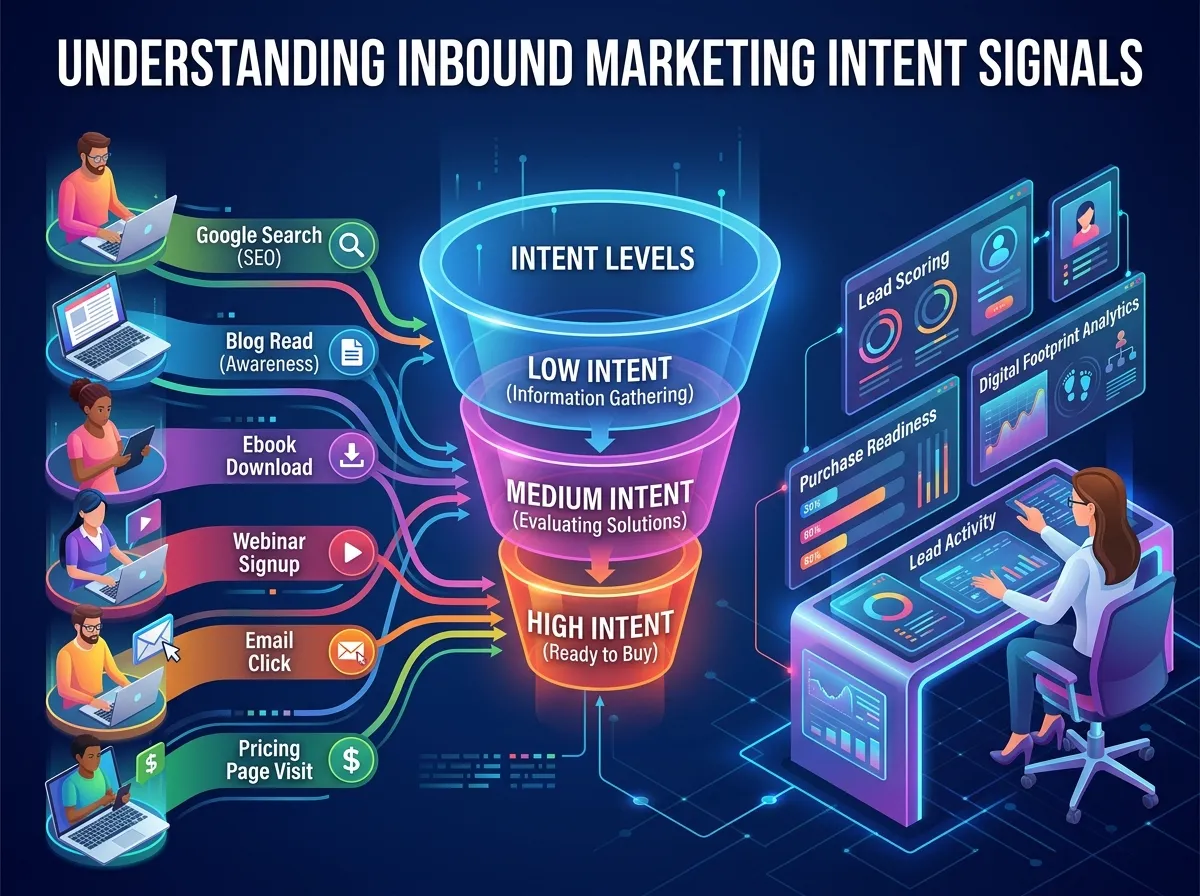
Inbound marketing intent signals are behavioral, contextual, and engagement-based indicators that suggest a potential customer is interested in a particular topic, product, service, or solution. They provide marketers with useful information about what prospects are researching and which subjects matter most to them.
For example, someone who reads a general article about marketing automation may simply be exploring the topic. However, a visitor who repeatedly views automation service pages, compares available solutions, and downloads a product-related resource may demonstrate stronger purchasing interest. Although neither behavior guarantees an immediate purchase, the combined signals provide a clearer picture of the prospect’s potential needs.
Inbound Marketing Buyer Intent is especially valuable because it connects content engagement with possible purchasing decisions. Businesses can examine how people interact with their websites, emails, landing pages, and educational materials to understand which topics attract the most attention. These insights help marketers create relevant follow-up experiences instead of sending the same message to every visitor.
Intent signals are not limited to direct product interactions. Reading comparison articles, exploring pricing information, attending webinars, or searching for implementation advice may also reveal important interests. The meaning of each signal depends on its context, frequency, and relationship to the customer’s potential needs.
Why Intent Signals Matter in Inbound Marketing
Successful inbound marketing depends on attracting the right audience and providing information that supports its decision-making process. Without understanding customer intent, businesses may attract website visitors but struggle to determine which interactions are likely to lead to qualified opportunities.
Inbound marketing intent signals help close this gap by connecting audience behavior with relevant marketing activities. When businesses recognize the topics prospects care about, they can create content that answers specific questions, addresses concerns, and explains available solutions. This makes the customer experience more useful while helping marketers understand which prospects may need additional attention.
Intent signals also improve communication between marketing and sales teams. Marketing professionals can share engagement patterns, content preferences, and potential buying indicators with sales representatives. Sales teams can then use this information to begin more relevant conversations instead of approaching prospects without understanding their interests.
For companies working with multiple customer segments, intent data can reveal differences in buying priorities. One audience may focus on affordability, while another may prioritize reliability, integration, or long-term support. Recognizing these differences allows businesses to personalize their messaging and develop more meaningful customer relationships.
Customer Purchase Intent Signals and Buyer Behavior
Customer Purchase Intent Signals provide clues about whether a potential customer is exploring a topic, evaluating alternatives, or considering a specific solution. These indicators become more useful when businesses examine them as part of a broader pattern rather than treating individual actions as definitive evidence of buying readiness.
A prospect who visits a blog article may be conducting early research. Someone who reads several related articles, subscribes to a newsletter, and returns to the website may demonstrate sustained interest. A visitor who examines pricing details, reviews implementation information, and requests a consultation may show stronger commercial intent.
Understanding these patterns requires effective Buyer Behavior Tracking. Businesses can observe which pages attract attention, how visitors move between content sections, which resources generate engagement, and what actions commonly precede inquiries. These observations help marketers understand the relationship between content consumption and customer decision-making.
However, buyer behavior should always be interpreted carefully. A person might revisit a pricing page for research purposes, while a highly interested prospect might read several educational articles before contacting a business. Context is therefore essential when assessing intent.
By combining behavioral patterns with relevant customer information, marketers can develop a more complete understanding of their audience. This makes it easier to deliver appropriate content without assuming that every interaction signals an immediate desire to purchase.
The Role of Lead Intent Data Analysis

Lead Intent Data Analysis involves examining information collected from customer interactions to identify meaningful patterns in prospect interest. It helps businesses move beyond isolated website visits or email clicks and understand how different behaviors relate to potential sales opportunities.
For example, marketers may discover that prospects who read solution-focused articles and later visit service pages are more likely to request consultations. Another analysis might reveal that certain resources attract visitors who eventually become qualified leads. These findings can guide content development, audience segmentation, and follow-up decisions.
Marketing teams can combine website analytics, customer relationship management records, email engagement information, and form submissions to build a clearer picture of prospect activity. When these data sources are connected appropriately, businesses can identify recurring interests and understand how engagement changes over time.
A well-developed Inbound Marketing Prospect Insights approach complements intent analysis by helping marketers understand customer needs, preferences, and research behavior. Rather than focusing only on the number of leads generated, businesses can evaluate the quality of those leads and the relevance of their interactions.
The most useful analysis focuses on patterns that support practical decisions. Marketers should identify which signals indicate meaningful engagement, which content contributes to qualified inquiries, and where prospects tend to lose interest. These insights make marketing activities more focused and help teams improve their understanding of customer demand.
Prospect Intent Identification and Inbound Lead Qualification
Prospect Intent Identification helps businesses distinguish between general audience interest and behavior that may indicate a genuine need for a product or service. This distinction matters because not every visitor is a potential customer, and not every lead is ready for a sales conversation.
Inbound Lead Qualification becomes more effective when intent signals are considered alongside factors such as business needs, organizational fit, budget expectations, and decision-making authority. A prospect may demonstrate strong engagement but lack the resources or requirements necessary to become a suitable customer. Another prospect may show fewer interactions but have a clear business problem that the company’s solution can address.
Businesses can develop lead qualification models that assign different levels of importance to relevant actions. Viewing a general article might indicate early interest, while requesting a demonstration or asking detailed pricing questions could indicate stronger commercial intent. These models should reflect the company’s sales process and the behavior of its actual customers.
Qualification also benefits from collaboration between marketing and sales teams. Both departments should agree on what constitutes a qualified lead and which signals justify direct outreach. Regular discussions about lead quality can reveal whether the qualification criteria are accurate or need adjustment.
When qualification reflects both customer intent and business suitability, teams can prioritize opportunities more effectively. This reduces unnecessary follow-up, improves the relevance of sales conversations, and creates a smoother experience for potential customers.
Customer Buying Signals Across the Inbound Marketing Funnel
Customer Buying Signals change as prospects progress through their decision-making process. Early-stage signals often indicate curiosity or a need for information, while later-stage signals may reflect active evaluation or a desire to discuss a specific solution.
During the awareness stage, prospects may search for answers to common questions, read educational articles, or explore industry topics. At this point, informative content can help them understand their challenges without pressuring them to make a decision.
As prospects move into the consideration stage, they may compare different approaches, examine product features, read case studies, or download detailed resources. These interactions can suggest that they are evaluating possible solutions and need more specific information.
During the decision stage, visitors may explore pricing pages, review implementation details, request consultations, or ask about service availability. Such activities can indicate stronger commercial interest, particularly when they align with a clear business need.
A structured Inbound Marketing Funnel helps businesses connect these changing signals with appropriate content and communication. Prospects who are still researching may benefit from educational resources, while those comparing solutions may need detailed explanations of benefits, limitations, and practical applications.
Recognizing these differences allows businesses to respond to customer needs at the right stage. It also prevents premature sales outreach that could interrupt the research process or make potential customers feel pressured.
Marketing Intent Data and Lead Engagement Signals
Marketing Intent Data can come from a variety of sources, including first-party website activity, email interactions, form submissions, content downloads, and customer conversations. Some businesses may also use external intent data to understand broader research activity related to particular products, services, or industry challenges.
First-party data is particularly valuable because it reflects interactions directly associated with the business. It can show which topics attract returning visitors, which resources generate inquiries, and how prospects engage with different types of content. External data may provide additional context, but its availability, accuracy, and permitted uses depend on the provider and collection methods.
Lead Engagement Signals help marketers understand whether communication is attracting meaningful attention. These signals can include repeated visits, detailed resource consumption, relevant form submissions, and responses to targeted messages. However, individual metrics should not be interpreted in isolation. An email open, for instance, may be affected by privacy features or automated systems rather than genuine interest.
Businesses can improve interpretation by combining several relevant indicators. When multiple signals point toward the same need, marketers have stronger evidence for choosing the next communication. This does not eliminate uncertainty, but it supports more informed decisions.
Privacy and transparency are equally important. Companies should collect and use information responsibly, follow applicable data protection requirements, and respect customer communication preferences. Trust is essential to effective inbound marketing, and intent data should support a better customer experience rather than create intrusive interactions.
Improving Intent Signals Through Marketing Automation
Marketing automation helps businesses respond to customer behavior consistently and efficiently. Instead of manually reviewing every interaction, teams can use automation systems to organize engagement information, update lead records, and trigger relevant communications when predefined conditions are met.
For example, a prospect who downloads an educational resource may receive related information that expands on the original topic. If the same person later explores a relevant service page, the system may update the lead’s engagement profile or notify the appropriate team, depending on the business’s qualification process.
An effective Inbound Marketing Automation Guide can help businesses understand how automated workflows support lead nurturing, audience segmentation, and timely communication. Automation becomes particularly useful when prospects interact with multiple content channels and require different follow-up experiences.
Nevertheless, automation should not replace human judgment. A prospect’s behavior can be influenced by research responsibilities, changing priorities, or circumstances unrelated to purchasing. Businesses should regularly review automated rules to prevent irrelevant messages and unnecessary sales contact.
Automation also works best when it supports personalization. Rather than sending repeated generic promotions, businesses can provide resources related to the prospect’s demonstrated interests. This makes communication more useful and allows customers to explore available solutions at their own pace.
B2B Buyer Intent Analysis and Better Marketing Decisions
B2B Buyer Intent Analysis can be more complex than consumer-focused analysis because business purchases often involve several decision-makers, longer evaluation periods, and multiple approval stages. A single employee’s interest may indicate an emerging opportunity, but it does not necessarily represent the priorities of the entire organization.
Businesses can examine account-level patterns to understand whether several relevant stakeholders are researching similar topics. For instance, repeated engagement with implementation resources, product comparisons, and service information from the same organization may suggest broader interest in a solution.
This information can help marketing and sales teams prioritize accounts, personalize communication, and identify the questions that may arise during evaluation. It can also reveal which industries or business segments are showing interest in particular services.
Intent analysis can support wider business decisions as well. Marketing teams may identify content gaps, discover emerging customer concerns, and refine messaging based on recurring research patterns. Companies evaluating marketing effectiveness can also connect qualified opportunities with relevant campaign activities.
For organizations using multiple marketing channels, related concepts such as Maximizing ROI in Influencer Marketing Strategy demonstrate the broader importance of evaluating how marketing activities contribute to business outcomes. Although the channels and measurement methods differ, the underlying principle remains valuable: marketing decisions should be informed by meaningful evidence rather than engagement numbers alone.
Measuring the Effectiveness of Inbound Marketing Intent Signals
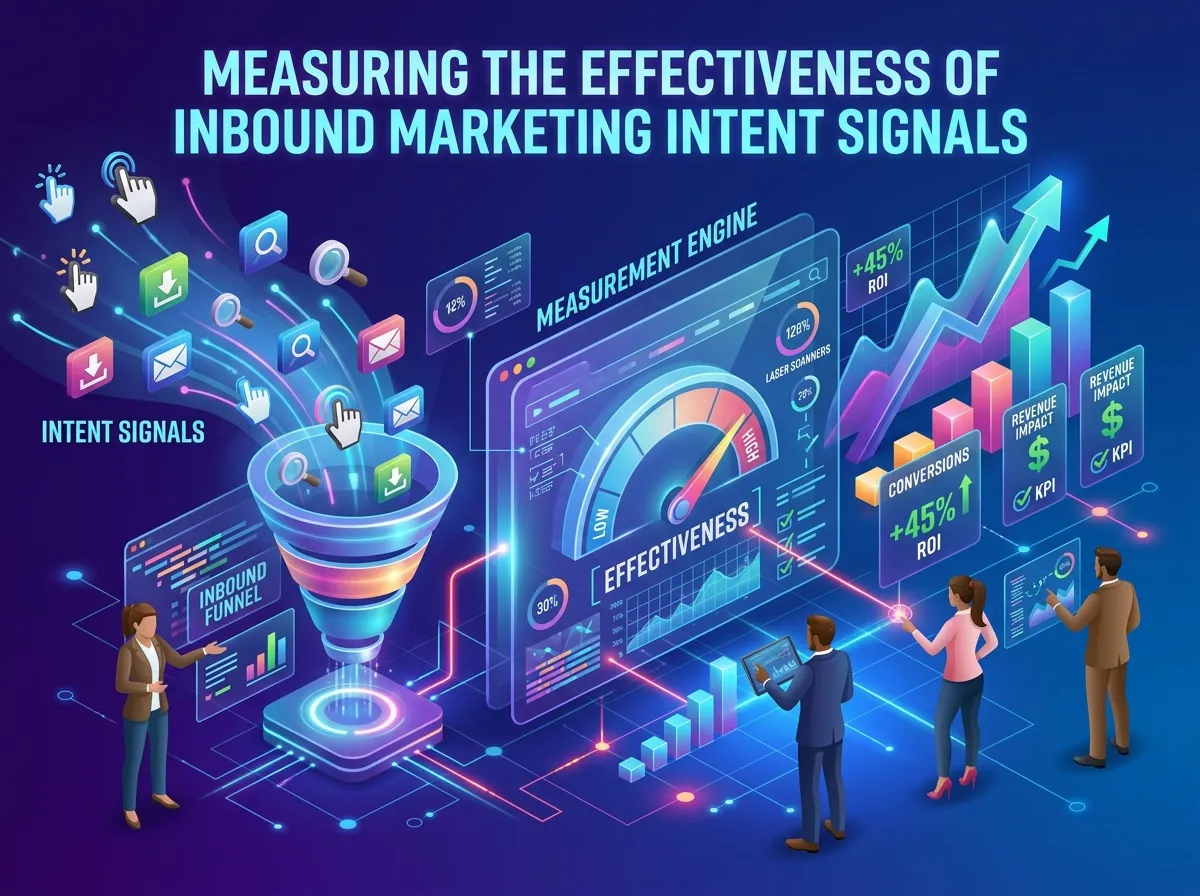
Measuring intent signal effectiveness requires businesses to examine whether their insights improve lead quality, communication relevance, and sales outcomes. Collecting large amounts of behavioral information is not enough if the data does not support better decisions.
Marketing teams can evaluate the percentage of leads that become qualified opportunities, the rate at which qualified leads progress through the sales process, and the relationship between specific engagement patterns and conversions. They can also examine how quickly sales teams respond to promising inquiries and whether prospects find follow-up communication relevant.
Conversion rates should be interpreted alongside other factors, including audience quality, product suitability, sales cycle length, and campaign objectives. A signal that works well for one industry may have limited value in another. Businesses should therefore test their assumptions and refine qualification models using actual results.
Regular reporting helps identify signals that consistently contribute to meaningful opportunities. It can also expose misleading indicators, such as high engagement with general educational content that rarely results in qualified inquiries. Removing or reducing the importance of weak signals can make lead prioritization more accurate.
Ultimately, the value of inbound marketing intent signals lies in their ability to connect customer interest with useful action. When businesses combine reliable data, thoughtful interpretation, relevant content, and responsible communication, they can create a more effective inbound marketing experience that supports both customer needs and sustainable growth.
Conclusion
Inbound marketing intent signals provide valuable insight into customer interests, research behavior, and potential purchasing readiness. By analyzing buying signals, evaluating lead engagement, and understanding how prospects move through the marketing funnel, businesses can improve qualification and create more relevant customer experiences.
The most effective approach combines multiple indicators instead of relying on a single interaction. With accurate data, responsible tracking, and appropriate automation, businesses can recognize meaningful opportunities and coordinate marketing and sales activities more effectively. Rather than treating intent signals as guaranteed predictions, companies should use them as evidence that supports better decisions, stronger relationships, and long-term business growth.
Frequently Asked Questions
1. What are inbound marketing intent signals?
Inbound marketing intent signals are indicators of a prospect’s interest in a topic, product, service, or solution. They include website visits, content downloads, pricing page views, email interactions, and consultation requests. When analyzed in context, these signals help marketers understand customer needs and potential purchasing readiness.
2. Why are inbound marketing intent signals important?
They help businesses understand which prospects are showing meaningful interest and which topics matter most to their audience. This information supports better lead qualification, personalized communication, more relevant content, and stronger coordination between marketing and sales teams.
3. What are common customer purchase intent signals?
Common signals include repeated visits to product pages, pricing research, product comparisons, case study downloads, consultation requests, and detailed questions about implementation. These behaviors may suggest purchasing interest, although their significance depends on the prospect’s circumstances and other available information.
4. How does buyer behavior tracking improve lead qualification?
Buyer behavior tracking reveals how prospects interact with content, websites, and marketing communications. By examining these patterns alongside business needs and organizational fit, marketers can distinguish general interest from more relevant opportunities and prioritize leads more effectively.
5. What is lead intent data analysis?
Lead intent data analysis is the process of examining behavioral and engagement information to identify patterns that may indicate customer interest. Businesses use it to understand prospect needs, evaluate content effectiveness, refine lead scoring, and identify interactions associated with qualified opportunities.
6. How do customer buying signals relate to the inbound marketing funnel?
Customer buying signals change as prospects move from awareness to consideration and decision-making. Early signals often reflect information gathering, while later signals may include pricing research, product comparisons, and consultation requests. Matching content to each stage makes communication more relevant.
7. What is the difference between marketing intent data and lead engagement signals?
Marketing intent data describes information that suggests interest in particular topics or solutions. Lead engagement signals are specific interactions, such as visiting a page, downloading a resource, or responding to an email. Engagement can contribute to intent analysis, but not every interaction indicates a desire to purchase.
8. How can marketing automation support intent signal analysis?
Marketing automation can organize lead activity, update engagement records, support lead scoring, and trigger relevant follow-up communications. It allows businesses to respond more consistently to customer behavior while reducing manual work. Automated decisions should still be reviewed to ensure that messages remain appropriate and useful.
9. How can B2B companies use buyer intent analysis?
B2B companies can analyze account activity, stakeholder engagement, content consumption, and inquiries to identify organizations that may be evaluating solutions. Combining these indicators with business fit and sales information helps teams prioritize accounts and prepare more relevant conversations.
10. How can businesses measure the success of inbound marketing intent signals?
Businesses can measure success through qualified lead rates, opportunity progression, conversion rates, sales response times, and the relationship between specific signals and meaningful outcomes. Regular evaluation helps teams identify reliable indicators, improve lead scoring, and avoid placing too much importance on isolated engagement metrics.