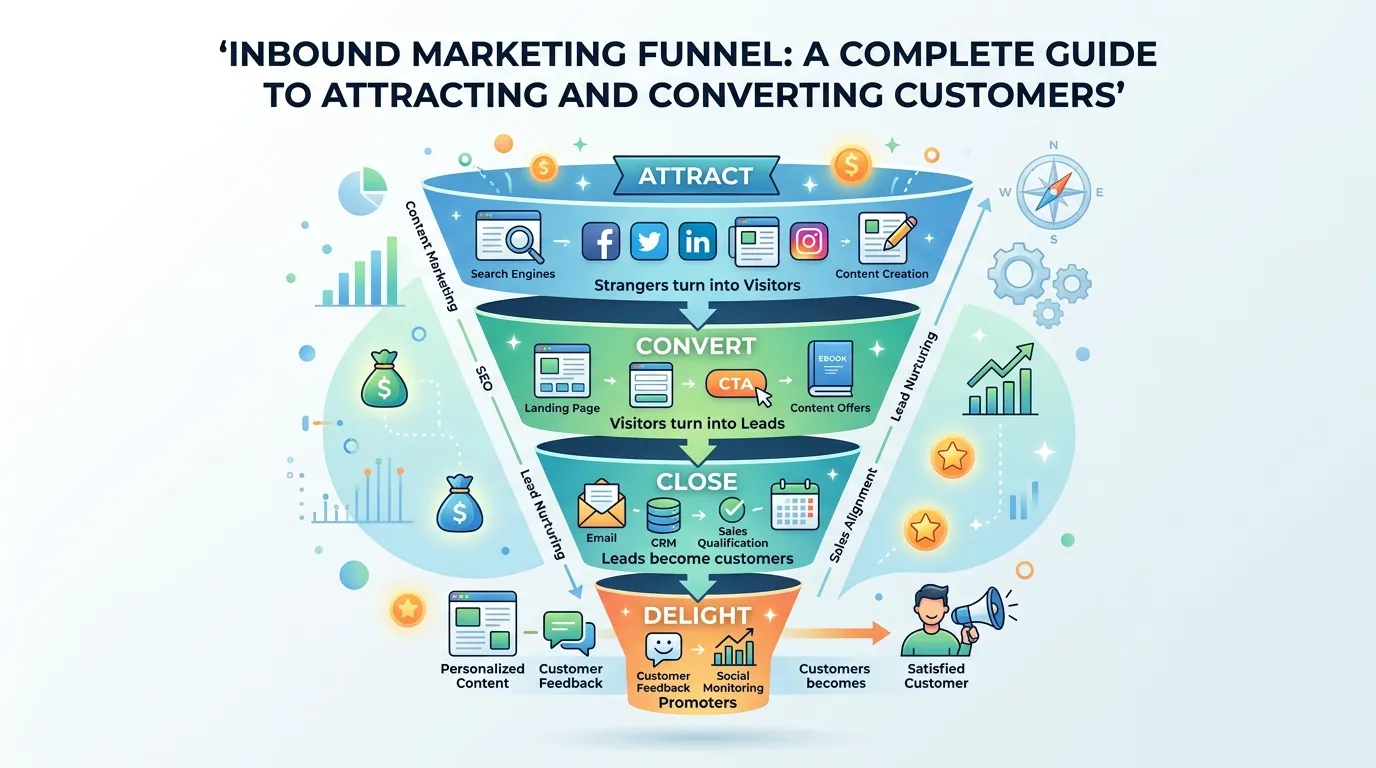
An inbound marketing funnel guides potential customers from their first interaction with a brand to conversion. It uses content, SEO, lead generation, nurturing, and conversion optimization to attract the right audience, build trust, and turn prospects into loyal customers.
An inbound marketing funnel provides a structured way for businesses to attract potential customers, build relationships, and guide prospects toward a purchase. Instead of relying only on traditional advertising or direct sales approaches, inbound marketing focuses on creating useful experiences that encourage people to discover and engage with a business naturally.
Today, customers often research products and services before speaking with a salesperson. They may search Google, read articles, watch videos, compare solutions, review customer feedback, and visit several websites before deciding what to buy. This means businesses need to provide valuable information throughout the customer’s decision-making process.
An inbound marketing funnel helps organize this process. It connects content, SEO, social media, email marketing, lead generation, sales activities, and automation so that prospects receive relevant information at the right stage of their journey.
What Is an Inbound Marketing Funnel?
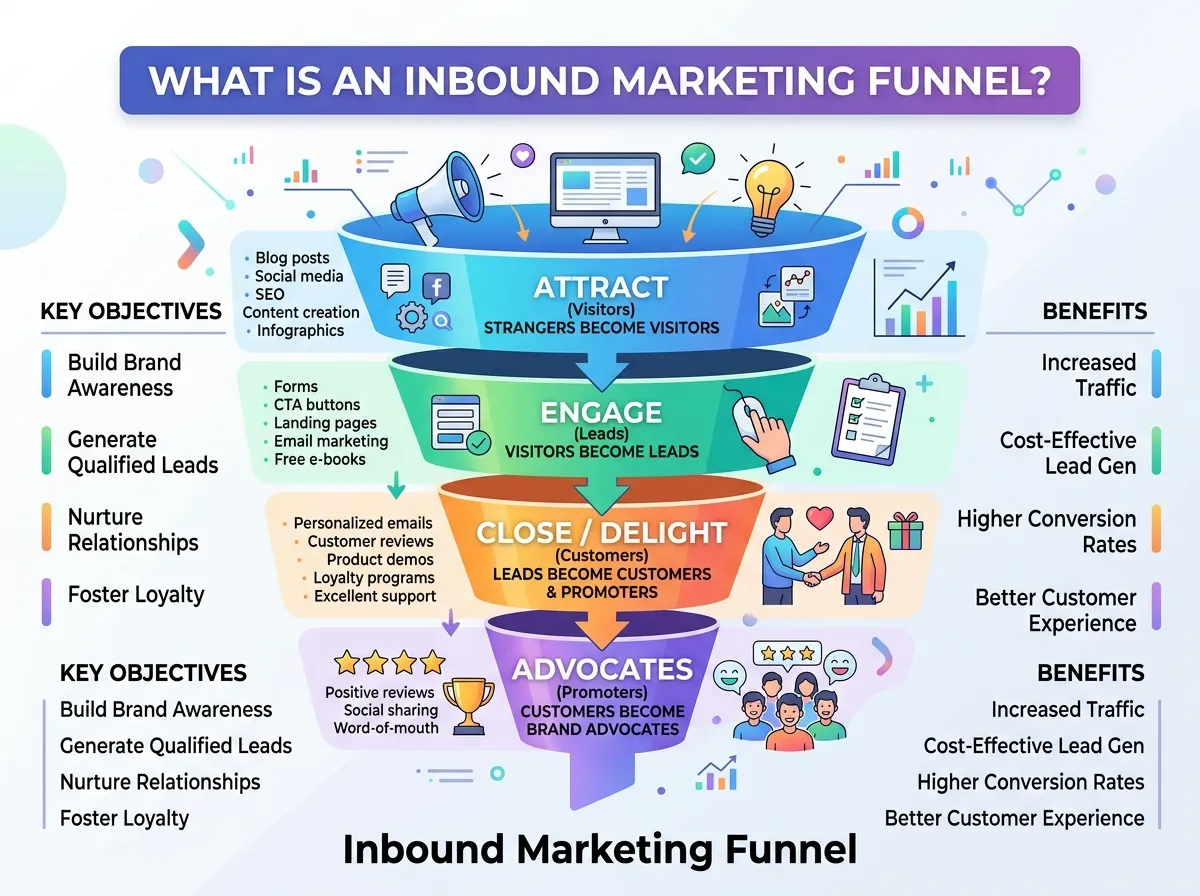
An inbound marketing funnel is a framework that represents the process a potential customer follows from discovering a business to becoming a customer. The funnel begins by attracting people who have a problem, question, or need and gradually moves them toward deeper engagement and conversion.
At the beginning of the funnel, people may not know that a business exists. They may simply be searching for information about a problem. As they interact with helpful content, they become more familiar with the brand.
Further down the funnel, prospects may subscribe to an email list, download a resource, request more information, compare products, or speak with a sales representative. Eventually, qualified prospects may become customers.
The funnel is useful because it helps businesses understand that not every visitor is ready to buy immediately. Different people require different types of information depending on where they are in their decision-making process.
Understanding the Inbound Marketing Strategy
An effective inbound marketing strategy begins by understanding the target audience and the problems they want to solve. Instead of starting with promotional messages, businesses identify what potential customers are searching for and create useful resources that address those needs.
Content can then attract people through search engines, social media, email, referrals, and other digital channels. Once visitors arrive, the business can encourage them to take a meaningful next step, such as reading another article, subscribing to a newsletter, downloading a guide, or contacting the company.
The strategy should connect each stage rather than treating content, lead generation, and sales as separate activities. When these components work together, businesses can create a more consistent customer experience.
A strong inbound strategy should also include measurement. Businesses need to understand which content attracts visitors, which sources generate leads, which leads become customers, and where prospects leave the funnel.
Understanding the Marketing Funnel Stages
The marketing funnel stages describe the different levels of customer awareness and intent. Although businesses may use different terminology, the funnel is commonly divided into awareness, consideration, and decision stages.
During the awareness stage, potential customers are identifying a problem or learning about a particular topic. They may not yet know which products or businesses can help them. Educational blog posts, videos, guides, social media content, and search-focused resources can be effective at this stage.
During consideration, prospects have a better understanding of their problem and begin evaluating possible solutions. They may compare products, research providers, read case studies, or look for detailed explanations. Comparison content, webinars, product guides, case studies, and email communication can be useful here.
The decision stage is where prospects are closer to taking action. They may request a quote, schedule a consultation, start a trial, or make a purchase. Testimonials, product demonstrations, pricing information, detailed service pages, and clear calls to action can help remove remaining concerns.
Understanding these stages helps businesses avoid giving every visitor the same message.
The Inbound Sales Funnel
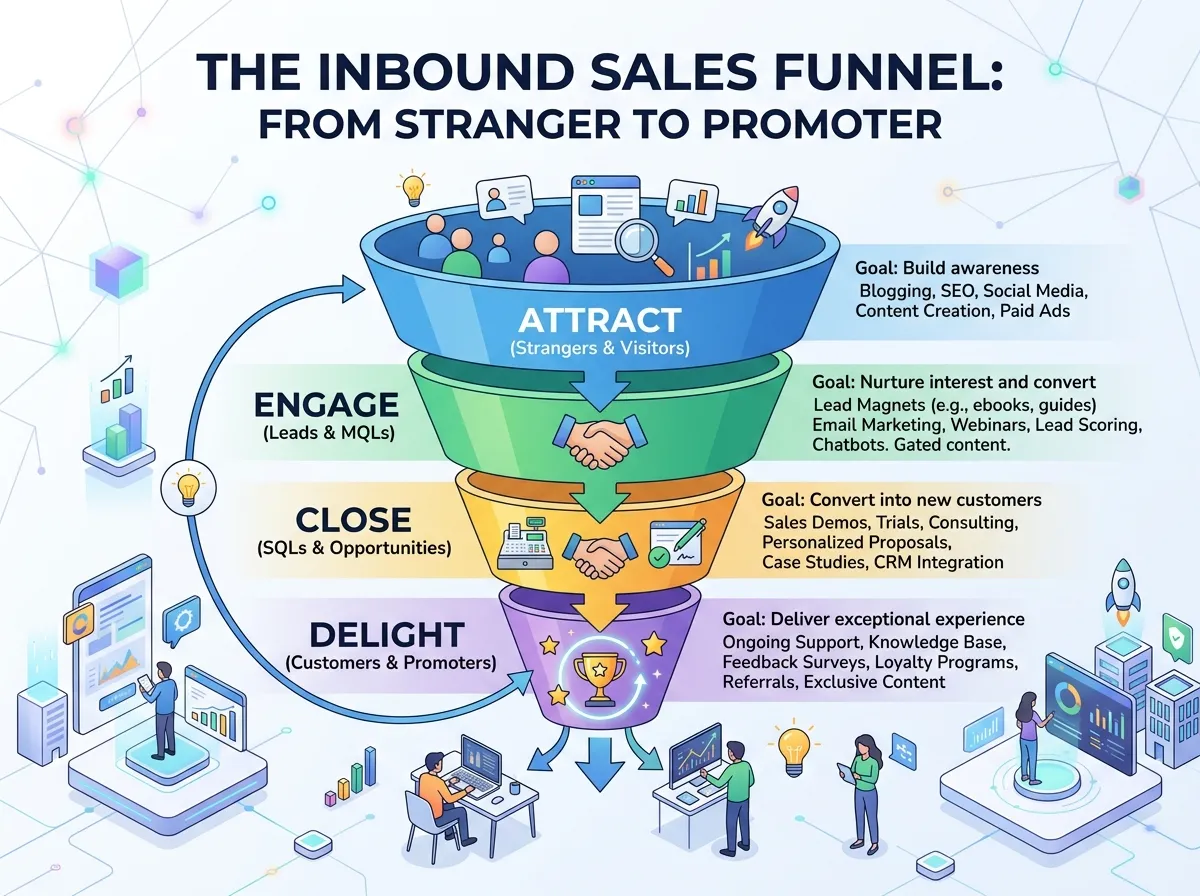
The inbound sales funnel connects marketing activities with the sales process. Marketing may attract and educate prospects, but qualified leads eventually need to move toward a sales conversation or purchase.
When someone becomes a lead, the sales team can evaluate whether the person is a good fit. This may involve looking at their company, needs, engagement, budget, timeline, or other relevant factors.
Not every lead should receive the same sales approach. Someone who downloaded an introductory guide may need more education, while someone requesting a product demonstration may be much closer to making a decision.
A well-integrated inbound sales funnel allows marketing and sales teams to share information and coordinate their activities. Marketing can provide sales teams with useful information about the lead’s interactions, while sales feedback can help marketers improve future content and campaigns.
Building a Lead Generation Funnel
A lead generation funnel is designed to turn anonymous visitors into identifiable prospects. The process typically starts with attracting the right audience and then giving visitors a reason to provide their contact information.
For example, a business might publish an educational article that answers a common customer question. At the end of the article, the visitor could be offered a useful downloadable guide, checklist, report, or other resource in exchange for an email address.
The quality of the offer is important. People are more likely to provide their information when they believe the resource provides genuine value.
Landing pages can also play an important role. A focused landing page should clearly explain the value of the offer and make the next step easy. Unnecessary fields or confusing navigation can discourage visitors from completing a form.
Once someone becomes a lead, the business can begin developing the relationship through relevant communication.
The Content Marketing Funnel
The content marketing funnel connects content with different stages of the customer’s journey. Content should not simply be created to increase website traffic. It should have a purpose within the overall funnel and help businesses attract, educate, engage, and convert potential customers.
Top-of-funnel content generally focuses on education and awareness. It may answer questions, explain concepts, or help people understand a problem. This content can attract people who are still researching. Creating useful educational content can also support inbound marketing content distribution by helping businesses share valuable resources with relevant audiences.
Middle-of-funnel content can help prospects evaluate solutions. Detailed guides, comparisons, case studies, webinars, and product-focused educational content can help prospects understand their options.
Bottom-of-funnel content supports the decision process. Prospects may want pricing information, demonstrations, customer stories, implementation details, or answers to specific objections.
Using different content types throughout the funnel allows businesses to provide relevant information instead of repeatedly presenting direct sales messages.
Understanding the Customer Journey Funnel
The customer journey funnel focuses on how people move from awareness to consideration, decision, and eventually customer loyalty. The journey is not always perfectly linear. Businesses can use an inbound marketing customer journey framework to better understand how prospects interact with content and move through different stages.
A prospect might discover a company through social media, visit its website several times, read reviews, subscribe to email, leave for several weeks, and then return through a search engine before making a purchase.
This is why businesses should create connected experiences rather than assuming every customer follows the same path. A consistent experience across content, email, social media, and other channels can also help increase customer engagement through inbound marketing.
Understanding customer behavior can help businesses identify common questions and obstacles. Analytics, surveys, customer interviews, sales conversations, and support interactions can all provide useful insights.
The better a business understands the journey, the easier it becomes to provide relevant information at each stage.
Developing a Lead Nurturing Strategy
A lead nurturing strategy helps businesses build relationships with prospects who are not yet ready to buy. Many leads need additional information before they feel comfortable making a decision.
Email marketing is commonly used for nurturing because it allows businesses to communicate with prospects over time. However, nurturing should not consist of sending constant promotional emails.
Instead, businesses can provide useful information based on the prospect’s interests. Someone who downloads a beginner’s guide could receive educational content that helps them understand the topic in greater depth. Later, they could receive a case study or comparison guide that introduces potential solutions.
Personalization can make nurturing more relevant. Businesses can segment leads based on their interests, behavior, industry, previous interactions, or stage in the buying process.
The objective is to remain helpful and relevant until the prospect is ready to take the next step.
Inbound Lead Generation
Inbound lead generation focuses on attracting potential customers rather than relying entirely on outbound approaches. Search engine optimization, content marketing, social media, webinars, email subscriptions, and educational resources can all contribute to inbound lead generation.
SEO is particularly valuable because it allows businesses to attract people who are already searching for relevant information. A well-optimized article can introduce a potential customer to a business without requiring the company to actively contact that person.
Content can then guide the visitor toward another useful resource or conversion opportunity. Over time, a collection of high-quality content can create a consistent source of inbound traffic and leads.
The most important factor is relevance. Attracting large amounts of traffic is not useful if the visitors have no interest in the company’s products or services.
Conversion Funnel Optimization

Conversion funnel optimization focuses on improving the percentage of prospects who move from one stage of the funnel to the next.
A business may have significant website traffic but very few leads. In this situation, marketers may need to examine landing pages, forms, calls to action, content relevance, and the overall user experience.
Similarly, a company may generate many leads but have a low percentage of customers. This could indicate problems with lead quality, nurturing, sales follow-up, pricing, product positioning, or other parts of the customer journey.
Optimization involves identifying where prospects are dropping out and investigating why. Businesses can use analytics, heatmaps, user feedback, A/B testing, and conversion data to find potential improvements.
Small changes can sometimes make a meaningful difference. Improving a headline, simplifying a form, strengthening a call to action, or providing additional information at the right moment can help reduce friction.
Inbound Marketing Automation
Inbound marketing automation allows businesses to automate repetitive marketing activities while maintaining relevant communication with prospects and customers.
Automation can be used for email sequences, lead scoring, segmentation, follow-up messages, content recommendations, and other activities. For example, when someone downloads a particular resource, they could automatically receive a series of related educational emails.
Automation can also help sales teams identify more engaged prospects. A lead who repeatedly visits product pages, opens emails, and requests information may receive a higher priority than someone who only downloaded one introductory resource.
However, automation should not replace thoughtful communication. Poorly designed automated campaigns can feel repetitive or irrelevant. The best approach combines automation with useful content, personalization, and human involvement where necessary.
Aligning Marketing and Sales
An inbound funnel works best when marketing and sales teams share common goals and definitions.
Marketing teams should understand what sales considers a qualified lead, while sales teams should provide feedback about the quality of leads being generated.
This alignment can improve the entire funnel. If sales representatives repeatedly hear the same questions from prospects, marketers can create content that answers those questions earlier in the journey.
Likewise, if certain content consistently produces high-quality leads, marketing teams can invest more resources into similar topics and formats.
Communication between departments can therefore turn customer interactions into useful insights for future marketing activities.
Measuring the Inbound Marketing Funnel
Measuring the funnel allows businesses to understand how effectively they attract, engage, nurture, and convert prospects.
At the top of the funnel, businesses may monitor organic traffic, content views, search visibility, and social engagement. Further down, they can track email subscriptions, downloads, leads, qualified leads, sales conversations, and conversions.
Conversion rates between stages are particularly useful. If thousands of people visit a website but very few become leads, the business can investigate its conversion process. If many leads are generated but few become customers, the problem may exist further down the funnel.
Revenue should ultimately be connected to marketing activities whenever possible. Understanding which channels and content contribute to actual business outcomes allows companies to make more informed investment decisions.
Common Inbound Marketing Funnel Mistakes
One common mistake is creating content without understanding the audience. Content should address genuine questions and problems rather than simply target keywords.
Another problem is using the same message for every stage of the funnel. Someone discovering a problem for the first time does not necessarily need a sales pitch. Similarly, someone who is ready to purchase may need specific product or pricing information rather than basic educational content. However, businesses can also consider targeted outbound approaches when appropriate. A well-planned outbound marketing strategy for business growth can complement inbound activities and help reach specific prospects more directly.
Businesses can also lose potential customers by making conversion steps unnecessarily complicated. Long forms, unclear calls to action, slow websites, and confusing landing pages can create friction.
Ignoring existing leads is another mistake. Businesses may spend significant resources generating leads but fail to follow up effectively. A consistent nurturing process can help prevent valuable prospects from being forgotten.
Finally, relying too heavily on automation can reduce the quality of communication. Automation should support the customer experience rather than make it feel impersonal.
How to Build a Successful Inbound Marketing Funnel
Building a successful funnel starts with understanding the customer. Businesses should identify the questions customers ask, the problems they experience, and the information they need before making a purchase.
The next step is creating content that supports those needs. Awareness content can attract new audiences, consideration content can help prospects evaluate options, and decision-stage content can help customers take action.
Lead generation mechanisms should then connect visitors with the business. Useful resources, newsletters, consultations, demonstrations, and other relevant offers can encourage visitors to continue the relationship.
Lead nurturing can keep prospects engaged until they are ready to purchase, while sales teams can take over when leads demonstrate stronger buying intent.
Finally, the entire funnel should be measured and optimized. Businesses should continually identify where prospects are dropping out and test ways to improve the experience.
Final Thoughts
An inbound marketing funnel provides businesses with a structured way to attract potential customers, educate them, develop relationships, and guide them toward a purchase. It brings together content marketing, SEO, lead generation, email marketing, sales, automation, and conversion optimization.
The most successful funnels are built around customer needs rather than aggressive promotion. Businesses should provide useful information when people are researching, offer deeper resources when prospects are evaluating solutions, and make the purchasing process easier when customers are ready to act.
An effective funnel is also not static. Customer behavior changes, new channels emerge, and different content approaches produce different results. Regular measurement and optimization allow businesses to improve the journey over time.
By developing a thoughtful inbound marketing strategy and connecting every stage of the funnel, businesses can attract more relevant prospects, nurture stronger relationships, improve conversions, and create a more sustainable source of long-term growth.
Frequently Asked Questions
1. What is an inbound marketing funnel?
An inbound marketing funnel is a framework that guides potential customers from discovering a business to engaging with it, becoming a qualified lead, and eventually making a purchase. It uses helpful content and relevant communication throughout the customer journey.
2. What are the main stages of an inbound marketing funnel?
The main stages generally include awareness, consideration, and decision. Some businesses also include customer retention and advocacy after the purchase.
3. What is the difference between an inbound marketing funnel and a sales funnel?
An inbound marketing funnel focuses heavily on attracting and educating prospects through useful content and digital experiences. An inbound sales funnel focuses more closely on qualifying prospects and guiding them toward a sales conversation or purchase.
4. How does content support an inbound marketing funnel?
Content provides information that matches different stages of the customer journey. Educational content can attract new prospects, detailed resources can support consideration, and product-focused content can help prospects make purchasing decisions.
5. What is a lead generation funnel?
A lead generation funnel is designed to turn website visitors or other audience members into identifiable leads. It usually combines valuable content or offers with landing pages, forms, and follow-up communication.
6. What is lead nurturing?
Lead nurturing is the process of developing relationships with prospects who are not yet ready to purchase. Businesses can use relevant content, email communication, and personalized follow-up to help prospects move closer to a decision.
7. How can I improve my inbound marketing funnel?
Businesses can improve their funnel by understanding customer needs, creating more relevant content, improving calls to action, simplifying forms, strengthening lead nurturing, improving sales follow-up, and analyzing conversion data.
8. How does marketing automation support inbound funnels?
Marketing automation can handle repetitive tasks such as email sequences, lead segmentation, follow-ups, and lead scoring. This allows businesses to communicate with prospects consistently while reducing manual work.
9. How long does it take to build an inbound marketing funnel?
The timeframe depends on the business, audience, content requirements, technology, and sales process. A basic funnel can be established relatively quickly, but developing a mature funnel with strong content, automation, and optimization usually requires ongoing work.
10. How do you measure an inbound marketing funnel?
Businesses can measure website traffic, content engagement, leads, qualified leads, email engagement, sales opportunities, conversion rates, customer acquisition costs, and revenue. Comparing performance between funnel stages helps identify where improvements are needed.