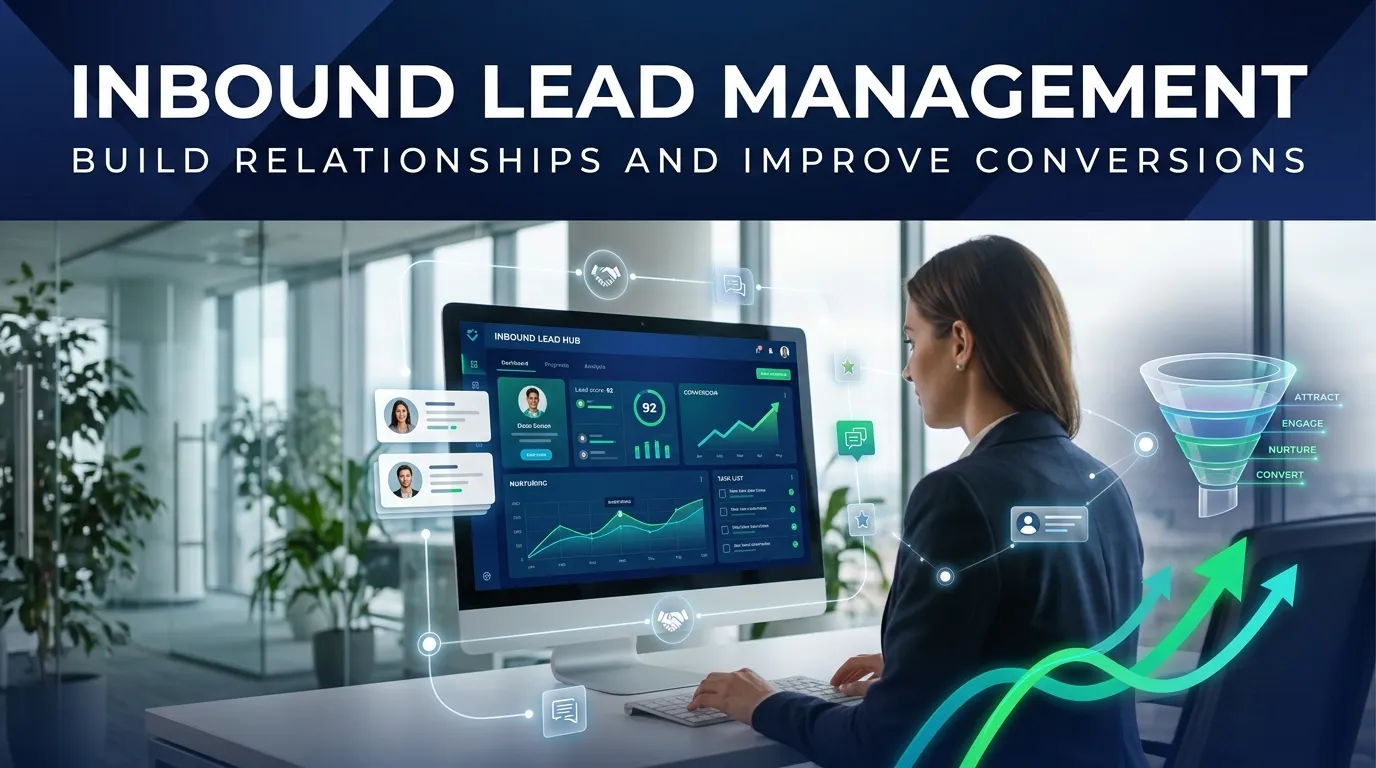
Inbound lead management helps businesses organize, qualify, nurture, track, and convert prospects throughout the buying journey. Effective lead scoring, clear MQL and SQL criteria, a structured sales pipeline, and reliable lead distribution improve coordination between marketing and sales. By maintaining accurate records, delivering relevant communication, and reviewing performance regularly, businesses can improve lead quality, strengthen customer relationships, and create more consistent sales opportunities.
Inbound lead management helps businesses turn the interest generated through marketing activities into meaningful sales opportunities. When potential customers discover a company through search engines, blog posts, social media, or other digital channels, businesses need a reliable process to understand their interests, maintain communication, and identify when they are ready to make a purchase.
A well-organized inbound lead management process connects marketing and sales activities, allowing teams to guide prospects through the buying journey with relevant information and timely follow-ups. Rather than treating every inquiry as an immediate sales opportunity, businesses can evaluate customer needs, recognize buying signals, and prioritize leads according to their potential value.
Without an effective process, promising prospects may receive delayed responses, irrelevant messages, or inconsistent communication. A structured approach helps businesses avoid these problems while improving lead quality, sales coordination, and marketing performance. By combining accurate tracking, personalized nurturing, clear qualification criteria, and continuous evaluation, organizations can build a more predictable path from initial interest to customer conversion.
Understanding the Role of Inbound Lead Management
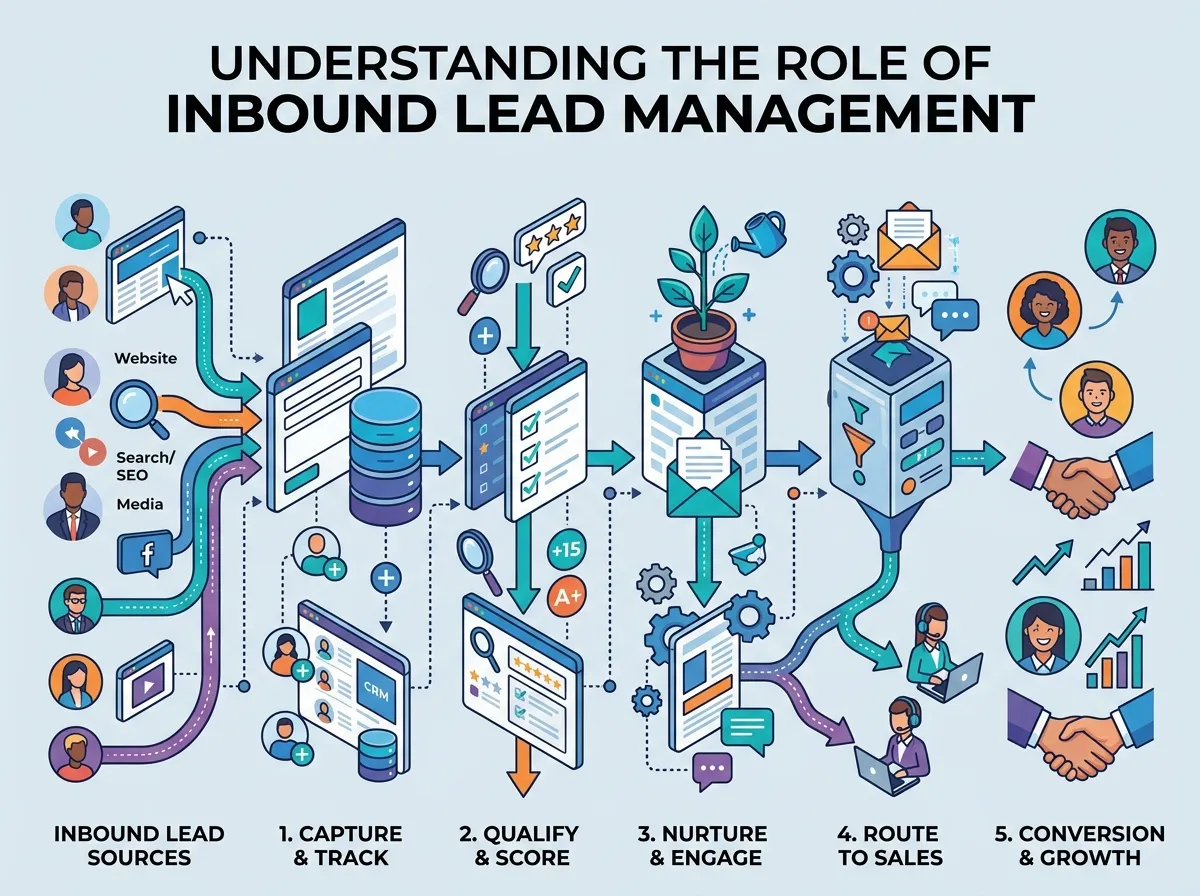
Inbound lead management covers the activities involved in capturing, organizing, qualifying, nurturing, and converting prospects who express interest in a business. Its purpose is to ensure that potential customers receive the right information and support as they move closer to a purchasing decision.
The process begins when someone interacts with a company’s marketing content, completes a form, subscribes to updates, or requests additional information. From that point, businesses can collect relevant details, understand the prospect’s interests, and determine which communication or sales activity is most appropriate.
This process is particularly valuable because prospects rarely follow identical buying journeys. One person may need educational content to understand a problem, while another may already be comparing service providers. Recognizing these differences helps businesses avoid sending the same message to every contact.
Effective lead management also strengthens coordination between marketing and sales. Marketing teams can concentrate on attracting relevant audiences and developing interest, while sales representatives focus on prospects who demonstrate a suitable level of need and buying intent. Shared processes and accurate records help both departments work toward the same commercial objectives.
Recognizing High-Potential Prospects Through Inbound Lead Qualification
Inbound lead qualification helps businesses determine which prospects are most likely to benefit from their products or services. Although a large number of inquiries can indicate marketing reach, lead volume alone does not guarantee meaningful sales opportunities. Businesses need to understand whether those contacts match their target audience and have a genuine reason to consider the offering.
Qualification often considers characteristics such as industry, company size, location, budget, business requirements, and decision-making authority. The most relevant factors depend on the company’s ideal customer profile. For a business-to-business provider, organizational needs and purchasing responsibilities may be important, while a consumer-focused company may place greater emphasis on individual preferences and product requirements.
Behavioral information can provide additional context. A prospect who repeatedly explores product pages or requests a consultation may show stronger interest than someone who visits a general article once. However, no single action should automatically determine qualification. Businesses should interpret behavior alongside customer fit and the prospect’s stated needs.
Consistent qualification criteria make it easier for marketing and sales teams to decide which leads require further nurturing and which deserve direct sales attention. This reduces wasted effort and helps ensure that promising prospects are not overlooked.
Developing Lead Nurturing Strategies That Encourage Engagement
Many prospects need time to research their options before making a purchasing decision. Lead nurturing strategies help businesses maintain relationships during this period by delivering useful information that addresses customer questions and concerns.
Educational blog posts, case studies, email newsletters, product comparisons, webinars, and relevant industry insights can help prospects understand their challenges and evaluate possible solutions. The content should reflect the questions people are likely to ask at different stages of their buying journey rather than repeatedly presenting the same promotional message.
For example, someone researching a business challenge may appreciate an introductory article explaining the problem and its possible causes. A prospect comparing providers may prefer information about product capabilities, implementation requirements, service quality, or pricing considerations. Matching communication to these needs makes each interaction more useful.
Email marketing can support nurturing when messages reflect subscriber interests and communication preferences. Automated sequences may deliver related resources after a prospect downloads a guide or subscribes to updates. Follow-up messages can also respond to meaningful actions, provided the communication remains relevant and respects applicable consent requirements.
Nurturing works best when it forms part of a broader inbound marketing approach. Businesses can strengthen their efforts by connecting content, audience research, search visibility, and personalized communication with established inbound marketing techniques. These activities help prospects discover relevant information and continue engaging with the business as their needs develop.
The goal is to build trust and support informed decisions, not to pressure every contact into purchasing immediately.
Improving Decision-Making With Inbound Lead Tracking

Understanding how prospects interact with a business is essential for improving marketing and sales performance. Inbound lead tracking records relevant interactions throughout the customer journey, helping teams identify where leads originate, which resources attract attention, and how interest develops over time.
Tracking information may include acquisition sources, website visits, form submissions, email engagement, content downloads, consultation requests, and sales interactions. When these details are maintained in an organized system, businesses can develop a clearer picture of each prospect’s journey.
Consider a potential customer who discovers a company through organic search, reads several educational articles, subscribes to a newsletter, and eventually requests a product demonstration. Tracking these interactions helps the business understand the sequence of activities associated with the inquiry. It also provides useful evidence for evaluating which marketing channels contribute to qualified opportunities.
Businesses can improve this visibility through inbound marketing lead tracking, connecting prospect monitoring with conversion analysis. Accurate tracking makes it easier to evaluate acquisition sources, identify engagement patterns, and discover weaknesses in the customer journey.
Reliable data is essential for useful reporting. Duplicate records, incomplete contact information, inconsistent source labels, and outdated details can distort results. Businesses should establish clear processes for maintaining contact records and updating information as relationships develop.
Privacy should remain central to tracking activities. Organizations should collect appropriate information for legitimate purposes, follow applicable data protection requirements, and respect customer consent and communication preferences.
Applying Lead Scoring Methods to Prioritize Opportunities
As businesses attract more prospects, deciding which leads deserve immediate attention becomes increasingly important. Lead scoring methods help teams rank prospects according to their suitability and demonstrated interest, allowing sales representatives to focus on opportunities with stronger potential.
A scoring model typically evaluates two broad factors: customer fit and engagement. Customer fit may include company size, industry, location, or alignment with the ideal customer profile. Engagement may reflect actions such as requesting a consultation, visiting product pages, attending a webinar, or downloading relevant resources.
Separating these factors provides a more balanced assessment. A prospect who interacts with many resources but falls outside the target market may not represent a strong opportunity. Meanwhile, a suitable prospect who has shown moderate interest may deserve further attention if their business needs closely match the offering.
Scoring rules should reflect evidence wherever possible. Historical sales data can reveal which characteristics and behaviors are commonly associated with successful conversions. Marketing and sales teams can use these findings to establish initial scoring criteria and refine them as more results become available.
Lead scores should support professional judgment rather than replace it. Some prospects may have urgent needs that are not fully reflected in their recorded activity, while others may engage frequently without having a realistic intention to purchase. Sales feedback and regular performance reviews help keep scoring models useful and relevant.
Managing Lead Conversion From Initial Interest to Purchase
Lead conversion management focuses on helping qualified prospects progress toward a purchasing decision. It brings together communication, follow-up, sales support, and performance evaluation to make the buying experience more consistent.
Prospects may hesitate for several reasons, including uncertainty about product suitability, concerns about pricing, limited trust, implementation questions, or difficulty understanding the expected benefits. Businesses can address these barriers through demonstrations, customer testimonials, detailed product information, consultations, and clear explanations of the purchasing process.
Timely follow-up is another important factor. When someone requests a consultation or asks a detailed question, a relevant response helps maintain interest and establishes confidence. Delays can create uncertainty and allow competitors to engage the prospect first.
The experience should remain consistent across marketing and sales channels. Advertisements, landing pages, emails, and sales conversations should communicate compatible information and avoid conflicting promises. Consistency helps prospects understand what the business offers and what they can reasonably expect.
Conversion performance should be measured beyond the number of initial inquiries. Businesses can examine how many qualified leads become sales opportunities, how many opportunities result in customers, and how long the buying process takes. Reviewing lost opportunities can also reveal recurring objections and weaknesses in the sales experience.
Not every lead will convert immediately. Some prospects need additional information, while others may not have a suitable budget or immediate requirement. Recognizing these differences helps businesses decide whether to continue nurturing, initiate sales engagement, or stop investing in an unsuitable opportunity.
Creating a Clear and Organized Inbound Sales Pipeline
An inbound sales pipeline provides a structured view of how prospects progress through the sales process. It helps teams understand the status of opportunities, identify stalled conversations, and maintain visibility into potential revenue.
Pipeline stages should reflect the company’s actual sales cycle. Depending on the business, these stages might include new inquiry, qualification, discovery, solution evaluation, proposal, negotiation, and final outcome. Each stage should have a clear meaning so that team members can determine when an opportunity is ready to advance.
For instance, a prospect should not automatically enter the proposal stage simply because a sales representative has made contact. The business may first need to understand the prospect’s requirements, confirm that its solution is suitable, and establish whether a realistic purchasing opportunity exists.
A clearly defined pipeline also helps managers recognize recurring obstacles. If many prospects remain in the discovery stage, the business may need to improve qualification or follow-up. If opportunities frequently stall after proposals are delivered, the team may need to address pricing concerns, clarify value, or improve its approach to decision-maker engagement.
Marketing teams can use pipeline information to assess the quality of incoming leads and refine future campaigns. Sales teams can use it to prioritize their workload and plan follow-up activities. When both departments rely on the same definitions and records, the pipeline becomes a more dependable tool for decision-making.
Establishing an Efficient Lead Distribution Process
A lead distribution process determines how incoming prospects are assigned to the appropriate sales representative or team. Clear distribution reduces delays, prevents inquiries from being overlooked, and helps prospects receive relevant support.
The most suitable method depends on the organization’s structure. Leads may be assigned according to territory, industry, product expertise, account ownership, representative availability, or a rotating assignment system. The important factor is ensuring that each inquiry has a clear owner.
Distribution rules should also reflect urgency and qualification. Someone requesting a consultation may need faster attention than someone downloading a general educational resource. Prioritization can help the team respond appropriately without ignoring prospects who are still in the research stage.
Automation can make assignment more consistent by routing leads according to predefined conditions. However, the system needs accurate information and a way to handle exceptions. If a prospect’s details are incomplete or do not match established rules, the inquiry should be flagged for review rather than left unassigned.
Clear accountability completes the process. Businesses should establish expectations for accepting new leads, making initial contact, updating records, and returning unsuitable assignments for reassessment. These practices reduce confusion and make it easier to identify where follow-up is falling behind.
Building Stronger Connections Through Prospect Relationship Management

Prospect relationship management helps businesses maintain meaningful communication with potential customers throughout the buying journey. Since purchasing decisions can take time, organizations need a way to preserve context, understand individual needs, and provide consistent support even when prospects are not ready to buy.
A relationship-focused approach considers previous interactions, stated preferences, business requirements, and unresolved questions. Sales representatives can use this information to make conversations more relevant instead of asking prospects to repeat details they have already provided.
A centralized customer relationship management system can support this process by maintaining contact details, interaction histories, sales notes, communication preferences, and planned follow-ups. These records help teams collaborate and ensure that a prospect receives a consistent experience when different employees become involved.
Personalization should remain useful and appropriate. Referring to a prospect’s stated requirements or previously requested information can make communication more helpful. Using unnecessary personal details or sending messages that feel intrusive may have the opposite effect.
Relationship management also matters when prospects postpone purchasing. A project may be delayed because of budget restrictions, internal changes, or competing priorities. Permission-based communication and relevant follow-up can keep the relationship active until circumstances become more suitable.
For businesses seeking to expand their contact networks, a well-organized lead generation contacts database can support prospect organization and outreach when contact information is accurate, appropriately sourced, and managed in accordance with applicable privacy requirements. Contact records are most valuable when they help teams understand and serve prospects rather than simply increase the number of names in a database.
Understanding Marketing Qualified Leads and Sales Qualified Leads
Clear qualification stages help marketing and sales teams decide when a prospect is ready for a different type of engagement. Two common categories are Marketing Qualified Leads (MQLs) and Sales Qualified Leads (SQLs).
A Marketing Qualified Lead (MQL) is a prospect who meets defined criteria indicating that they are suitable for continued marketing attention. This assessment may consider audience fit, engagement with relevant resources, repeated interest, or other signals that suggest the prospect could become a customer. An MQL may still need additional education before a direct sales conversation is appropriate.
A Sales Qualified Lead (SQL) has generally been assessed more closely and is considered suitable for direct sales engagement. The prospect may have a relevant business need, an appropriate level of interest, and a realistic opportunity to purchase. The precise criteria vary according to the business model and sales cycle.
The transition from MQL to SQL should be based on shared definitions rather than assumptions. Marketing and sales teams need to agree on which signals justify sales follow-up, what information should accompany an assigned lead, and how quickly the sales team should review it.
Feedback between departments helps maintain these definitions. If sales representatives frequently reject MQLs because they lack suitable needs or buying intent, marketing may need to refine its qualification criteria. If qualified prospects receive delayed follow-up, the business may need to improve lead distribution, workload management, or response expectations.
Clear MQL and SQL definitions improve accountability and help businesses understand how effectively marketing activity contributes to sales opportunities.
Strengthening Results Through Continuous Lead Management Improvement
Inbound lead management should evolve as businesses learn more about their customers, campaigns, and sales performance. Regular evaluation helps teams determine whether qualification criteria remain effective, nurturing activities support engagement, and lead distribution processes encourage timely follow-up.
Useful performance indicators include lead-to-MQL conversion rate, MQL-to-SQL conversion rate, lead-to-customer conversion rate, response time, cost per qualified lead, and sales cycle length. Together, these measures provide a more complete view of lead quality and commercial outcomes.
For example, a business may generate a high volume of leads but discover that only a small proportion match its target customer profile. This could indicate that campaign messaging, audience targeting, or acquisition channels need improvement. Another business may attract suitable leads but struggle to convert them because follow-up is delayed or prospects do not receive enough information to make a decision.
Sales feedback and customer questions can reveal issues that numerical reporting does not fully explain. Prospects may need clearer product information, while sales representatives may identify recurring objections or missing contact details. Addressing these problems can improve both the customer experience and the efficiency of the management process.
Businesses should make adjustments based on evidence and review the results over time. Refining scoring criteria, improving follow-up messages, or changing distribution rules may produce useful gains, but their impact needs to be evaluated rather than assumed.
When reliable data, relevant communication, clear responsibilities, and regular reviews work together, inbound lead management becomes a practical foundation for stronger prospect relationships and more consistent business growth.
Frequently Asked Questions
1. What is inbound lead management?
Inbound lead management is the process of capturing, organizing, qualifying, nurturing, and converting prospects generated through inbound marketing activities. It helps businesses understand customer needs, identify buying readiness, and guide potential customers toward suitable sales opportunities.
2. Why is inbound lead management important?
It helps businesses prevent promising prospects from being overlooked, improve coordination between marketing and sales, and focus attention on qualified opportunities. It also supports more accurate reporting, better customer communication, and more efficient use of marketing resources.
3. What is inbound lead qualification?
Inbound lead qualification evaluates whether a prospect matches the company’s target customer profile and demonstrates a relevant need or interest. Businesses may consider industry, company size, budget, business requirements, engagement behavior, and purchasing readiness.
4. How do lead nurturing strategies improve conversions?
Lead nurturing provides prospects with relevant information as they research problems and evaluate solutions. Educational content, personalized emails, case studies, and timely follow-ups can address concerns, establish trust, and help potential customers make informed purchasing decisions.
5. What is the difference between inbound lead tracking and lead scoring?
Inbound lead tracking records prospect interactions, such as website visits, content downloads, and form submissions. Lead scoring assigns values to selected characteristics and behaviors to help businesses prioritize prospects according to their fit and potential buying intent.
6. What are Marketing Qualified Leads (MQLs)?
Marketing Qualified Leads are prospects who meet defined criteria indicating that they are suitable for continued marketing attention. Their characteristics or engagement suggest potential interest, although they may not yet be ready for direct sales engagement.
7. What are Sales Qualified Leads (SQLs)?
Sales Qualified Leads are prospects who have been assessed as suitable for direct sales follow-up. They generally demonstrate a relevant need and sufficient alignment with the company’s offering to justify a more focused sales conversation.
8. How can businesses improve their inbound sales pipeline?
Businesses can improve their pipeline by defining clear stages, maintaining accurate records, establishing criteria for advancing opportunities, and monitoring stalled conversations. Reviewing conversion rates, response times, and sales feedback helps identify areas that need attention.
9. How does lead distribution affect sales performance?
Lead distribution determines which representative receives each inquiry and how quickly follow-up begins. Clear assignment rules improve accountability, reduce missed opportunities, and connect prospects with representatives who have the appropriate expertise or responsibility.
10. Which metrics should businesses track for inbound lead management?
Important metrics include lead-to-MQL conversion rate, MQL-to-SQL conversion rate, lead-to-customer conversion rate, response time, cost per qualified lead, pipeline progression, and sales cycle length. Reviewing these indicators together helps businesses evaluate lead quality and improve performance.