
Inbound marketing is a customer-centric strategy that attracts, engages, and retains audiences through valuable content creation, SEO, and personalized experiences—rather than interrupting them with ads. When executed well, it turns strangers into loyal customers and loyal customers into brand advocates.
Most businesses spend enormous energy chasing customers. Inbound marketing flips that equation entirely—it builds systems that make customers come to you.
The shift from outbound to inbound thinking represents one of the most significant pivots in modern marketing. Traditional advertising pushed messages at people, regardless of whether they were ready to hear them. Inbound marketing, by contrast, earns attention by solving real problems, answering genuine questions, and delivering value before asking for anything in return.
This post walks you through the full inbound marketing process—from the first piece of content your audience discovers to the loyalty strategies that keep customers coming back. Whether you’re mapping out your first inbound strategy or refining an existing one, you’ll find practical frameworks, strategic clarity, and actionable steps here.
Content creation sits at the core of every successful inbound program. But content alone isn’t enough. What separates effective inbound marketers from those who simply “publish and hope” is a systematic approach that connects content to conversion, and conversion to long-term retention.
By the end of this post, you’ll understand exactly how each stage of the inbound process works, how the components connect, and which strategies give you the highest return on your investment.
What Is Inbound Marketing?
Inbound marketing is a methodology that attracts potential customers by creating helpful, relevant content and experiences tailored to their needs—rather than pushing promotional messages onto an audience that hasn’t asked for them.
The concept was popularized by HubSpot co-founders Brian Halligan and Dharmesh Shah in the mid-2000s, and it has since become a foundational framework for digital marketing teams worldwide. At its core, inbound marketing operates on a simple premise: when you help people solve their problems, they trust you—and trust leads to business.
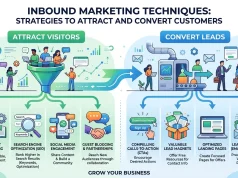
The inbound methodology is typically organized around four stages:
|
Stage |
Goal |
Key Activity |
|---|---|---|
|
Attract |
Drive the right traffic |
Content creation, SEO, social media |
|
Convert |
Turn visitors into leads |
CTAs, landing pages, forms |
|
Close |
Turn leads into customers |
Email marketing, CRM, lead nurturing |
|
Delight |
Turn customers into advocates |
Personalization, support, community |
Each stage depends on the one before it. Without strong content creation at the attract stage, there are no visitors to convert. Without effective conversion, there are no leads to close. And without a delight strategy, even your best customers may quietly drift away.
How Does Inbound Marketing Work?

Inbound marketing works by aligning your content, channels, and messaging with the specific needs of your target audience at each stage of their buying journey.
Think of it as a flywheel rather than a funnel. A traditional sales funnel ends at the purchase. The inbound flywheel keeps spinning—satisfied customers create momentum that fuels new growth through referrals, reviews, and organic word-of-mouth.
Here’s how the process flows in practice:
- A potential customer searches for an answer to a problem they’re experiencing.
- They find a piece of your content—a blog post, video, or social media post—that addresses that problem.
- Your content builds trust and credibility, prompting them to explore more of your site.
- They encounter a compelling offer—a free guide, webinar, or trial—and exchange their contact details.
- Your team nurtures that lead through targeted email sequences and personalized follow-ups.
- The prospect becomes a customer, and your post-sale experience is strong enough to keep them engaged and encourage referrals.
This process doesn’t happen overnight. Inbound marketing is a long-term investment. But the returns compound over time: a blog post published today can generate organic traffic for years, while a paid ad stops delivering the moment you stop paying for it.
Inbound Marketing vs Outbound Marketing: What’s the Real Difference?
The distinction between inbound and outbound marketing isn’t just philosophical—it has practical implications for your budget, your team’s workflow, and the quality of leads you generate.
Outbound marketing involves pushing your message to a broad audience through channels like TV commercials, cold calls, display ads, and direct mail. The audience hasn’t necessarily asked to hear from you, which means conversion rates are typically lower and costs per acquisition are higher.
Inbound marketing earns attention by creating content and experiences that people actively seek out. Because your audience is already looking for what you offer, the leads tend to be more qualified and more likely to convert.
|
Factor |
Inbound Marketing |
Outbound Marketing |
|---|---|---|
|
Audience targeting |
Specific, intent-based |
Broad, interruption-based |
|
Cost over time |
Decreases as assets compound |
Consistent or increasing |
|
Lead quality |
Higher (self-selected) |
Variable |
|
Trust building |
Gradual, value-driven |
Immediate but less trusted |
|
Measurement |
Highly trackable |
Often harder to attribute |
Neither approach is universally superior. Outbound still plays a role in certain industries and scenarios—particularly for time-sensitive campaigns or brand awareness at scale. But for sustainable, cost-efficient growth, inbound marketing consistently outperforms over a 12- to 24-month horizon.
The Role of Content Creation in Inbound Marketing
Content creation is the engine that powers every other stage of the inbound process. Without content, there is nothing to attract visitors, nothing to build trust, and nothing to guide a prospect from awareness to decision.
Effective content creation for inbound marketing isn’t about publishing as much as possible—it’s about publishing the right content for the right audience at the right stage of their journey. This is where many brands go wrong. They create content they want to make, rather than content their audience is actively searching for.
What Types of Content Work Best for Inbound Marketing?
The answer depends on your audience, your industry, and the stage of the buyer’s journey you’re targeting. That said, certain content formats consistently perform well across industries:
- Blog posts and long-form articles — Ideal for capturing organic search traffic and establishing topical authority. A well-structured post targeting a specific keyword can rank for years.
- Pillar pages and topic clusters — Comprehensive guides that cover a broad topic, supported by interconnected cluster content. This structure signals depth and authority to search engines.
- Video content — Particularly effective for product demonstrations, tutorials, and thought leadership. YouTube remains the world’s second-largest search engine, making it a critical channel for inbound visibility.
- Infographics and visual content — Effective for communicating complex data quickly and generating backlinks.
- Podcasts — Growing in popularity as a top-of-funnel touchpoint for audiences who prefer audio content during commutes or workouts.
- Ebooks and whitepapers — High-value assets positioned behind lead capture forms, ideal for the conversion stage.
- Case studies and testimonials — Powerful at the decision stage, where prospects need social proof before committing.
How to Align Content Creation with the Buyer’s Journey
Every piece of content should serve a specific purpose mapped to where a prospect is in their decision-making process.
Awareness stage: The prospect knows they have a problem but hasn’t yet identified a solution. Content here should be educational and non-promotional. Blog posts, how-to guides, and explainer videos perform well.
Consideration stage: The prospect is actively evaluating options. Comparison articles, product webinars, and detailed guides that walk through different solutions help them narrow their choices.
Decision stage: The prospect is ready to buy. Case studies, free trials, demos, and ROI calculators address remaining objections and provide the final nudge.
Mapping your content creation calendar to these three stages ensures you’re not just attracting visitors—you’re guiding them toward a decision.
Best Inbound Marketing Strategies to Drive Traffic and Leads
With a clear understanding of what inbound marketing is and how content creation supports it, let’s explore the core strategies that make the entire system work.
Search Engine Optimization (SEO)
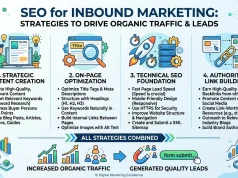
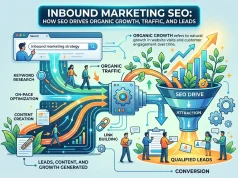
SEO and inbound marketing are inseparable. Nearly every piece of content you create has the potential to rank in search engines—and organic search remains one of the highest-converting traffic sources available to marketers.
Effective SEO for inbound marketing involves three interconnected disciplines:
Technical SEO ensures your website is crawlable, fast, and mobile-friendly. Core Web Vitals, structured data, clean URL structures, and proper indexing are foundational.
On-page SEO involves optimizing individual pages for target keywords through well-crafted titles, meta descriptions, header tags, and semantically rich content. Keyword placement should feel natural—never forced.
Off-page SEO focuses on building authority through backlinks from reputable sources, digital PR, and brand mentions across the web.
Keyword research is the starting point for any content creation effort tied to SEO. Tools like Ahrefs, SEMrush, and Google Search Console help identify the exact terms your audience uses when searching for solutions—giving you a data-driven foundation for your content calendar.
Content Hubs and Topic Authority
Search engines increasingly reward depth and breadth of coverage on specific topics. A content hub—sometimes called a pillar-and-cluster model—organizes your content around a central topic page supported by a network of related, interlinked articles.
For example, a software company focused on project management might build a pillar page titled “The Complete Guide to Project Management” and support it with cluster content covering topics like Agile methodology, remote team collaboration, and project timeline templates. Each cluster post links back to the pillar, and the pillar links out to each cluster—creating a web of authority that search engines can clearly map.
Lead Magnets and Conversion Optimization
Attracting traffic is only half the equation. Inbound marketing only generates revenue when visitors convert into leads. Lead magnets—free, high-value resources offered in exchange for contact information—are the most effective conversion mechanism in inbound marketing.
Effective lead magnets solve a specific, immediate problem for your audience. Templates, checklists, free tools, webinar registrations, and exclusive reports all perform well. The key is specificity: a “30-Day Content Calendar Template for B2B SaaS Marketers” will consistently outperform a generic “Marketing Guide.”
Conversion rate optimization (CRO) complements your lead magnet strategy by improving the percentage of visitors who take action. A/B testing landing page headlines, CTA button copy, form length, and page layout can dramatically increase conversion rates without requiring additional traffic.
Email Marketing and Lead Nurturing
Once a visitor converts into a lead, email marketing takes over. Email remains one of the highest-ROI channels in digital marketing—the Data & Marketing Association estimates an average return of $42 for every $1 spent.
Lead nurturing sequences guide prospects through the consideration and decision stages with targeted, relevant content. A well-structured nurture sequence might look like this:
- Email 1 (Day 1): Deliver the promised lead magnet and introduce your brand.
- Email 2 (Day 3): Share a relevant blog post or case study that addresses a common pain point.
- Email 3 (Day 7): Offer a product demonstration, free trial, or consultation.
- Email 4 (Day 14): Address common objections and share testimonials.
- Email 5 (Day 21): Create urgency with a time-sensitive offer or next step.
Segmentation is critical here. Not all leads are at the same stage or facing the same challenge. The more precisely you can tailor your nurture sequence to a lead’s behavior and profile, the higher your conversion rates will be.
Social Media as an Inbound Distribution Channel
Social media platforms are distribution channels, not just brand-building tools. When used strategically, social media amplifies your content creation efforts—driving traffic back to your website, building community, and generating leads.
The platforms you prioritize should reflect where your audience spends time. LinkedIn is typically the strongest channel for B2B inbound marketing. Instagram and TikTok work well for consumer brands. Pinterest drives significant traffic for content in categories like home design, food, and fashion.
Consistency matters more than volume. A brand that publishes three thoughtful, audience-relevant posts per week will consistently outperform one that publishes daily but without strategic intention.
How to Create an Inbound Marketing Strategy from Scratch
Building an inbound marketing strategy requires a structured approach. Here’s a proven framework for getting started:
Step 1: Define Your Buyer Personas
A buyer persona is a semi-fictional representation of your ideal customer, built from real data about your existing audience combined with research on your target market.
Effective personas go beyond basic demographics. They capture psychographic details: what motivates your audience, what frustrates them, where they seek information, and what objections they typically raise before buying.
Most businesses operate with two to four core personas. Having too many dilutes your focus; having too few risks overgeneralizing.
Step 2: Map the Buyer’s Journey
For each persona, document the typical path from problem awareness to purchase decision. What questions do they ask at each stage? What content would most effectively address those questions? What channels do they use to find information?
This mapping exercise becomes the strategic backbone of your content creation plan.
Step 3: Conduct Keyword and Topic Research
Use your buyer persona insights to identify the specific queries your audience types into search engines. Cluster these keywords by topic and by funnel stage. Prioritize topics where you can realistically compete—this typically means targeting long-tail keywords with lower competition before building toward higher-volume head terms.
Step 4: Build Your Content Creation Calendar
Translate your keyword research into a structured publishing plan. Assign topics to team members, set realistic deadlines, and establish a review process that ensures every piece of content meets your quality standards before publication.
A consistent publishing cadence—even if it’s only one well-researched post per week—delivers better results than sporadic bursts of output.
Step 5: Set Up Your Conversion Infrastructure
Before you drive traffic, ensure your website is equipped to convert visitors. This means having clear calls to action on key pages, at least one high-value lead magnet, well-designed landing pages, and a functional CRM connected to your email marketing platform.
Step 6: Analyze, Iterate, and Scale
Inbound marketing improves with data. Review your analytics monthly to identify which content pieces drive the most traffic, which lead magnets convert at the highest rate, and which nurture sequences generate the most closed deals. Double down on what works, diagnose what doesn’t, and update older content regularly to maintain rankings and relevance.
From Lead to Customer: Closing the Loop
The close stage is where inbound marketing connects to revenue. After nurturing a lead with valuable content and personalised email sequences, the final step is to convert them into a paying customer.
Sales enablement plays a critical role here. Inbound marketing generates leads, but the sales team needs the right tools and information to close them effectively. This includes detailed lead intelligence from your CRM—what content the prospect has consumed, which emails they’ve opened, which pages they’ve visited—so sales conversations can be highly personalized and relevant.
Alignment between marketing and sales is essential. When both teams share a common definition of a qualified lead and operate from the same data, conversion rates improve significantly. This alignment is often formalized in a Service Level Agreement (SLA) that defines exactly when a lead should be handed from marketing to sales and what the sales team commits to doing with it.
Customer Retention: The Inbound Strategy Most Brands Undervalue
Acquiring a new customer costs five to seven times more than retaining an existing one, according to research from Bain & Company. Yet most inbound marketing strategies focus almost entirely on acquisition, leaving retention largely unaddressed.
The delight stage of the inbound methodology is designed to fix this. Delighting customers means delivering ongoing value after the sale—through exceptional support, personalized content, exclusive community access, and proactive communication.
Strategies That Drive Customer Retention in Inbound Marketing
Personalized post-sale content: Continue sending relevant, valuable content to customers after they purchase. Onboarding email sequences, tutorial content, and product update communications keep customers engaged and reduce churn.
Customer success programs: Proactively help customers achieve their goals with your product or service. When customers succeed, they stay—and they refer others.
Loyalty and advocacy programs: Reward your best customers with exclusive benefits, early access to new features, or referral incentives. Turning customers into advocates creates a self-sustaining growth loop.
Net Promoter Score (NPS) surveys: Regularly measure customer satisfaction and act on the feedback you receive. NPS surveys identify at-risk customers before they churn and surface insights that improve your overall offering.
Community building: Creating a community around your brand—whether through a private forum, a LinkedIn group, or an in-person event series—gives customers a reason to stay connected beyond the transactional relationship.
Measuring Inbound Marketing Performance: The Metrics That Matter
Effective inbound marketing requires a clear measurement framework. Here are the key performance indicators (KPIs) to track at each stage:
|
Stage |
Key Metrics |
|---|---|
|
Attract |
Organic traffic, keyword rankings, social reach, backlinks |
|
Convert |
Conversion rate, lead volume, cost per lead, form completions |
|
Close |
Lead-to-customer rate, sales cycle length, revenue attributed to inbound |
|
Delight |
Customer retention rate, NPS score, referral volume, upsell revenue |
Tracking these metrics monthly gives you a clear picture of where your inbound system is performing well and where it needs attention. Over time, this data becomes your most valuable strategic asset.
Building an Inbound Marketing Engine That Compounds Over Time

The most powerful characteristic of a well-built inbound marketing system is that it compounds. A blog post published today can rank and generate leads for three, five, or ten years. An email sequence built once can nurture thousands of leads with zero additional effort. A loyal customer community grows organically as new members join and existing members invite others.
This compounding effect is what separates inbound marketing from advertising. Ad spend produces results only as long as the money flows. Inbound assets—built on strong content creation, smart SEO, and genuine audience relationships—continue to deliver returns long after the initial investment.
The brands that win with inbound are those that commit to the process before the results arrive. The early months feel slow. Rankings take time to build. Lead volumes start small. But the trajectory is consistent, and the ceiling is far higher than most brands expect.
Conclusion
Inbound marketing is a long-term commitment to earning your audience’s trust through consistent content creation, smart distribution, and genuine care for the customer experience. From the first blog post that brings a stranger to your site, to the email sequence that converts them into a lead, to the retention strategy that keeps them loyal for years—every stage of the process connects. The businesses that invest in building this system thoughtfully, measure it consistently, and refine it over time are the ones that generate sustainable, compounding growth. Start with your audience. Build content that genuinely helps them. Make it easy for them to take the next step. Then keep showing up—because that consistency is what separates brands that grow from brands that plateau.
Frequently Asked Questions
What is inbound marketing, and how is it different from traditional marketing?
Inbound marketing is a strategy that attracts customers by creating valuable content and experiences tailored to their needs, rather than pushing promotional messages through interruption-based channels. Unlike traditional outbound marketing—which includes cold calls, TV ads, and display advertising—inbound marketing earns attention organically. Prospects find your brand by searching for solutions, not because they were interrupted by an ad.
How does inbound marketing work step by step?
Inbound marketing works in four stages: attract, convert, close, and delight. First, content creation and SEO bring relevant visitors to your website. Then, lead magnets and landing pages convert those visitors into leads. Email marketing and sales outreach close those leads into customers. Finally, personalized post-sale content and community engagement delight customers and turn them into advocates.
What are the best inbound marketing strategies for a new business?
For new businesses, the most effective starting point is a combination of keyword-driven content creation and a strong lead magnet. Publishing consistent, high-quality blog posts targeting long-tail keywords builds organic traffic over time, while a compelling lead magnet captures emails from visitors who aren’t yet ready to buy. Email nurture sequences can then guide those leads toward a purchase decision.
How long does it take for inbound marketing to produce results?
Inbound marketing typically takes three to six months to generate measurable organic traffic growth, and nine to twelve months to produce significant lead volume from SEO-driven content. Results vary based on the competitiveness of your niche, the quality and frequency of your content creation, and the strength of your domain authority. Email marketing and paid social amplification can accelerate early results while organic channels build momentum.
What is the role of content creation in inbound marketing?
Content creation is the foundation of inbound marketing. Every other component—SEO, lead generation, email nurturing, and customer retention—depends on having valuable content to attract and engage your audience. Without a consistent content creation strategy, there is nothing to rank in search engines, nothing to offer as a lead magnet, and nothing to send in your email sequences.
How do I create an inbound marketing strategy from scratch?
Start by defining your buyer personas and mapping their journey from problem awareness to purchase decision. Then conduct keyword research to identify the topics your audience is actively searching for. Build a content creation calendar based on that research, set up your conversion infrastructure (lead magnets, landing pages, CRM), and establish a consistent publishing schedule. Analyze performance monthly and refine your approach based on data.
What metrics should I use to measure inbound marketing success?
Key metrics include organic traffic (attract stage), conversion rate and lead volume (convert stage), lead-to-customer rate and sales cycle length (close stage), and customer retention rate and Net Promoter Score (delight stage). Tracking these across all stages gives you a comprehensive picture of how your inbound system is performing.
What is the difference between inbound and outbound marketing in terms of ROI?
Inbound marketing typically delivers higher ROI over a 12-to-24-month period because the assets you create—blog posts, lead magnets, email sequences—continue to generate results long after the initial investment. Outbound marketing produces faster short-term results but requires continuous spend to maintain. For most businesses with a medium-to-long time horizon, inbound marketing offers a lower cost per acquisition and a higher lifetime value of leads.
How does customer retention fit into the inbound marketing process?
Customer retention is the “delight” stage of the inbound methodology and is often the most underinvested area of inbound marketing. Retaining customers costs significantly less than acquiring new ones, and loyal customers generate referrals that fuel new growth. Effective retention strategies include personalized post-sale content, customer success programs, loyalty incentives, and regular satisfaction surveys.
Which content formats work best for inbound marketing?
The most effective content formats depend on your audience and industry, but blog posts and long-form articles consistently perform well for SEO and organic traffic. Ebooks and whitepapers work well as lead magnets. Case studies and testimonials are highly effective at the decision stage. Video content drives strong engagement across multiple platforms. The most successful inbound strategies use a mix of formats mapped to different stages of the buyer’s journey.