
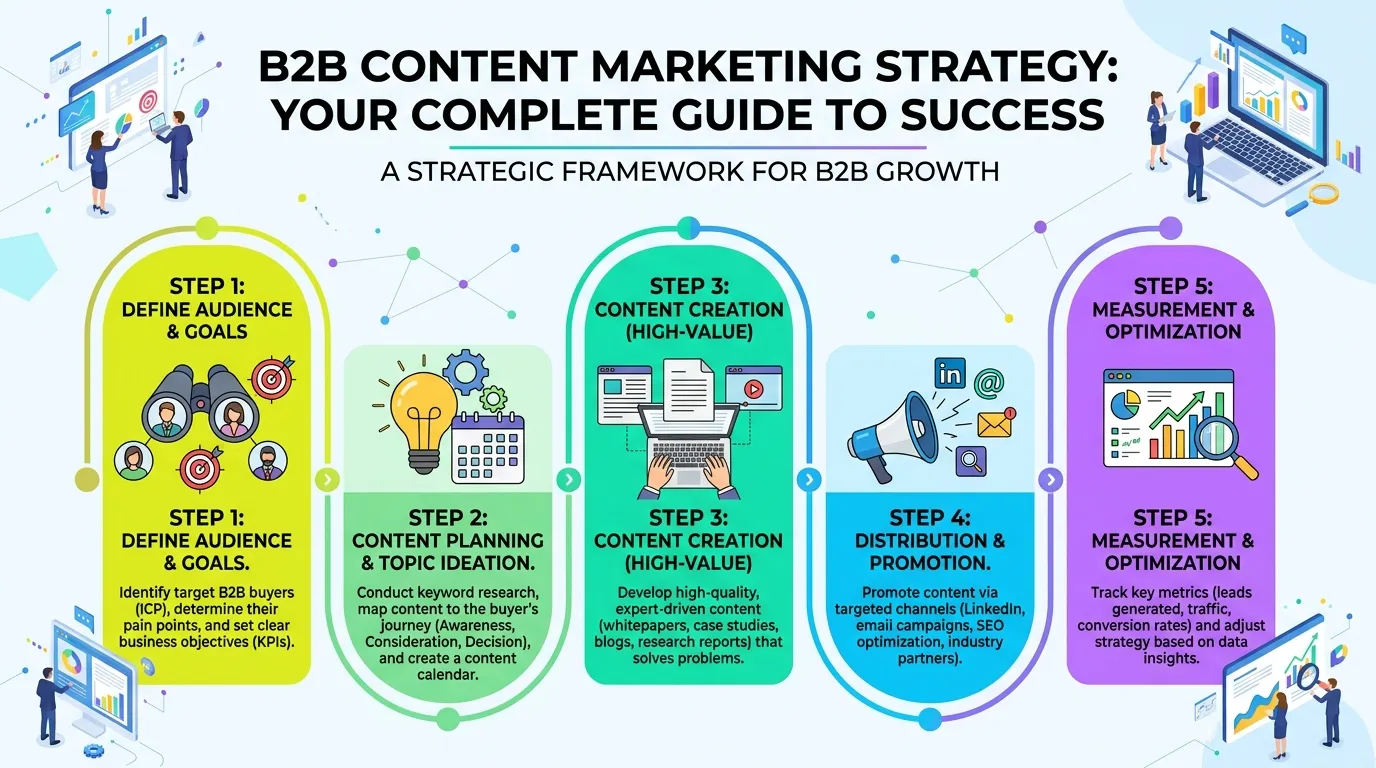
A successful content marketing strategy for B2B businesses is about much more than publishing blog posts regularly. B2B buyers usually spend considerable time researching products, comparing solutions, evaluating vendors, and discussing purchasing decisions with other stakeholders before they commit to a product or service. Because of this longer and more complex buying process, businesses need content that educates potential customers, answers their questions, builds trust, and guides them toward the right purchasing decision.
A well-developed B2B content marketing strategy helps companies attract relevant audiences through search engines, establish authority within their industry, generate qualified leads, and support the sales process. When content is created around customer needs and distributed through the right channels, it can become a long-term source of organic traffic and business growth.
This guide explains how businesses can create an effective B2B content strategy, develop a practical content marketing plan, use different content marketing tactics, build a content funnel, generate leads, and measure overall performance.
What Is a B2B Content Marketing Strategy?
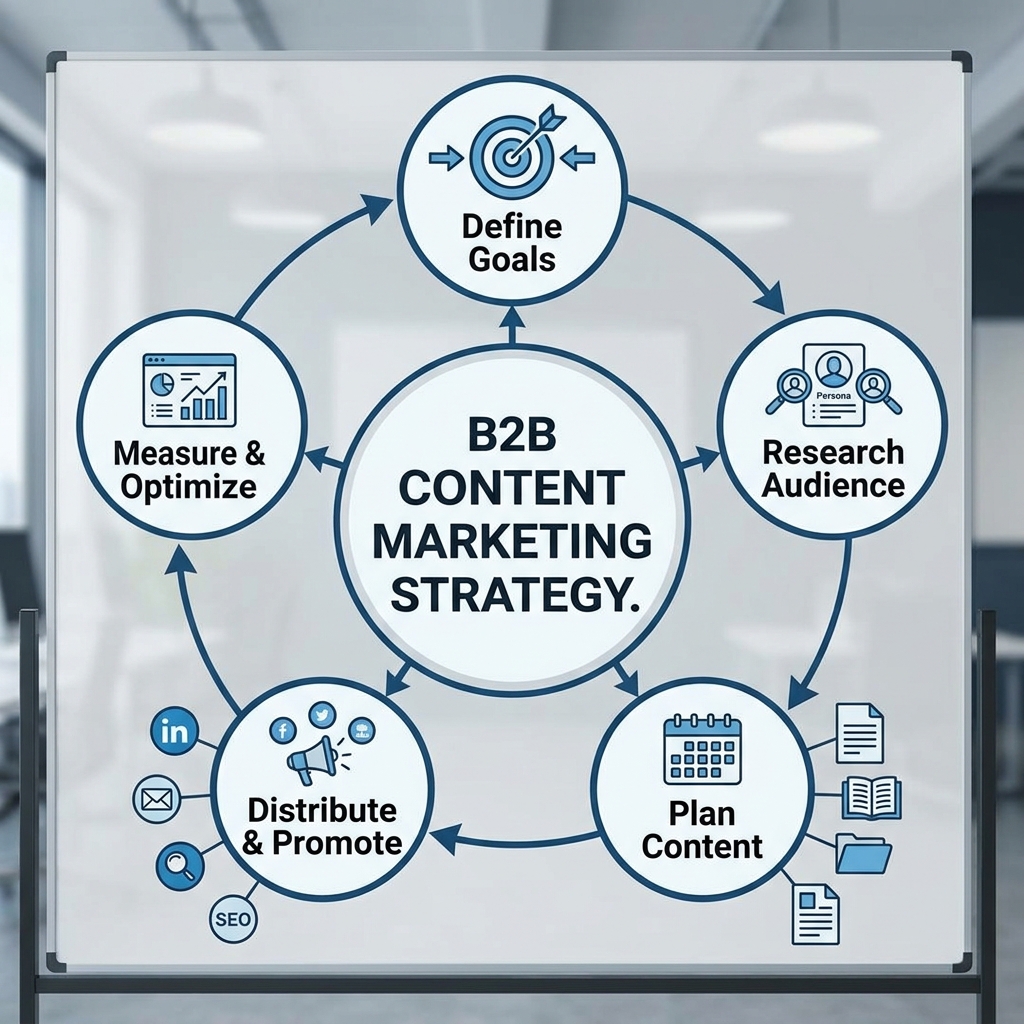
A B2B content marketing strategy is a structured approach to creating, publishing, distributing, and measuring content for a business audience. Its purpose is to attract potential customers, educate them about their challenges, demonstrate expertise, and eventually encourage them to take a valuable action, such as requesting a consultation, booking a product demonstration, downloading a resource, or making a purchase.
Unlike traditional advertising, content marketing does not always focus directly on selling a product. Instead, it provides useful information that helps prospects solve problems and make informed decisions. For example, a software company may publish an article explaining how to automate a particular business process. A reader who is experiencing that problem may discover the article through Google, learn about possible solutions, and eventually become interested in the software company’s product.
This approach is particularly valuable in B2B marketing because purchasing decisions often involve multiple stakeholders. A company may have executives concerned about costs, managers focused on productivity, and technical teams evaluating implementation. Content can address the concerns of each group and help move the entire buying committee toward a decision.
Why Is Content Marketing Important for B2B Businesses?
Content marketing is especially important for B2B companies because customers often research extensively before contacting a sales team. A potential buyer may visit several websites, read articles, watch videos, compare products, download reports, and look at customer reviews before deciding which vendors deserve consideration.
Businesses that provide helpful content during this research process have an opportunity to influence the buyer before a sales conversation even begins. Educational content can introduce a company to new prospects, while detailed guides and case studies can establish credibility and demonstrate expertise.
Content can also play an important role in improving customer relationships. Businesses can use educational resources, personalized content, and helpful communication to keep prospects engaged throughout the buying journey. For more insights, see How Inbound Marketing Increases Customer Engagement.
How to Create a Successful B2B Content Marketing Strategy
Creating an effective strategy starts with understanding what the business wants to accomplish. Without clear objectives, content production can become a process of publishing articles without knowing whether those articles are contributing to business growth.
Define Your Content Marketing Goals
The first step is to establish clear and measurable goals. A company may want to increase organic search traffic, generate more marketing-qualified leads, improve brand awareness, increase product demo requests, support a new product launch, or help the sales team convert more prospects.
The goals should be connected to broader business objectives. For example, if the company’s primary goal is increasing qualified leads, the content strategy should focus on topics that attract potential customers and provide clear opportunities for conversion. If the primary goal is building authority, the strategy may place greater emphasis on thought leadership, original research, expert insights, and industry analysis.
Having measurable goals also makes it easier to evaluate content performance later. Instead of simply asking whether a blog post received traffic, marketers can determine whether that traffic resulted in email subscriptions, leads, sales opportunities, or revenue.
Understand Your Target Audience
A successful B2B content strategy starts with a detailed understanding of the target audience. Businesses need to know who their ideal customers are, what problems they face, what goals they are trying to achieve, and what information they need before making a purchase.
Creating buyer personas can help marketers organize this information. For a B2B software company, for example, the decision-maker may be a marketing director, while the person researching technical requirements could be an IT manager. Both people may need different types of information before the purchase can move forward.
Understanding the audience also makes content more relevant. Instead of writing generic articles about an industry, marketers can create content that directly addresses the challenges their customers experience. This makes the content more useful and increases the likelihood that readers will continue engaging with the brand.
Conduct Keyword and Search Intent Research
Keyword research is an important part of B2B content marketing because it reveals the topics and questions potential customers are searching for online. However, keyword research should not be limited to finding terms with high search volume.
Marketers should also understand the intent behind each search. Someone searching for “what is CRM software” is probably looking for educational information, while someone searching for “best CRM software for small businesses” is likely comparing potential solutions.
Creating content that matches search intent improves the user experience and increases the likelihood of attracting qualified visitors. Businesses should target a mixture of informational, commercial, product-related, industry-specific, and long-tail keywords.
The primary keyword, content marketing strategy for B2B, can serve as the central topic, while related phrases such as B2B content marketing plan, B2B content strategy, and B2B content marketing funnel can support related sections of the content.
Develop a B2B Content Marketing Plan
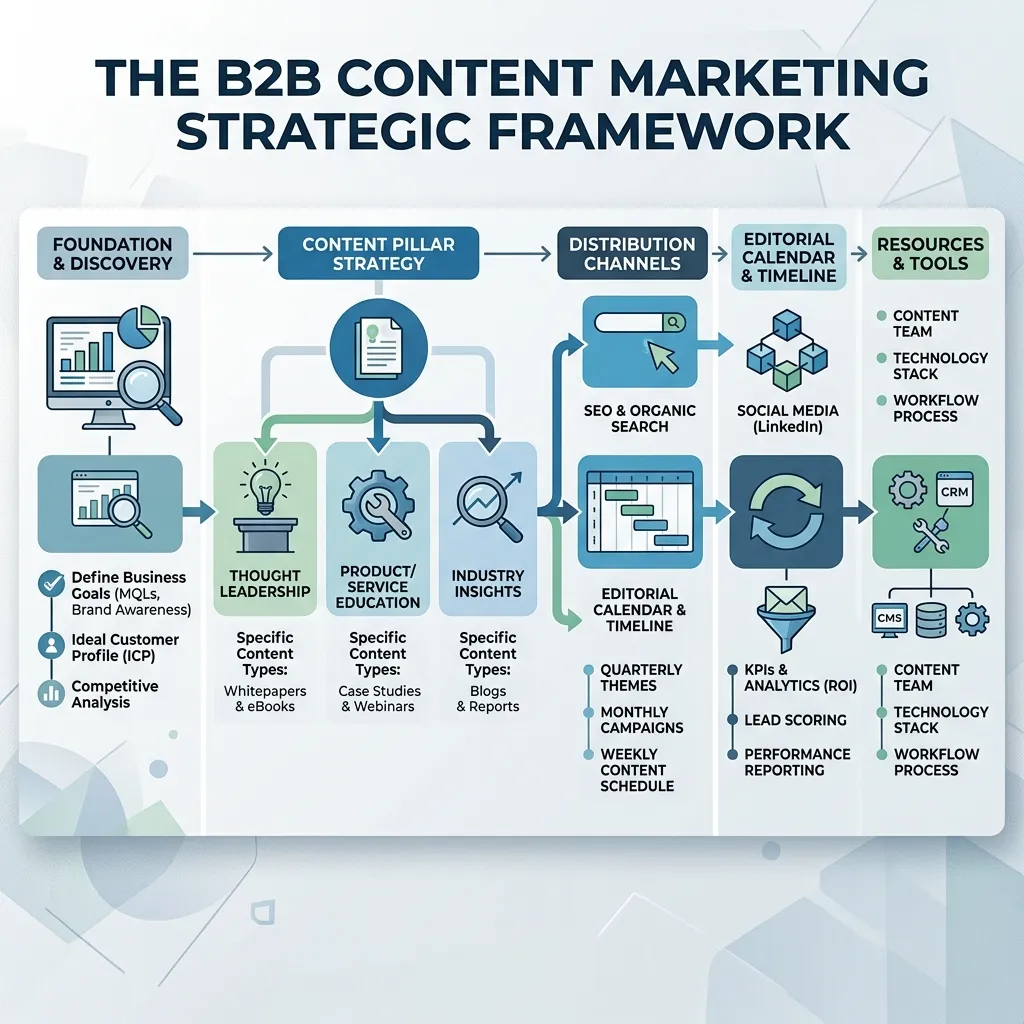
A B2B content marketing plan transforms the overall strategy into an actionable publishing process. It determines what content should be created, who it is intended for, which keywords and topics it will target, when it should be published, and how it will be distributed.
A good content plan should cover different stages of the buyer journey rather than focusing entirely on one type of article. For example, a company may publish educational blog posts to attract new visitors, detailed guides to educate prospects, case studies to demonstrate results, and product-focused content to support purchasing decisions.
The plan should also account for content updates. Existing articles can become outdated as statistics, technologies, products, and industry trends change. Reviewing and improving older content can often be more efficient than creating completely new articles.
Consistency is another important factor. A company does not necessarily need to publish content every day. What matters is creating useful content consistently and maintaining a publishing schedule that the marketing team can realistically manage.
Use Different B2B Content Marketing Tactics
Effective B2B content marketing tactics involve using multiple content formats and distribution channels instead of relying exclusively on blog posts. Different prospects consume information in different ways, so businesses should consider how their audience prefers to learn.
Blog content is particularly useful for SEO because it allows businesses to target informational and commercial search queries. However, long-form guides, case studies, webinars, videos, whitepapers, research reports, newsletters, and social media content can expand the reach of the overall strategy.
For example, a company could publish a detailed report about an industry challenge and then turn the report into several blog articles. The company could also discuss the findings in a webinar, create short social media posts from the key insights, and use the report as a lead-generation asset.
This process is known as content repurposing. It allows marketers to extract more value from high-quality research and content while reaching audiences across different platforms.
Build a B2B Content Marketing Funnel
The B2B content marketing funnel helps businesses create content that matches the buyer’s stage in the purchasing journey. Not every visitor is ready to buy immediately, so content should guide prospects gradually from awareness to consideration and finally to a purchasing decision.
At the awareness stage, prospects are usually trying to understand a problem or learn more about a particular topic. Educational blog posts, introductory guides, industry reports, videos, and informative articles are effective at this stage because they provide value without immediately pushing a product.
During the consideration stage, prospects have a better understanding of their problem and are researching possible solutions. They may want more detailed information about different approaches, technologies, or vendors. Comparison articles, webinars, ebooks, detailed guides, case studies, and solution-focused content can help them evaluate their options.
At the decision stage, prospects are much closer to making a purchase. They may want to understand pricing, implementation, product capabilities, expected results, and customer experiences. Product demonstrations, detailed case studies, ROI information, comparison pages, testimonials, and consultation offers can help remove uncertainty and encourage conversion.
A well-structured funnel ensures that prospects receive information that is relevant to their current needs rather than being presented with the same sales message at every stage.
Use Content for B2B Lead Generation
B2B lead generation through content works by providing valuable information in exchange for a prospect’s contact details or encouraging them to take another meaningful action.
For example, a business might publish a blog post explaining how to solve a common industry problem and then offer a more detailed downloadable guide at the end of the article. A visitor who wants additional information can submit a form to access the guide.
Other valuable lead-generation resources can include templates, checklists, industry reports, calculators, webinars, ebooks, and research studies. The important factor is relevance. The resource should provide additional value that naturally connects to the content the visitor has already consumed.
Lead generation becomes even more effective when the collected leads are nurtured with additional relevant content. Email campaigns can provide educational resources, product information, case studies, and invitations to webinars until the prospect becomes ready to speak with sales.
Create B2B Content Marketing Campaigns
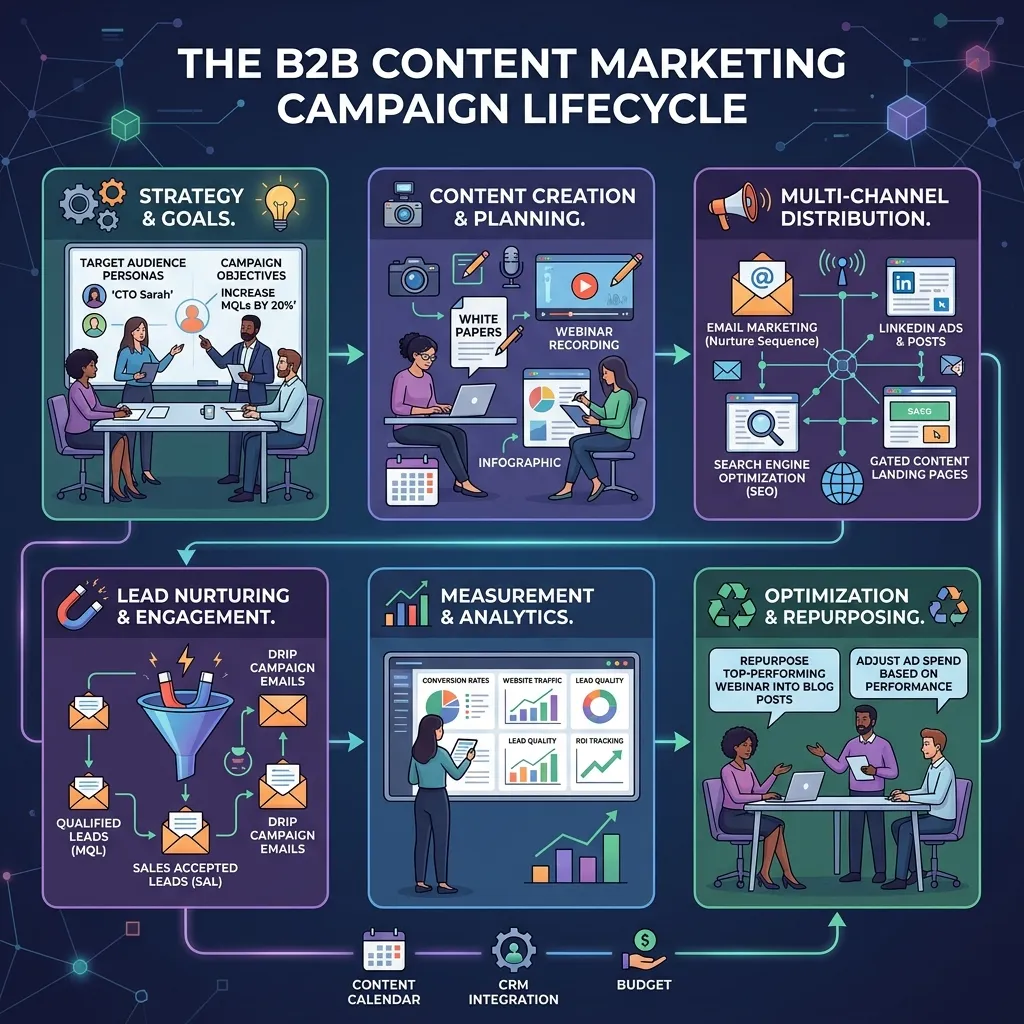
Individual content pieces can attract visitors, but coordinated B2B content marketing campaigns can create a stronger and more consistent marketing experience.
A campaign usually focuses on a particular business objective. This could be a product launch, a new industry report, a seasonal promotion, a specific customer problem, or an important industry trend.
For example, a B2B technology company launching a new software platform could create an educational guide explaining the problem the product solves. It could then publish supporting blog posts, create a webinar, develop a customer case study, send an email campaign, and publish social media content. All of these assets would support the same campaign objective.
For additional ideas on planning and executing campaigns, explore Effective Inbound Marketing Campaigns.
This integrated approach allows marketers to reach potential customers through multiple touchpoints while maintaining a consistent message.
Follow B2B Content Marketing Best Practices
Following B2B content marketing best practices helps businesses create content that provides genuine value instead of simply increasing the number of published pages.
One of the most important practices is to focus on customer problems. B2B buyers want information that helps them make better business decisions. Content should therefore answer real questions, explain complicated concepts clearly, and provide practical recommendations.
Another important practice is demonstrating genuine expertise. Businesses can strengthen their content by incorporating original research, expert opinions, real-world examples, customer experiences, and relevant data.
Content marketing should also work alongside a strong brand strategy. Consistent messaging, clear positioning, valuable content, and a recognizable brand identity can help businesses build credibility and strengthen relationships with their target audience. Businesses looking to improve their overall branding can also explore Proven Brand Development Strategies for practical approaches to building a stronger brand identity.
Quality should also be prioritized over quantity. Publishing several low-value articles every week is unlikely to produce sustainable results if those articles do not satisfy search intent or provide meaningful information. A smaller collection of comprehensive and useful resources can be more valuable.
Businesses should also optimize content for both search engines and humans. Keywords should be incorporated naturally, headings should make content easy to scan, internal links should connect related resources, and calls to action should guide readers toward useful next steps.
B2B Content Marketing Strategy Examples
Looking at B2B content marketing strategy examples can make the concept easier to understand.
A SaaS company could create educational content around the problems its software solves. It might publish SEO articles that attract users at the awareness stage, comparison guides for prospects evaluating solutions, and customer case studies for buyers who are close to making a decision.
A consulting company could build its strategy around thought leadership. Instead of focusing heavily on product promotion, it could publish industry research, expert analysis, executive guides, and webinars. This approach can help establish the company as a trusted source of professional knowledge.
A technology company could focus on technical education. It might create implementation guides, product tutorials, integration resources, webinars, and technical case studies. This content can help both decision-makers and technical teams understand the value and practicality of the solution.
The right strategy depends on the business model, target audience, sales cycle, industry, and purchasing process.
Measure and Improve Content Marketing Performance
A B2B content strategy should be measured continuously. Publishing content without tracking results makes it difficult to understand what works and where improvements are needed.
Organic traffic can show whether SEO content is attracting visitors, while keyword rankings can indicate how well pages are performing in search results. Engagement metrics can provide insight into whether visitors are actually consuming the content.
Businesses can also use inbound marketing analytics to better understand customer behavior, identify high-performing content, measure conversions, and make data-driven marketing decisions. For a deeper look at this topic, see How to Use Inbound Marketing Analytics.
However, B2B marketers should look beyond traffic. Lead conversions, demo requests, qualified leads, sales opportunities, and revenue are often more meaningful indicators of business impact.
Common B2B Content Marketing Mistakes
One common mistake is creating content without a clear strategy. Businesses sometimes publish articles simply because they have a list of keywords, without considering whether those topics are relevant to their customers or business goals.
Another mistake is focusing only on high-volume keywords. A keyword with thousands of monthly searches may attract a large audience but very few qualified buyers. More specific long-tail keywords can sometimes produce better business results because they reflect a clearer need.
Ignoring content distribution is another problem. Even excellent content needs promotion. Businesses should consider email marketing, social media, partnerships, industry communities, and other appropriate channels to reach their target audience.
Businesses should also avoid making every piece of content overly promotional. Prospects are more likely to trust content that educates them and helps solve their problems rather than content that constantly pushes a product.
Finally, failing to measure conversions can prevent businesses from understanding the real value of their content. Traffic and rankings are useful, but the ultimate objective should be connected to business outcomes.
Conclusion
A successful content marketing strategy for B2B businesses requires a customer-focused approach that combines SEO, useful content, strategic distribution, lead generation, and continuous measurement. Instead of simply publishing articles, businesses should create content that supports customers throughout their entire buying journey.
The process begins with understanding the target audience and defining clear business objectives. From there, marketers can conduct keyword research, develop a B2B content marketing plan, create valuable content, implement effective B2B content marketing tactics, and organize resources around a B2B content marketing funnel.
When businesses consistently provide useful information and connect that content to measurable business goals, content marketing can become a long-term source of qualified traffic, leads, customer trust, and revenue.
Frequently Asked Questions
What is a content marketing strategy for B2B?
A B2B content marketing strategy is a plan for creating and distributing useful content to attract prospects, build trust, generate leads, and support sales.
Why is B2B content marketing important?
B2B content marketing helps businesses attract potential customers, demonstrate expertise, improve search visibility, and build trust during the buying process.
What should a B2B content marketing plan include?
A B2B content marketing plan should include target audiences, goals, topics, keywords, content formats, publishing schedules, distribution channels, and performance metrics.
What are effective B2B content marketing tactics?
Effective tactics include SEO blogging, case studies, webinars, email marketing, thought leadership, ebooks, videos, research reports, and content repurposing.
How does a B2B content marketing funnel work?
A B2B content marketing funnel guides prospects through awareness, consideration, and decision stages using content suited to each stage of the buying journey.
How can content generate B2B leads?
Businesses can generate leads by offering valuable resources such as ebooks, templates, reports, webinars, and guides in exchange for visitor contact information.
What types of content work best for B2B companies?
Blog posts, case studies, whitepapers, webinars, ebooks, videos, research reports, comparison guides, and product demonstrations are effective B2B content formats.
How often should B2B businesses publish content?
B2B businesses should publish content consistently while prioritizing quality and relevance over publishing a large volume of low-quality content.
How long does B2B content marketing take to produce results?
Results vary, but SEO content often takes several months to gain significant visibility. Consistency, quality, competition, and promotion can affect the timeline.
How do you measure B2B content marketing success?
Measure success through organic traffic, rankings, engagement, conversions, qualified leads, demo requests, sales opportunities, and revenue.