
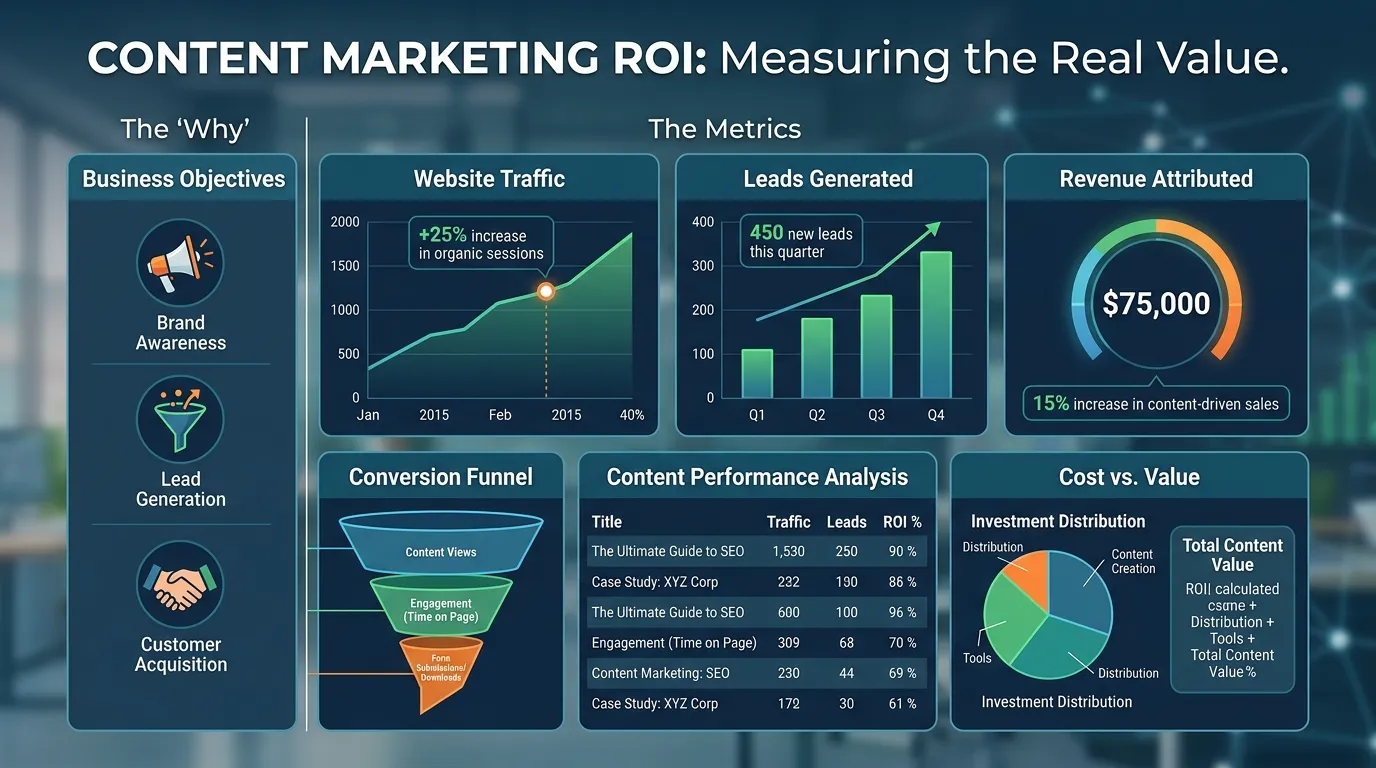
Content marketing ROI helps businesses understand the real value of their content investment. By measuring content performance, KPIs, conversions, and revenue, companies can identify successful strategies, improve results, and turn content into a valuable long-term business asset.
Content marketing ROI is one of the most important measurements for businesses investing in content creation and digital marketing. Companies spend considerable time and resources producing blog posts, landing pages, videos, case studies, social media content, ebooks, and other valuable materials. However, creating content is only part of the investment. Businesses also need to understand whether that investment is generating meaningful returns.
Unlike some forms of advertising, content marketing can produce results over a long period. A blog post may attract visitors months or even years after publication. An educational resource may generate leads long after the original campaign has ended. Because of this long-term nature, measuring content marketing return on investment requires more than looking at immediate sales.
Content marketing ROI connects the resources invested in content with the business value generated from that content. When measured correctly, it helps marketing teams understand which content contributes to traffic, engagement, leads, conversions, revenue, and customer relationships.
What Is Content Marketing ROI?
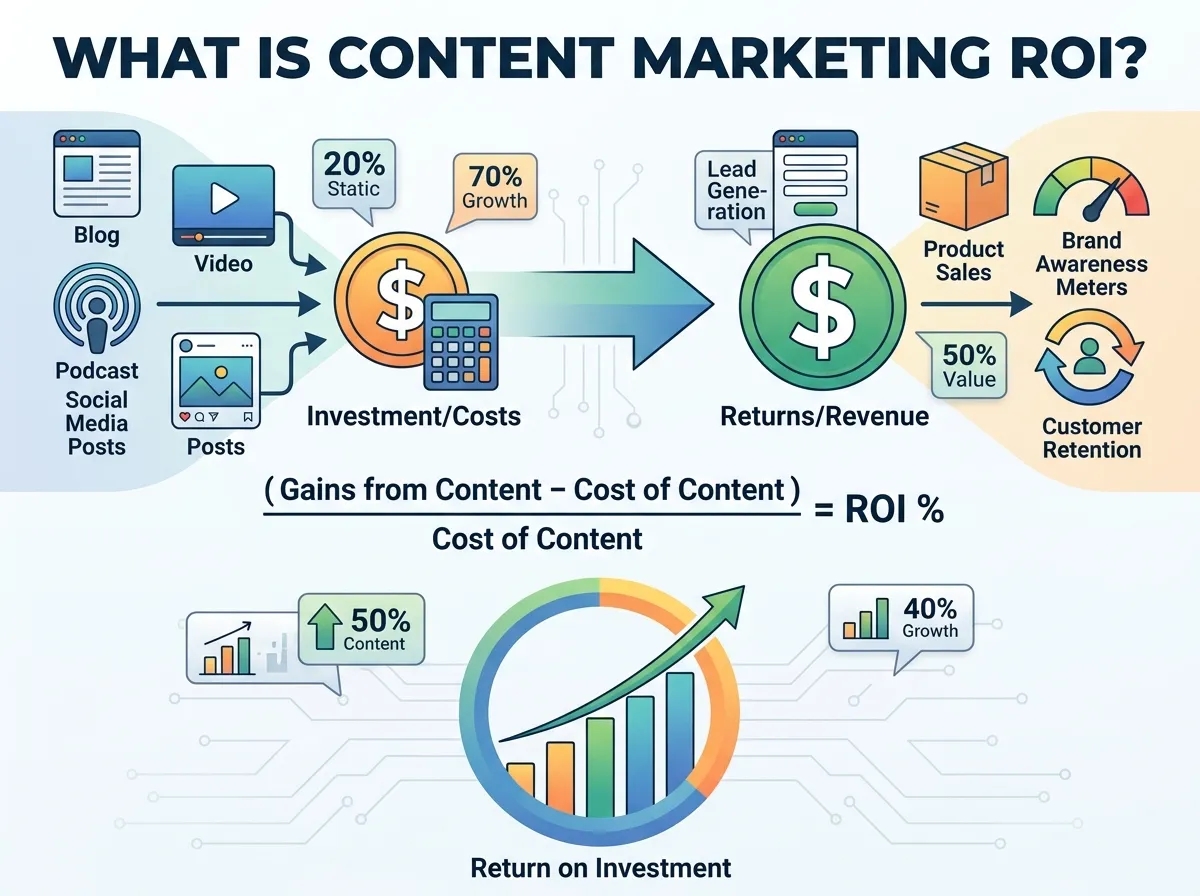
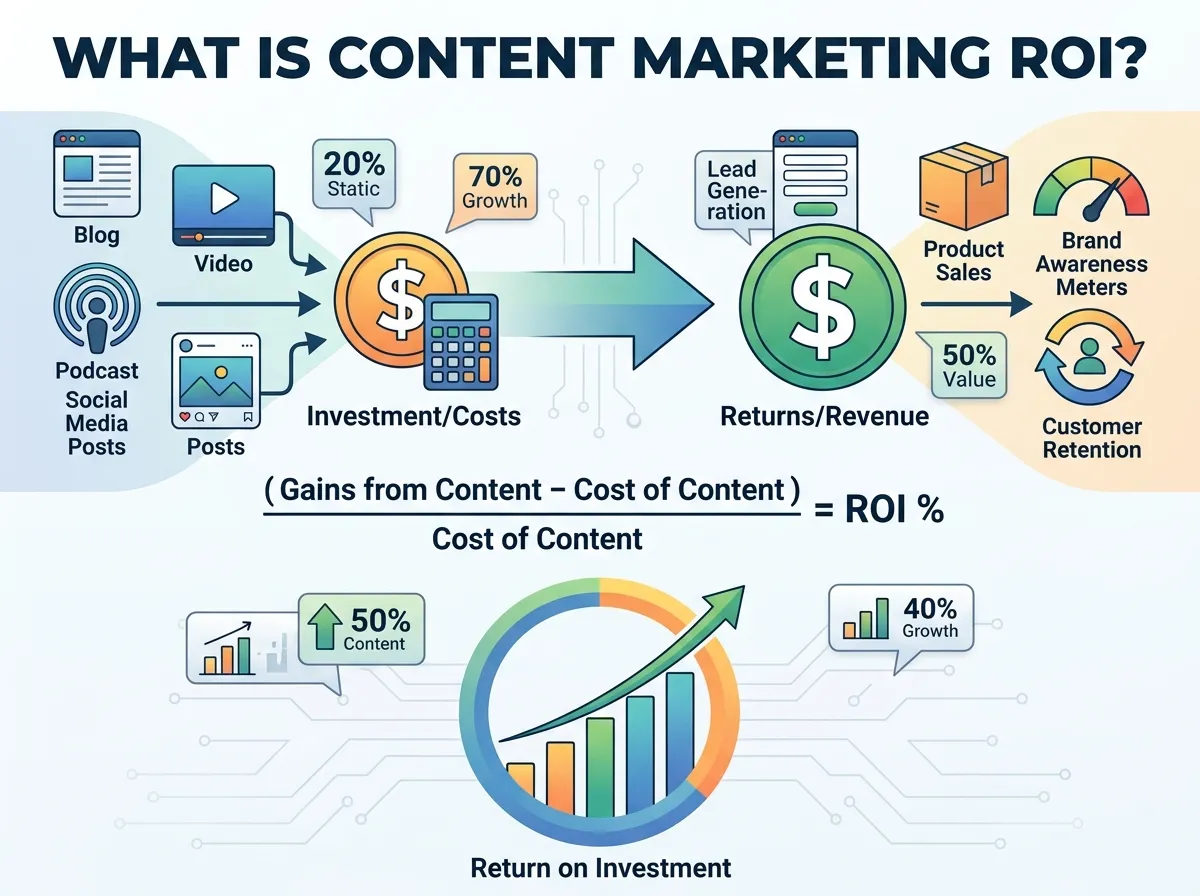
Content marketing ROI represents the financial or business return generated from content marketing compared with the cost of producing and promoting that content.
A simple ROI calculation compares the value generated by content with the investment required to create it. However, determining that value can be more complicated than calculating the performance of a single advertisement.
Content marketing often influences customers at different stages of the buying journey. Someone may first discover a company through a search-optimized blog post, return later after reading another article, download a resource, subscribe to an email list, and eventually become a customer.
If marketers only measure the final interaction, they may underestimate the contribution of content.
Content marketing return on investment should therefore consider both direct and indirect business outcomes. Revenue and conversions are important, but traffic quality, qualified leads, brand engagement, customer retention, and assisted conversions can also demonstrate content value.
Why Content Marketing ROI Matters
Understanding content marketing ROI allows businesses to determine whether their content investment is supporting broader business objectives.
Without measurement, content marketing can become focused on publishing volume rather than business results. A company may publish dozens of articles and receive significant traffic but generate very few qualified leads. Another company may publish fewer pieces but create content that attracts highly relevant prospects and produces substantial revenue.
ROI measurement provides a clearer picture of these differences.
It also helps marketing teams make better investment decisions. When marketers understand which topics, formats, channels, and campaigns generate the strongest results, they can allocate resources more effectively.
Content marketing ROI can also help demonstrate the value of marketing to executives and other stakeholders. Instead of reporting only how many articles were published or how much traffic the website received, marketers can connect content activity to measurable business outcomes.
Understanding Content Marketing Performance
Content marketing performance reflects how effectively content achieves its intended objectives. Those objectives can vary depending on the organization and the stage of the customer journey.
Some content is designed to attract organic search traffic. Other content may focus on generating leads, educating prospects, building brand authority, supporting sales conversations, or retaining existing customers. A strong inbound marketing relationship marketing framework can help businesses align content with customer needs and build stronger relationships throughout the buyer journey.
Because objectives differ, performance should not be judged by one universal metric.
A search-focused article may perform well because it generates consistent organic traffic and attracts relevant visitors. A case study may receive relatively little traffic but influence several high-value sales opportunities. A product comparison page may attract fewer visitors while producing a strong content marketing conversion rate.
Evaluating content based on its purpose provides a more accurate understanding of performance.
The Role of Content Marketing Metrics
Content marketing metrics provide the data needed to understand how audiences interact with content. Common metrics include page views, organic traffic, engagement, average engagement time, returning visitors, downloads, email subscriptions, leads, conversions, and revenue.
Traffic is often one of the first metrics marketers examine. While traffic can indicate that content is attracting attention, high traffic does not automatically mean high business value.
Traffic quality is more important than traffic volume alone. A page attracting thousands of visitors who have no interest in the company’s products may produce less value than a page attracting a smaller audience of highly relevant prospects.
Engagement metrics can provide additional context. If visitors spend meaningful time with an article, explore other pages, or interact with a resource, the content may be successfully supporting their research process.
The most useful metrics are therefore those that connect content activity with specific marketing and business objectives.
Using Content Marketing Analytics
Content marketing analytics brings together data from different sources to create a broader understanding of content performance.
Analytics platforms can show how visitors discover content, what pages they view, where they come from, how long they engage, and what actions they take afterward.
Search data can reveal which keywords bring visitors to content and whether organic visibility is increasing. Website analytics can show whether visitors move from informational articles to product or service pages. CRM data can help marketers determine whether content interactions are associated with qualified leads and customers.
Combining these sources is particularly important for understanding ROI.
A visitor may read a blog post without converting immediately. Several weeks later, that same person might return through a branded search and request a consultation. If marketers only attribute the conversion to the final search interaction, the earlier content’s influence could be overlooked.
Content marketing analytics helps reveal these relationships. Businesses can use inbound marketing tools and techniques to collect, organize, and analyze customer interactions across different stages of the marketing journey.
Content ROI Measurement and Attribution
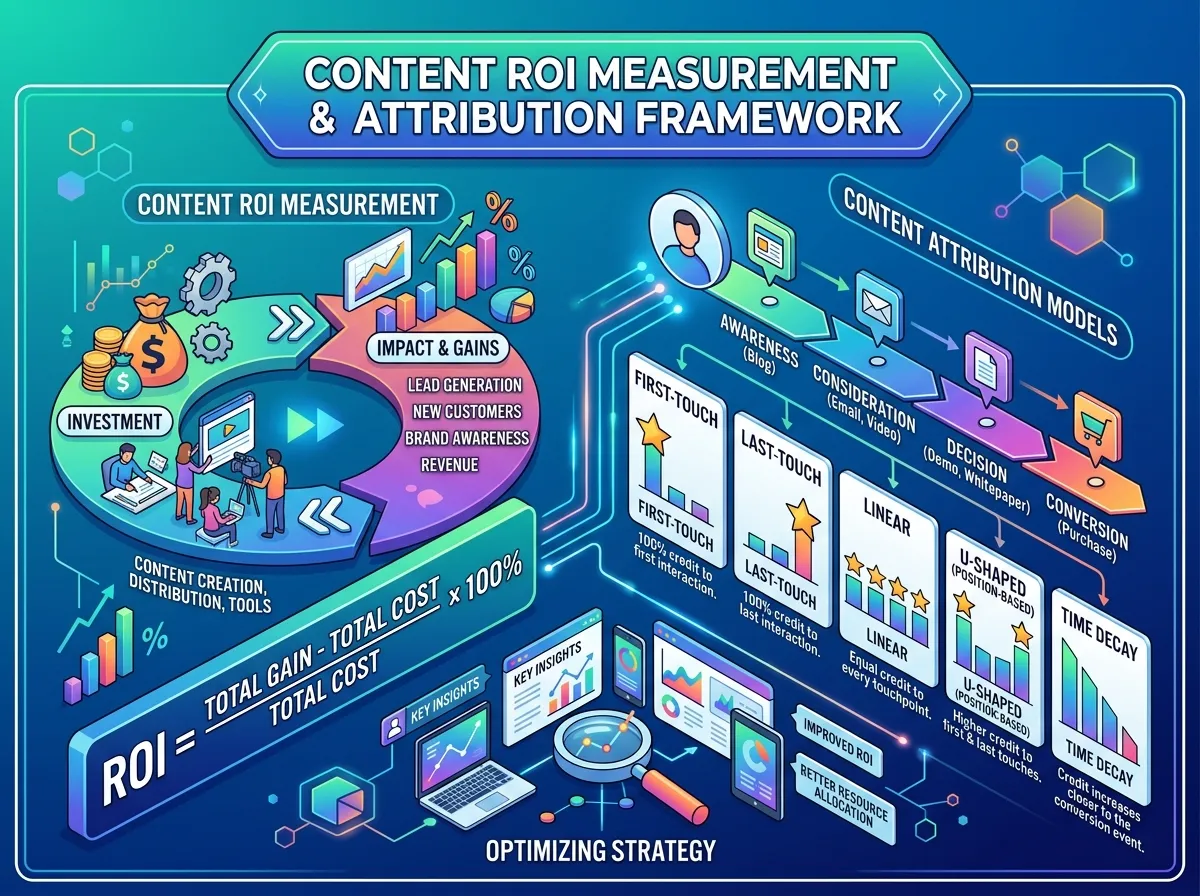
Content ROI measurement can become challenging because customers often interact with multiple pieces of content before converting.
Attribution models attempt to assign value to these different interactions. A first-touch model gives greater importance to the content that initially introduced the customer to the business. A last-touch model focuses on the interaction immediately before conversion.
Multi-touch approaches consider several interactions across the customer journey.
No single attribution model is perfect for every business. The appropriate approach depends on the sales cycle, customer journey, marketing channels, and available data.
For businesses with longer buying cycles, content may play an important role long before a customer becomes ready to purchase. In these cases, relying only on last-touch attribution can significantly underestimate content’s contribution.
Content ROI measurement becomes more useful when businesses combine attribution data with qualitative feedback and customer journey analysis.
Important Content Marketing KPIs
Content marketing KPIs are measurable indicators that help businesses evaluate whether content is moving toward defined objectives.
Traffic-related KPIs can help evaluate reach and visibility. Engagement KPIs can provide information about audience interest. Lead-generation KPIs can demonstrate whether content is attracting potential customers. Conversion and revenue KPIs connect content with direct business outcomes.
For example, a B2B company may consider qualified leads, demo requests, sales opportunities, and influenced revenue more important than total page views.
An ecommerce company may focus more heavily on product views, add-to-cart activity, purchases, and revenue generated by content visitors.
A media or publishing business might prioritize subscriptions, returning visitors, engagement, and advertising value. Understanding inbound marketing vs outbound marketing can also help businesses determine which marketing approach and performance indicators best support their overall strategy.
The right KPIs should therefore reflect the organization’s business model and content marketing objectives.
Content Marketing Effectiveness
Content marketing effectiveness depends on whether content produces meaningful outcomes for the intended audience and business.
Effective content addresses genuine customer questions and problems. It provides useful information, supports decision-making, and creates a reason for audiences to continue interacting with the brand.
Search visibility can increase content’s reach, but ranking alone does not guarantee effectiveness. Content needs to satisfy the user’s intent and provide enough value to encourage further engagement.
The relationship between quality and ROI is important. Well-researched, useful content may continue attracting relevant visitors for an extended period, creating a compounding return from the original investment.
Poor-quality content may require continuous promotion without generating equivalent results.
Measuring Content Marketing Success
Measuring content marketing success requires looking beyond individual pieces of content. A broader campaign or content library may generate value through multiple interactions.
For example, an educational article might introduce a prospect to a brand, a downloadable guide might capture their contact information, and a case study might help influence their purchase decision.
Each asset contributes differently to the customer journey.
Businesses should therefore evaluate both individual content performance and overall content ecosystem performance.
Content publishing consistency can also influence results. Search engines and audiences may need time to recognize and trust a growing content library. As more relevant content is created, businesses can develop stronger topical authority and increase opportunities to attract users at different stages of the buying process.
Content Marketing Conversion Rate
Content marketing conversion rate measures the percentage of users who complete a desired action after interacting with content.
The desired action depends on the content’s purpose. For an informational article, the conversion may be an email signup or resource download. For a product-focused page, it may be a purchase or consultation request.
Conversion rates can help marketers identify content that successfully moves users toward business objectives.
However, conversion rate should always be interpreted in context. A page with a lower conversion rate but very high-value leads may be more valuable than a page with a higher conversion rate but low-quality leads.
Conversion quality and revenue should therefore be considered alongside conversion volume.
Calculating Content Marketing Return on Investment
A basic content marketing ROI calculation compares the value generated by content with the total cost of the content investment.
Costs can include writer fees, editing, design, video production, research, SEO services, software, content management, promotion, advertising, and employee time.
Revenue can be measured directly when content interactions can be connected to purchases or sales opportunities. In other cases, marketers may use estimated lead values, influenced revenue, or other business-value models.
For example, suppose a company spends $5,000 creating and promoting content and attributes $15,000 in revenue to that content investment. The resulting return is $10,000 after accounting for the original investment, representing a positive ROI.
The exact calculation should reflect the organization’s attribution methodology and business model.
Long-Term Value of Content
One of the biggest advantages of content marketing is its potential to generate long-term value.
An advertisement generally stops producing traffic when the campaign ends or the budget is exhausted. A useful search-optimized article can continue attracting visitors without requiring the same level of ongoing investment.
This creates an opportunity for compounding returns.
A growing content library can attract new audiences, support internal linking, strengthen organic search visibility, and provide sales teams with resources they can share with prospects.
Evergreen content can be especially valuable because it remains relevant over an extended period. However, even evergreen content requires occasional review to ensure that information remains accurate and useful.
Improving Content Marketing Strategy ROI
Content marketing strategy ROI improves when content decisions are connected to audience needs and measurable business objectives.
Publishing content simply because competitors are doing so can create unnecessary costs. Businesses can generate stronger returns by identifying topics that align with customer intent, business expertise, search demand, and commercial opportunities.
Content distribution also affects ROI. A high-quality article may produce limited results if the intended audience never discovers it. Search optimization, email marketing, social distribution, partnerships, and other promotional channels can increase the reach of valuable content.
Repurposing content can also improve efficiency. A detailed article can become a video, newsletter, social post, presentation, or downloadable resource. This allows businesses to extend the value of existing research and production efforts.
The Relationship Between Content and Revenue
Connecting content with revenue is one of the most important goals of ROI measurement.
Content can influence revenue directly through purchases and indirectly by supporting lead generation and sales conversations.
In B2B marketing, the relationship may be especially complex because sales cycles can extend over months. A prospect may consume numerous resources before speaking with a salesperson.
In ecommerce, the path may be shorter, but content can still influence product discovery, trust, comparison, and purchase decisions.
Understanding these relationships helps marketers avoid treating content as an isolated publishing activity. Content becomes part of a larger revenue-generating system.
Challenges in Measuring Content Marketing ROI
Measuring content ROI is not always straightforward. Attribution gaps, disconnected marketing platforms, long sales cycles, offline interactions, and incomplete customer data can make it difficult to identify the exact contribution of individual content assets.
Another challenge is time. Content marketing often takes longer to produce meaningful results than paid advertising. A newly published article may require weeks or months to gain search visibility and attract a consistent audience.
This means businesses should avoid judging content solely on short-term performance.
Qualitative feedback can also provide valuable context. Sales teams may report that certain resources help close deals, while customers may mention specific articles that influenced their decision. These insights can complement quantitative data.
Building a More Valuable Content Program
A strong content program balances creativity with measurement. Content should be useful and engaging, but it should also have a clear relationship with business objectives.
Over time, performance data can reveal which subjects attract valuable audiences, which formats encourage engagement, and which assets contribute to conversions. A well-defined product branding strategy can also help businesses create content that supports product awareness and strengthens the connection between content and broader brand objectives.
This creates a feedback loop. Marketing teams can use insights from existing content to inform future topics and investments.
The result is a content strategy that becomes increasingly data-driven without becoming entirely dependent on numbers. Creativity, expertise, customer understanding, and analytical insight all play important roles.
Conclusion
Content marketing ROI provides a way to understand whether content investments are generating meaningful business value. By combining content marketing metrics, analytics, KPIs, conversion data, and revenue information, businesses can develop a clearer picture of content marketing performance.
Measuring content marketing success requires patience because content can influence customers across long and complicated journeys. A single blog post may introduce a customer to a brand, while several additional pieces of content may support the eventual conversion.
For this reason, content ROI measurement should consider both immediate and long-term outcomes. When businesses connect content creation with customer needs, measurable objectives, and revenue opportunities, content marketing becomes more than a publishing activity.
It becomes a strategic investment capable of producing lasting visibility, engagement, leads, customer relationships, and revenue.
Frequently Asked Questions About Content Marketing ROI
What is content marketing ROI?
Content marketing ROI measures the value generated from content marketing compared with the resources invested in creating, distributing, and promoting that content.
Why is content marketing ROI important?
Content marketing ROI helps businesses understand whether their content investments are producing meaningful results. It can also help marketing teams determine which content activities deserve greater investment.
How do you calculate content marketing ROI?
Content marketing ROI can be calculated by comparing the value generated by content with the total cost of producing and promoting it. The exact calculation depends on the company’s attribution and revenue model.
What are the most important content marketing metrics?
Important metrics can include organic traffic, engagement, leads, conversions, conversion rate, qualified opportunities, customer acquisition, and revenue. The most relevant metrics depend on the business objective.
What are content marketing KPIs?
Content marketing KPIs are measurable indicators used to evaluate whether content is achieving specific objectives. They can include traffic, engagement, lead generation, conversions, revenue, and customer retention metrics.
How does content marketing analytics help measure ROI?
Content marketing analytics connects audience behavior with content performance. It can show how users discover content, interact with it, and move toward conversions or other business outcomes.
What is content marketing conversion rate?
Content marketing conversion rate measures the percentage of content visitors who complete a desired action, such as signing up for an email list, downloading a resource, requesting a consultation, or making a purchase.
How long does it take to see content marketing ROI?
The timeline varies by industry, content type, competition, website authority, distribution strategy, and customer journey. Search-focused content can take several months to build momentum, while some conversion-focused content may produce results sooner.
Can content marketing generate direct revenue?
Yes. Content can generate direct revenue when users make purchases after interacting with content. It can also contribute indirectly by generating leads, supporting sales conversations, increasing trust, and influencing purchasing decisions.
How can businesses improve content marketing strategy ROI?
Businesses can improve content marketing strategy ROI by creating content around customer needs and business objectives, measuring meaningful KPIs, improving distribution, updating valuable existing content, and connecting content performance with leads, conversions, and revenue.