
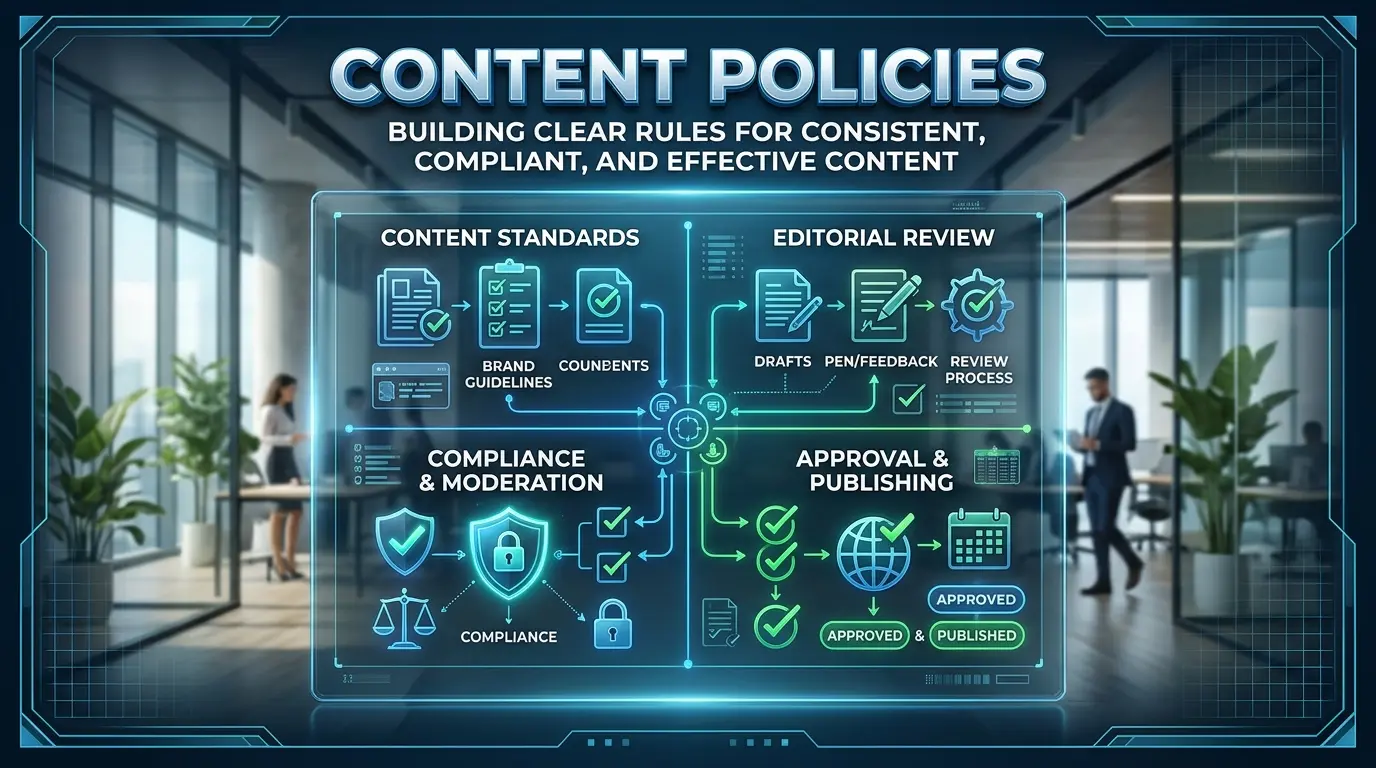
Content policies help businesses maintain consistency, quality, accuracy, and responsibility across their content activities. By establishing clear expectations for content creation, review, approval, moderation, and publishing, organizations can protect their brand identity while reducing communication risks. This article explores how effective content policies support marketing teams, improve collaboration, strengthen content compliance, and create a more reliable publishing environment.
Why Content Policies Matter in Modern Marketing
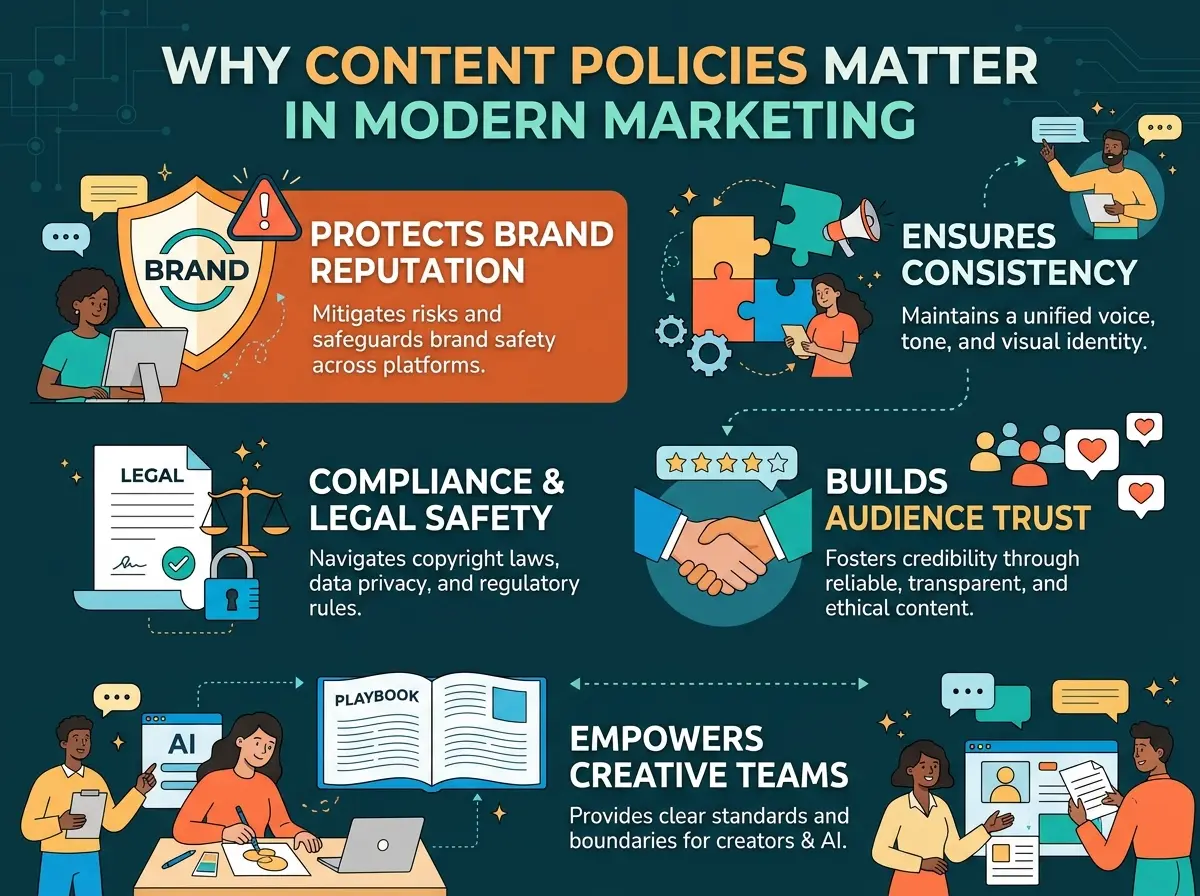
Content has become one of the most important ways businesses communicate with customers, establish credibility, and build lasting relationships. From website articles and social media posts to email campaigns, videos, and promotional materials, every published message contributes to how audiences understand a brand. However, maintaining quality across different platforms and communication channels requires more than creative ideas. Businesses need a clear system that determines what can be published, how information should be presented, and who is responsible for reviewing it.
This is where Content Policies become important. They establish the expectations and boundaries that guide how an organization creates, manages, approves, and distributes information. Rather than allowing every department to follow its own approach, businesses can use documented policies to maintain a consistent communication standard.
Without clear policies, content teams may publish conflicting messages, use inaccurate information, overlook legal requirements, or communicate in ways that do not reflect the company’s values. These problems can gradually affect customer confidence and create unnecessary operational difficulties.
Effective policies also make content production more organized. When employees understand the organization’s expectations, they can make better decisions during the creation process instead of waiting for repeated corrections from managers. This creates a healthier working relationship between writers, editors, marketing professionals, and other stakeholders.
Content policies should not limit creativity or make communication unnecessarily complicated. Their purpose is to provide a reliable foundation where creative work can develop while remaining accurate, responsible, and aligned with business objectives.
Understanding the Main Elements of a Content Policy
A strong content policy brings several important areas of communication under one coordinated structure. Each element addresses a different part of the content lifecycle, helping businesses maintain quality without creating unnecessary restrictions.
Content guidelines establish the general direction for communication. They explain the preferred writing style, tone of voice, language, formatting, and presentation standards. For example, a company may prefer professional but approachable language across its website and social media platforms. These expectations help different writers produce content that feels connected, even when they work independently.
Content standards focus more closely on the quality of published material. They may cover factual accuracy, originality, readability, source verification, and brand consistency. When these standards are clearly documented, editors have a reliable way to evaluate content instead of depending entirely on personal preferences.
Content rules establish specific expectations about acceptable communication. They may address copyright protection, misleading claims, confidential information, inappropriate language, and the use of customer information. These rules help employees understand which practices are acceptable and which could create problems for the organization.
Another important element is content compliance. Businesses operating in regulated industries may need to follow advertising requirements, privacy obligations, industry regulations, and platform-specific policies. Compliance expectations should be reflected in the content process so that important requirements are considered before publication rather than after an issue appears.
Together, these elements create a foundation for responsible communication. They also make it easier for organizations to explain their expectations to new employees, external writers, agencies, and other content contributors.
How Content Policies Improve Brand Consistency
Brand consistency depends on more than using the same logo, colors, or visual design. The language a business uses, the information it shares, and the way it responds to customers also influence its identity.
When multiple departments create content without shared expectations, their communication can become disconnected. A social media team might use a casual tone, while the website presents the company as highly formal. Sales materials may communicate benefits differently from the information published by the marketing department. Although each individual message might be acceptable, the overall experience can feel inconsistent.
Well-developed content policies help prevent this problem by establishing a shared communication direction. Writers and marketers can understand the company’s preferred terminology, messaging priorities, audience expectations, and approach to sensitive subjects.
This consistency becomes particularly valuable when businesses expand into new markets or introduce additional communication channels. New contributors can follow established expectations without having to interpret the brand identity independently.
Organizations that already maintain structured Content Operations can connect their policies with everyday production activities. This creates a more coordinated environment where content planning, creation, editing, and publishing follow the same organizational expectations.
The result is not identical content across every platform. Instead, businesses maintain a recognizable identity while allowing communication to adapt to different audiences and formats.
Establishing an Effective Content Approval Process
Content approval is an important part of policy management because even well-written material may require additional review before publication. A marketing article, for instance, could contain an outdated statistic, an unsupported product claim, or information that requires confirmation from another department.
An effective approval process identifies who is responsible for reviewing different types of material. Writers may complete the initial draft, editors may evaluate structure and readability, and subject specialists may verify technical information. Legal or compliance professionals can become involved when content contains regulated claims or sensitive information.
However, approval should not become an unnecessarily complicated process. Requiring too many people to review ordinary content can slow production and create confusion about responsibility. Businesses should distinguish between routine materials and publications that carry greater reputational, legal, or commercial risks.
For example, a general educational article may only require editorial review, while a financial promotion could need additional verification before publication. This approach allows teams to allocate attention according to the nature of the content.
Clear approval responsibilities also reduce repeated revisions. When contributors understand what reviewers expect, they can prepare more complete drafts and address potential problems earlier.
Most importantly, the final approval decision should have an identifiable owner. This prevents situations where several employees assume someone else has already checked the material.
Content Restrictions and Responsible Publishing Decisions

Every organization needs to determine which types of information are appropriate for public communication. Content restrictions establish boundaries around material that could create legal, ethical, reputational, or operational concerns.
These restrictions may cover confidential business information, copyrighted material, unsupported product claims, discriminatory language, misleading advertisements, and the unauthorized use of customer data. Organizations may also restrict employees from sharing internal documents, private communications, or information that has not been approved for public release.
The challenge is to establish reasonable boundaries without preventing useful communication. Overly broad restrictions can make employees hesitant to share legitimate information, while unclear restrictions can leave room for inconsistent decisions.
A practical approach is to explain why certain information requires special handling. Employees should understand the difference between publicly available information, internal business material, confidential records, and information that requires permission before publication.
Content moderation also contributes to responsible communication, particularly when businesses allow comments, customer submissions, community discussions, or user-generated content. Organizations need a consistent approach to identifying spam, abusive language, misleading statements, and other material that violates their published expectations.
These decisions become easier when moderation responsibilities and escalation procedures are already established. Instead of responding differently to similar situations, teams can use shared policies to make fair and consistent decisions.
The Role of Content Regulations in Business Communication
Content regulations can influence how organizations advertise products, communicate with customers, collect information, and present commercial claims. Depending on the business and its operating locations, these requirements may involve privacy laws, consumer protection rules, intellectual property rights, advertising standards, and industry-specific obligations.
For example, a business collecting personal information through a website must consider applicable privacy requirements when explaining how that information is used. Similarly, companies promoting products or services should ensure that their claims are accurate and not misleading.
These responsibilities make it important to connect content policies with the organization’s wider compliance practices. Marketing teams should not be expected to interpret every legal requirement independently. Instead, businesses can establish clear procedures for identifying content that needs specialist review.
Regulatory expectations can also change over time. New legislation, updated platform requirements, and changes in industry practices may affect previously approved communication materials. Consequently, content policies should be reviewed periodically rather than treated as permanent documents.
Organizations can strengthen this process by assigning responsibility for monitoring relevant changes. When a policy needs updating, affected departments should receive clear information about what has changed and how the new expectations apply to their work.
This helps businesses reduce avoidable mistakes while maintaining confidence in their public communication.
Connecting Content Policies With Content Strategy
Policies become more valuable when they support the broader direction of a company’s content strategy. They should not exist separately from audience research, editorial planning, search visibility, and business objectives.
For example, a company developing a topic-based publishing strategy needs to maintain consistency across related articles. Different writers may cover connected subjects, but their work should use accurate terminology, provide relevant information, and avoid unnecessary duplication.
A structured Content Marketing Topic Clusters approach can support this objective. By organizing related subjects around broader themes, businesses can establish clearer editorial relationships between individual publications. Content policies then help maintain quality, consistency, and appropriate messaging throughout those connected topics.
Policies also influence how teams select sources, use statistics, reference external research, and communicate product information. These expectations are especially important when multiple contributors are responsible for building a large content library.
Another consideration is communication across different platforms. A website article, email newsletter, social media update, and promotional landing page may require different presentation styles. However, each should reflect the same underlying brand values and accuracy standards.
Businesses can connect these expectations with their Communication Channels Strategy to create a more consistent experience across customer touchpoints. This makes content policies part of a wider communication structure rather than an isolated editorial document.
Managing Content Policies Across Different Teams
Content policy management becomes more challenging as an organization grows. A small business may have only a few people responsible for writing and publishing, whereas a larger company may involve marketing departments, sales teams, external agencies, product specialists, and regional offices.
When these contributors work independently, maintaining shared expectations requires an organized management structure. Businesses need to make policies accessible, explain their purpose, and ensure that employees understand how the rules apply to their responsibilities.
Centralized documentation can make this process easier. Instead of distributing separate instructions through emails or individual documents, organizations can maintain a shared resource containing their latest content expectations. Employees can refer to it when preparing new materials or resolving questions about publication decisions.
Regular communication is equally important. New employees and external contributors should receive an introduction to relevant policies before they begin producing content. Existing team members should also be informed when significant changes are introduced.
Technology can support this process through editorial platforms, content management systems, approval workflows, and collaboration tools. These systems can help teams track revisions, identify responsible reviewers, manage publishing permissions, and maintain records of important decisions.
However, software alone cannot guarantee responsible communication. Employees still need to understand the reasoning behind organizational policies and apply good judgment when unusual situations arise.
A successful management approach combines accessible documentation, clear ownership, regular communication, and practical tools.
Measuring the Effectiveness of Content Policies
Businesses should evaluate whether their content policies are actually improving communication and production quality. Having a documented policy does not automatically mean employees follow it or that it produces meaningful results.
One useful measurement is the frequency of content corrections. If published materials regularly require changes because of inaccurate information, inconsistent messaging, or overlooked requirements, the existing policies or review procedures may need improvement.
Approval time can provide another useful indication. When content takes too long to receive approval, organizations may have unclear responsibilities, unnecessary review stages, or conflicting expectations between departments.
Businesses can also examine compliance-related issues, moderation decisions, publication delays, and the number of revisions required before content is ready.
These measurements become more meaningful when connected to broader business performance. For example, Content Marketing ROI helps organizations evaluate how content activities contribute to measurable marketing outcomes. Although policies do not directly generate revenue, they can improve the reliability and consistency of the content supporting those activities.
Qualitative feedback should also be considered. Writers may identify confusing instructions, editors may notice recurring quality problems, and managers may recognize approval bottlenecks that are not immediately visible through numerical reporting.
By reviewing both operational data and employee feedback, organizations can identify where policies are working and where adjustments are necessary.
Common Problems Businesses Should Avoid
Even organizations with established content policies can experience difficulties when those policies are poorly designed or inconsistently applied.
One common problem is creating policies that are too complicated. Long documents filled with technical language can discourage employees from reading or using them. Important expectations may become difficult to identify, particularly when contributors need quick answers during content production.
Another issue is treating every publication as if it carries the same level of risk. A routine blog article and a sensitive corporate announcement do not necessarily require identical approval procedures. Applying excessive controls to ordinary content can reduce productivity without providing meaningful additional protection.
Outdated policies are another concern. Business communication changes as companies introduce new services, enter different markets, and adopt additional platforms. A policy that once reflected the organization’s needs may eventually become irrelevant or incomplete.
Some businesses also focus heavily on restrictions without explaining acceptable alternatives. Employees may understand what they cannot publish but remain uncertain about how to communicate the same information responsibly.
Finally, inconsistent enforcement can weaken the entire system. If certain employees follow strict review procedures while others publish without oversight, the organization may struggle to maintain consistent standards.
Avoiding these problems requires a practical approach. Policies should be understandable, relevant to actual business activities, regularly reviewed, and applied consistently across appropriate teams.
The Future of Content Policies in an AI-Driven Environment

The growing use of artificial intelligence is introducing new considerations for content management. Businesses increasingly use AI tools to research subjects, generate drafts, summarize information, edit articles, and create promotional materials.
While these technologies can improve production efficiency, they also introduce questions about originality, factual accuracy, intellectual property, privacy, and human accountability.
Organizations should establish clear expectations regarding the use of AI-generated content. These expectations may explain which tools employees can use, what information should never be entered into external systems, when human verification is necessary, and who remains responsible for the final publication.
Fact-checking is particularly important because AI-generated material can contain inaccurate information or present uncertain statements with confidence. Editorial teams should verify important claims and review references before approving content.
Businesses should also consider whether certain types of content require human-written explanations, additional disclosure, or specialist review based on their industry and applicable requirements.
Another developing area is content moderation. Automated systems can help identify spam, abusive language, and potentially inappropriate submissions, but complex decisions may still require human judgment.
As technology evolves, content policies will need to become more adaptable. Rather than focusing only on individual tools, businesses should establish principles that remain useful when their technology and production methods change.
Building a Sustainable Content Policy Framework
The long-term value of content policies comes from their ability to support everyday communication without creating unnecessary administrative pressure. Businesses should treat them as working organizational resources that develop alongside their content operations.
A sustainable framework connects editorial expectations, quality standards, approval responsibilities, compliance requirements, and publishing practices. Each area should have a clear purpose and should contribute to the organization’s overall communication objectives.
Leadership also plays an important role. When managers follow established expectations and support responsible publishing decisions, employees are more likely to take policies seriously. This creates a culture where quality and accountability become shared responsibilities rather than tasks assigned only to editors.
It is equally important to leave room for improvement. Teams should be able to report unclear requirements, suggest better review procedures, and identify emerging risks. This feedback helps organizations maintain policies that reflect their actual working environment.
Ultimately, effective content policies provide businesses with a reliable foundation for producing trustworthy information. They protect brand identity, improve collaboration, support regulatory responsibilities, and help organizations communicate with greater confidence.
As content becomes an increasingly important part of business growth, companies that establish clear and adaptable policies will be better positioned to maintain quality across every channel.
Frequently Asked Questions (FAQs)
1. What are content policies?
Content policies are documented rules and expectations that explain how an organization creates, reviews, approves, manages, and publishes content. They help maintain communication quality, brand consistency, and responsible publishing practices.
2. Why are content policies important for businesses?
They help businesses reduce communication risks, maintain consistent messaging, protect confidential information, improve collaboration, and ensure that published materials meet organizational expectations.
3. What should a content policy include?
A content policy should generally cover writing standards, brand voice, content quality, copyright requirements, privacy considerations, approval responsibilities, publishing rules, and moderation procedures.
4. How do content guidelines differ from content policies?
Content guidelines usually provide recommendations about writing style, tone, formatting, and presentation. Content policies establish broader organizational expectations, including mandatory rules, restrictions, and compliance responsibilities.
5. Who is responsible for managing content policies?
Responsibility may be shared between marketing managers, content managers, editors, compliance professionals, and department leaders. Organizations should assign clear ownership to ensure policies remain updated and consistently applied.
6. How does content approval improve publishing quality?
Content approval allows responsible reviewers to check accuracy, readability, brand alignment, and compliance before publication. It helps identify potential problems early and reduces the likelihood of publishing unsuitable material.
7. What are content restrictions?
Content restrictions identify information or communication practices that should not be published without appropriate authorization. They may cover confidential information, copyrighted material, misleading claims, and inappropriate content.
8. How often should content policies be updated?
Businesses should review their policies regularly and whenever significant changes occur in regulations, company operations, communication channels, or technology. The review frequency should reflect the organization’s industry and risk level.
9. How do content policies support SEO?
Content policies support SEO by encouraging originality, factual accuracy, consistent terminology, appropriate sourcing, and reliable editorial practices. These standards help businesses create more useful and trustworthy website content.
10. Can content policies apply to AI-generated content?
Yes. Businesses can establish rules for AI-assisted writing, fact-checking, originality, data privacy, human review, and publication responsibility. These policies help employees use AI tools more responsibly.