
nbound Marketing Sales Handoff Criteria establish when and how qualified leads should move from marketing teams to sales representatives. By defining lead requirements, qualification standards, scoring systems, and acceptance conditions, businesses can improve marketing and sales alignment, reduce communication gaps, and create more effective conversion opportunities.
When Does a Marketing Lead Become a Sales Opportunity?
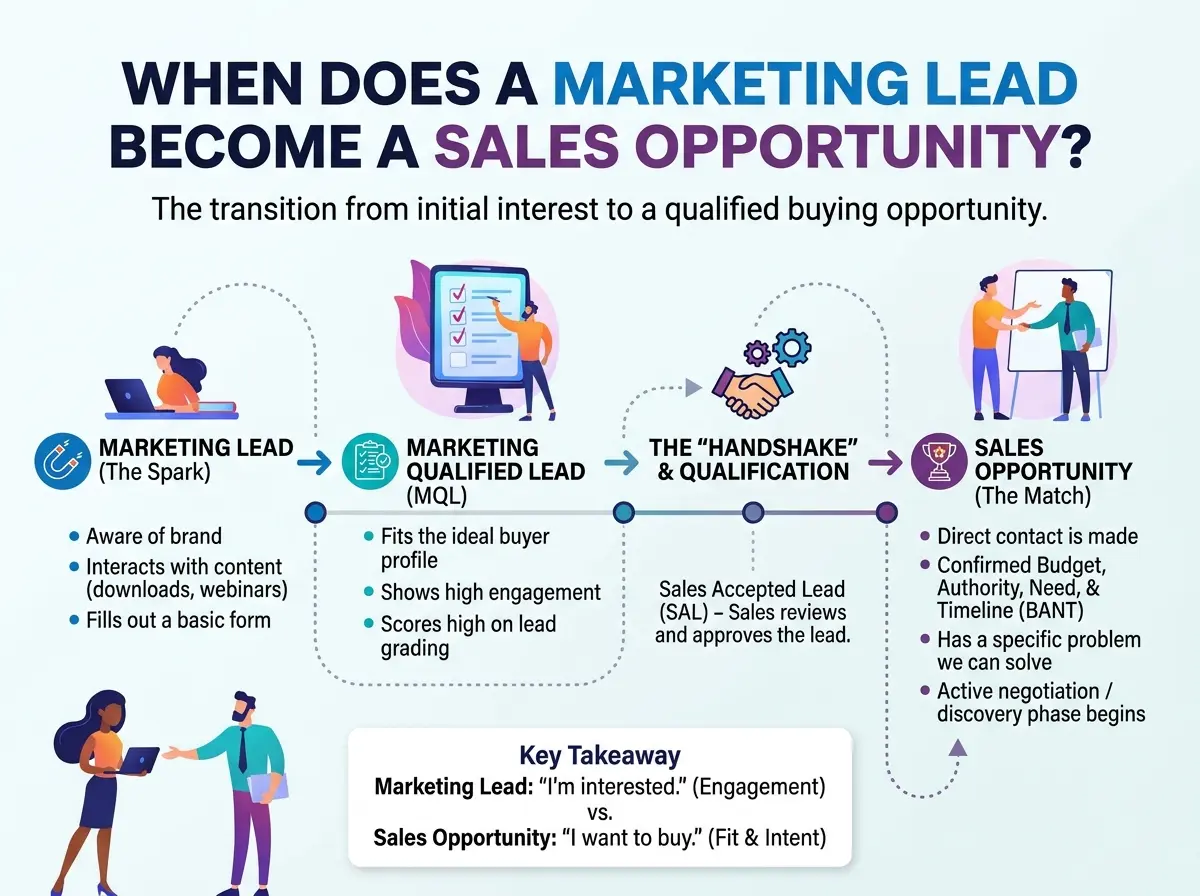
Generating leads is an important part of inbound marketing, but not every person who interacts with a business is ready to speak with a sales representative. Someone might download a resource, subscribe to a newsletter, visit a pricing page, or attend a webinar without having an immediate intention to purchase. Treating every interaction as a sales opportunity can overwhelm sales teams and create unnecessary communication with potential customers.
This is where Inbound Marketing Sales Handoff Criteria become important. They establish the conditions that determine when a lead has progressed beyond general interest and is ready for direct sales engagement. Instead of relying on assumptions or inconsistent decisions, marketing and sales teams work with shared expectations about lead quality, buying interest, and readiness.
A well-defined handoff process also helps businesses understand the difference between engagement and genuine purchasing potential. A lead who regularly reads educational articles may be interested in a subject, while someone requesting a product demonstration may have a more immediate commercial requirement.
Recognizing these differences allows businesses to connect prospects with the appropriate team at the right stage of their decision-making journey.
The Difference Between Lead Activity and Sales Readiness
Inbound marketing generates interactions across multiple channels. Website visits, email engagement, content downloads, social media interactions, and event registrations can all indicate interest in a company’s offerings. However, these activities do not carry equal commercial value.
For example, a visitor downloading an introductory industry report may simply be researching a topic. Another visitor who downloads a pricing comparison and requests a consultation could be evaluating potential solutions.
The distinction becomes clearer when businesses examine their Lead Handoff Requirements. These requirements identify the information and engagement signals that should be present before a prospect is transferred to sales.
Common considerations include the prospect’s business role, company information, industry relevance, identified challenges, purchasing interest, and previous interactions with marketing content.
The purpose is not to demand extensive personal information from every prospect. Instead, businesses need enough relevant context to determine whether a conversation with sales would be useful.
A successful handoff should provide sales representatives with more than a contact name and email address. It should explain why the lead has been considered suitable for further engagement and what information may help the representative begin a meaningful conversation.
Marketing Qualified Leads and Their Commercial Significance
A Marketing Qualified Lead (MQL) represents a prospect who has demonstrated sufficient interest and relevance to receive additional attention from the marketing team. However, the definition of a qualified lead varies according to business objectives, customer profiles, and product complexity.
Marketing Qualified Lead Criteria commonly combine demographic or firmographic information with behavioral engagement. A prospect may fit the company’s target audience, demonstrate interest in relevant products, and interact with content that indicates a developing business need.
For instance, a software company targeting medium-sized businesses may consider company size, industry, job responsibilities, and product-related engagement when evaluating MQL status.
However, marketing qualification should not automatically trigger a sales conversation. Some MQLs are still exploring available solutions and need additional educational content before they are ready to discuss commercial options.
This is where targeted content becomes valuable. Relevant Inbound Marketing Lead Magnets can attract prospects who are interested in specific business problems while providing useful information that supports the qualification process.
A well-designed lead magnet can also reveal the subjects that matter most to a prospect. Someone downloading an advanced comparison resource may demonstrate a different level of interest from someone accessing a general introductory guide.
When marketing teams interpret these signals together, they can distinguish between general engagement and more developed buying interest.
Sales Qualified Lead Standards: Evaluating Genuine Opportunities
An MQL becomes more valuable when its characteristics indicate that a sales conversation could produce a meaningful business outcome. This is where Sales Qualified Lead Standards become relevant.
A Sales Qualified Lead (SQL) has been evaluated as a suitable candidate for direct sales engagement. The assessment generally considers whether the prospect has a relevant business requirement, an appropriate level of interest, and a reasonable connection to the company’s target customer profile.
Sales qualification may involve reviewing the prospect’s current challenges, expected outcomes, purchasing timeline, decision-making responsibilities, and potential budget.
Not every business uses the same standards. A company selling affordable business software may qualify prospects differently from an enterprise technology provider dealing with complex purchasing decisions and multiple stakeholders.
The distinction between MQL and SQL is important because it creates a shared understanding of progression. Marketing identifies relevant engagement and potential interest, while sales evaluates whether the opportunity deserves direct commercial attention.
When both departments agree on these standards, fewer leads are transferred simply because they have accumulated website visits or email interactions.
Why the Lead Qualification Process Needs Shared Definitions
One of the most common sources of disagreement between marketing and sales is the meaning of a qualified lead. Marketing may consider a prospect valuable because of strong content engagement, while sales may reject that same prospect because the company is too small or the purchasing requirement is unclear.
A consistent Lead Qualification Process reduces this confusion by establishing common evaluation standards.
Both departments should understand which characteristics indicate a suitable prospect and which signals suggest that further nurturing is necessary. These definitions should reflect actual customer behavior and the company’s sales experience rather than assumptions about what makes someone interested.
For example, a prospect who repeatedly visits a service page may demonstrate interest, but their company profile and business requirements still need consideration. Similarly, a decision-maker who requests a consultation may be highly relevant even without extensive previous engagement.
Effective qualification combines multiple signals instead of depending on one activity.
Businesses can also improve qualification through different Inbound Marketing Techniques, including educational content, targeted campaigns, relevant landing pages, and personalized communication. These approaches help attract prospects whose interests are more closely connected to the company’s offerings.
As qualification becomes more consistent, marketing teams can focus on attracting suitable audiences while sales representatives spend more time evaluating genuine opportunities.
Marketing to Sales Alignment Is a Business Requirement
Marketing and sales alignment is not simply about maintaining communication between two departments. It directly influences how efficiently a business manages customer interest and converts potential demand into revenue.
Marketing to Sales Alignment requires both teams to understand their responsibilities, performance expectations, and shared revenue objectives.
Marketing teams are responsible for generating relevant demand and developing prospect engagement. Sales teams evaluate opportunities, understand purchasing requirements, and manage commercial conversations. The handoff connects these responsibilities.
Without alignment, marketing may prioritize the number of leads generated, while sales focuses on the number of opportunities that become customers. These different priorities can create conflicting expectations.
A shared qualification framework provides a more balanced approach. Marketing can evaluate lead quality alongside campaign performance, while sales can provide feedback about the relevance and readiness of transferred prospects.
Regular communication also helps identify changes in customer behavior. If sales representatives consistently report that certain leads lack purchasing authority, marketing can review its targeting and qualification criteria.
Likewise, when marketing discovers that particular content attracts prospects with strong conversion potential, sales can use that information to improve its conversations.
This shared approach makes the entire customer acquisition process more connected and measurable.
Lead Scoring Criteria and the Value of Behavioral Signals
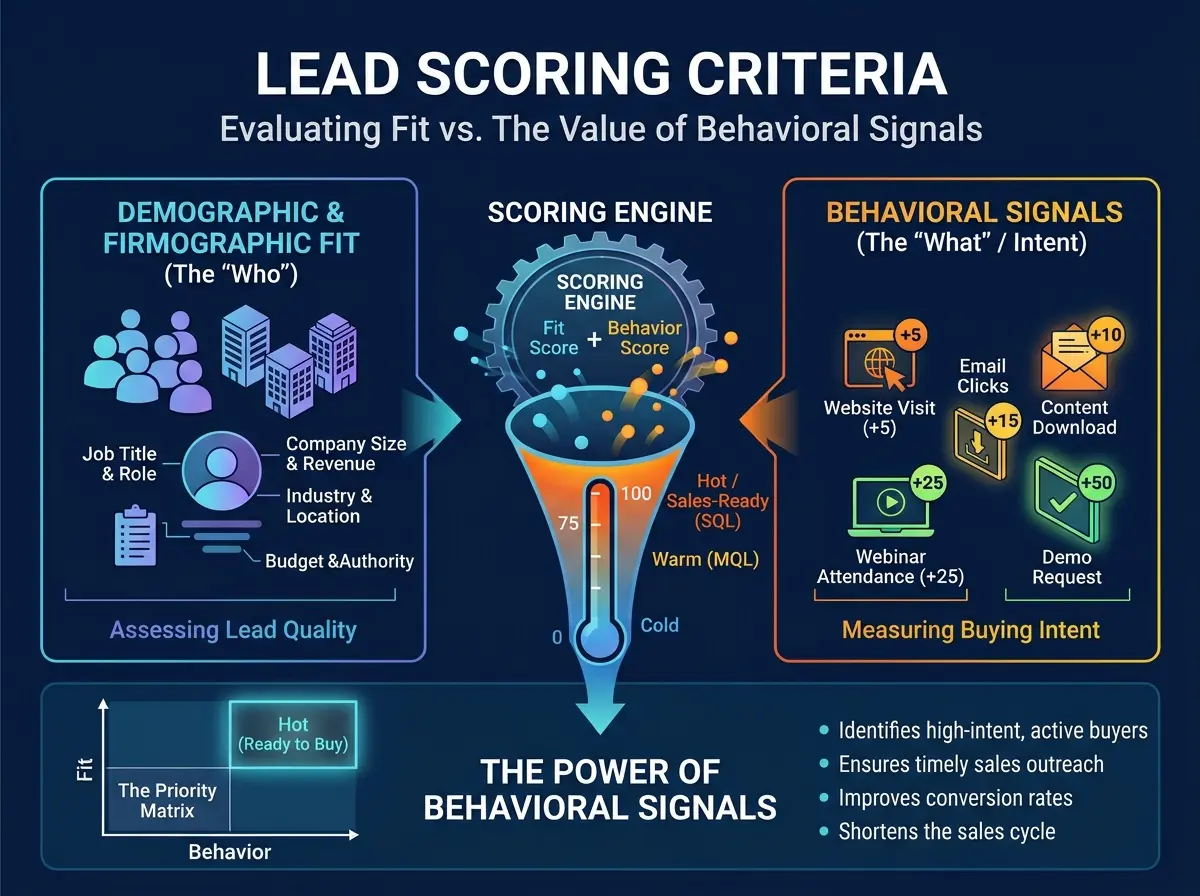
Lead scoring helps businesses assign numerical values to prospect characteristics and interactions. It provides a structured way to evaluate which leads deserve additional attention and which should remain within marketing communication programs.
Lead Scoring Criteria may include company size, job position, industry, website activity, email engagement, content downloads, event participation, and interactions with product-related pages.
However, scoring systems should distinguish between different types of activity. A single newsletter click should not necessarily carry the same importance as a request for a product demonstration.
For example, a prospect who matches the target customer profile and repeatedly visits pricing information may receive a higher score than someone who has only subscribed to a newsletter.
Negative signals can also be useful. An irrelevant industry, an unsuitable company size, or an invalid contact record may reduce a lead’s qualification value.
A scoring model becomes more effective when it reflects actual conversion patterns. Businesses can review historical sales data to identify which characteristics frequently appear among successful customers.
Automation can support this process by updating lead scores as prospects interact with marketing channels. However, automated scores should not replace human judgment when important business context is missing.
The objective is to make qualification more consistent while ensuring that sales representatives receive leads with meaningful commercial potential.
Lead Transfer Guidelines and the Importance of Context
A qualified lead can still become a missed opportunity if the transfer between departments is incomplete or delayed. Sales representatives need enough information to understand the prospect’s background without repeating questions that marketing has already answered.
Effective Lead Transfer Guidelines establish what information should accompany a lead when it moves between teams.
This information may include contact details, company background, lead source, relevant content interactions, expressed business challenges, qualification status, and previous communication.
Context is particularly important for prospects who have engaged with several marketing channels. A person who attended a webinar, downloaded a technical resource, and later requested a consultation has demonstrated a different journey from someone who completed a single registration form.
Sharing these interactions allows sales representatives to personalize their initial communication.
The transfer should also identify why the lead meets the agreed qualification requirements. This makes the handoff more transparent and helps sales understand the marketing activity that influenced the prospect’s interest.
A reliable transfer process reduces unnecessary back-and-forth communication and provides a smoother experience for potential customers.
Sales Readiness Assessment and the Right Moment to Engage
Sales readiness is not always determined by the number of interactions a prospect has completed. It is more closely connected to whether the prospect has a relevant requirement and is prepared to consider a business solution.
A Sales Readiness Assessment examines the available evidence of purchasing interest, business suitability, and potential timing.
Some prospects demonstrate strong readiness through direct actions, such as requesting a consultation, asking about pricing, or submitting a product inquiry. Others may show interest through repeated research without indicating an immediate purchasing decision.
Sales readiness also depends on the complexity of the product or service. A small business purchasing a simple subscription may make a decision relatively quickly, while an enterprise customer may require internal discussions, budget approval, technical evaluation, and stakeholder involvement.
Marketing teams should therefore avoid treating every highly engaged prospect as immediately sales-ready.
When a lead is not ready for direct engagement, continued nurturing can help address unanswered questions and develop stronger interest. Personalized emails, educational resources, and relevant product information can support this process without creating unnecessary pressure.
Automation platforms can make these interactions more consistent. A well-planned Inbound Marketing Automation Tools Guide to Boost Efficiency can provide useful context for understanding how automated workflows, lead management, and communication systems support this transition.
The Sales Handoff Process and Accountability After Transfer
The Sales Handoff Process should not end when a marketing team assigns a lead to a sales representative. It needs a clear outcome so that both departments understand what happens after the transfer.
Sales teams should review incoming leads, evaluate their suitability, and record whether they have accepted or rejected the opportunity. When a lead is rejected, the reason should be documented rather than communicated through informal comments.
Possible rejection reasons include insufficient purchasing intent, an unsuitable company profile, incomplete information, duplicate records, or incorrect qualification.
This feedback helps marketing identify weaknesses in its targeting and qualification methods.
Lead ownership also matters. Every transferred lead should have a clear responsible representative or sales team. Without ownership, prospects may receive delayed responses or no meaningful follow-up.
Businesses using multiple automation platforms should ensure that information remains consistent across their systems. The connection between marketing and sales technologies is particularly important when organizations combine different Marketing Automation Tools for Inbound and Outbound Efforts.
When data, ownership, and feedback are properly coordinated, the handoff becomes an accountable business process rather than a simple change in lead status.
Lead Acceptance Criteria and Continuous Improvement
Lead Acceptance Criteria define the conditions under which sales representatives agree to take responsibility for a transferred prospect.
These conditions should reflect the company’s target audience, qualification standards, and commercial objectives. A lead may be accepted because it matches the ideal customer profile, demonstrates relevant interest, and has a clear business requirement.
However, acceptance should not depend entirely on automated scoring. Sales representatives may discover important details during an initial conversation that were not available to the marketing team.
Similarly, a prospect with a high engagement score may still be unsuitable because the business requirement does not match the company’s services.
Tracking acceptance and rejection rates helps businesses understand how effectively their qualification criteria work.
If a large percentage of transferred leads are rejected for similar reasons, the problem may involve inaccurate targeting, unclear MQL definitions, or insufficient information during the handoff.
If accepted leads consistently progress into commercial opportunities, the qualification framework may be producing stronger results.
Businesses should review these patterns regularly and update their standards as customer expectations, products, and market conditions change.
Measuring the Impact of a Better Sales Handoff Structure

The performance of a sales handoff framework should be evaluated through more than the total number of leads transferred. Businesses need to understand whether those leads create meaningful sales opportunities and contribute to revenue.
Several measurements can provide useful insight, including MQL-to-SQL conversion rates, sales acceptance rates, lead response times, opportunity creation rates, and lead-to-customer conversion rates.
For example, a company might generate a high volume of MQLs but experience a low acceptance rate from its sales department. This could indicate that marketing is attracting visitors who show general interest but do not match the target customer profile.
Another business might transfer fewer leads but achieve stronger opportunity creation because its qualification standards are more closely connected to actual purchasing requirements.
Response time is another important factor. Delays between lead transfer and sales engagement can reduce the value of timely customer interest, particularly when prospects are actively comparing different providers.
Regular performance reviews allow both departments to identify these issues and improve their shared processes.
The goal is not simply to transfer more leads. It is to create a reliable connection between marketing engagement and sales opportunities.
Conclusion: Turning Qualified Leads Into Meaningful Sales Opportunities
A strong handoff framework creates consistency between the activities that generate customer interest and the processes that convert that interest into business relationships.
Inbound Marketing Sales Handoff Criteria help organizations define qualification standards, establish sales readiness, organize lead transfers, and clarify the responsibilities of marketing and sales teams.
When these expectations are shared, businesses can reduce unqualified transfers, improve lead management, and give sales representatives better information about potential customers.
The most effective approach combines meaningful lead scoring, relevant engagement data, clear acceptance conditions, and continuous feedback. Rather than treating the handoff as an isolated administrative activity, organizations should view it as an essential connection within the broader inbound marketing and customer acquisition process.
Ultimately, better alignment allows marketing and sales teams to focus on the same objective: turning relevant customer interest into valuable and sustainable business growth.
Frequently Asked Questions About Inbound Marketing Sales Handoff Criteria
1. What are Inbound Marketing Sales Handoff Criteria?
Inbound Marketing Sales Handoff Criteria are the agreed conditions that determine when a marketing-generated lead is ready to be transferred to a sales team. They typically consider lead quality, audience suitability, engagement, and purchasing interest.
2. What are the most important lead handoff requirements?
Important requirements include accurate contact information, a suitable customer profile, relevant engagement history, identified business needs, and a clear qualification status. These details help sales representatives understand the prospect before making contact.
3. What is the difference between an MQL and an SQL?
A Marketing Qualified Lead has demonstrated relevant interest and engagement through marketing activities. A Sales Qualified Lead has been evaluated as suitable for direct sales engagement based on stronger commercial relevance and purchasing readiness.
4. Why is the lead qualification process important?
The lead qualification process helps businesses distinguish between general audience interest and genuine sales opportunities. It reduces unnecessary transfers and allows sales representatives to prioritize prospects with stronger conversion potential.
5. How does marketing to sales alignment improve conversions?
Marketing to sales alignment creates shared expectations about lead quality, qualification, ownership, and follow-up. This reduces communication gaps and helps both teams focus on generating and converting relevant opportunities.
6. What should lead transfer guidelines include?
Lead transfer guidelines should include contact information, company details, lead source, engagement history, qualification status, expressed needs, and relevant communication records.
7. What are lead scoring criteria?
Lead scoring criteria are the characteristics and behaviors used to assign values to prospects. Common factors include company profile, job position, website activity, content engagement, and direct product inquiries.
8. How can businesses evaluate sales readiness?
Businesses can evaluate sales readiness by examining purchasing interest, business requirements, decision-making authority, company suitability, and engagement with commercial content or sales-related offers.
9. What are lead acceptance criteria?
Lead acceptance criteria are the standards sales teams use to decide whether a transferred lead is suitable for further engagement. These standards commonly reflect target customer profiles, business relevance, and qualification requirements.
10. How can businesses improve their sales handoff process?
Businesses can improve their sales handoff process by establishing shared qualification definitions, maintaining accurate lead information, assigning clear ownership, improving response times, and reviewing sales feedback regularly.