
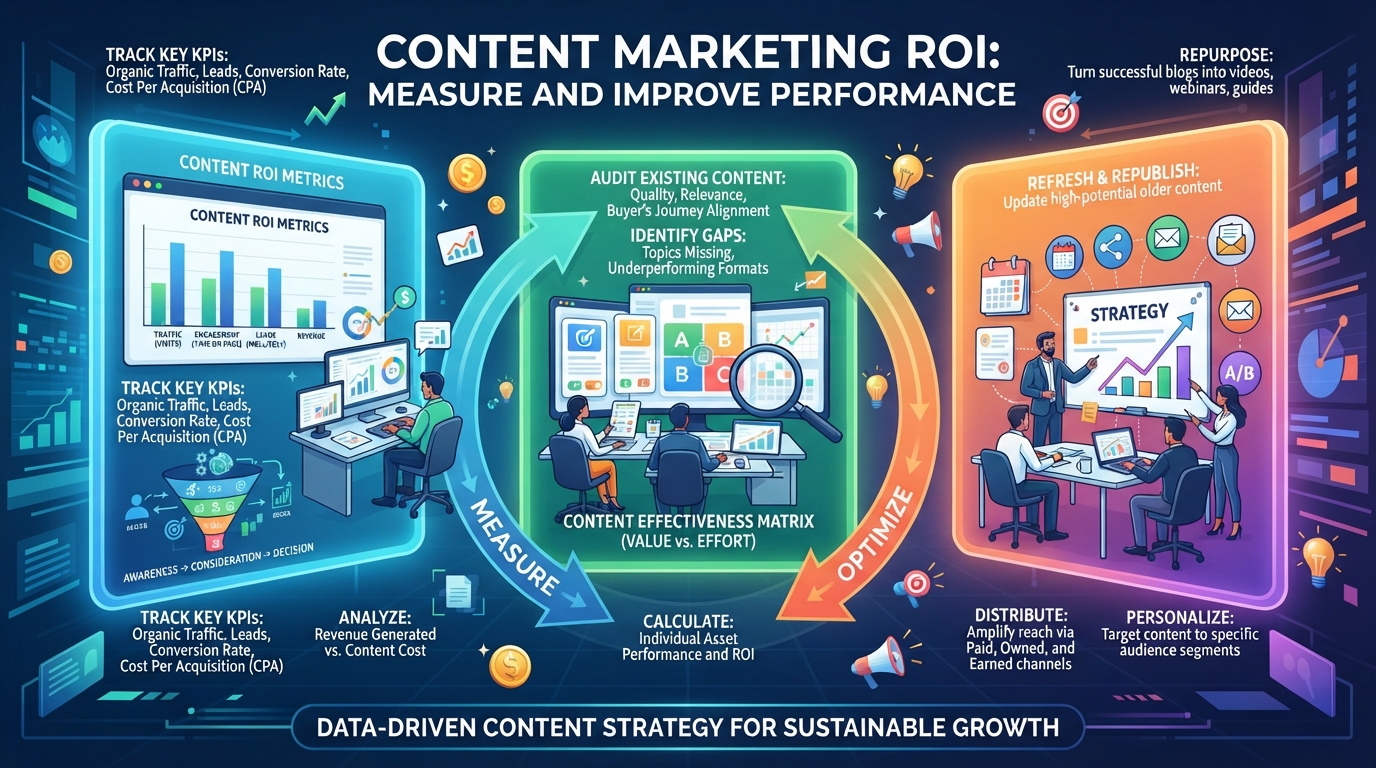
Content Marketing ROI shows how effectively content contributes to revenue, conversions, customer engagement, and business growth compared with the resources invested in creating and promoting it. By tracking the right performance metrics, connecting content with business outcomes, and using reliable analytics, businesses can understand which content produces real value and where improvements are needed.
Content marketing can generate significant long-term value, but publishing articles, videos, case studies, guides, and other resources does not automatically mean a business is getting a positive return. Companies need to understand whether their content attracts the right audience, creates meaningful engagement, generates qualified leads, supports conversions, and ultimately contributes to revenue. This is where Content Marketing ROI becomes an important part of a modern marketing strategy.
Content marketing ROI helps businesses move beyond surface-level numbers such as page views and social media likes. While traffic and engagement can indicate that content is reaching an audience, they do not always show whether that audience is helping the business achieve its goals. A strong ROI analysis connects content activity with measurable business results.
Understanding this connection also makes it easier to decide where marketing resources should be invested. When businesses know which topics, formats, channels, and campaigns produce the greatest value, they can create more effective content while reducing wasted effort.
What Is Content Marketing ROI?
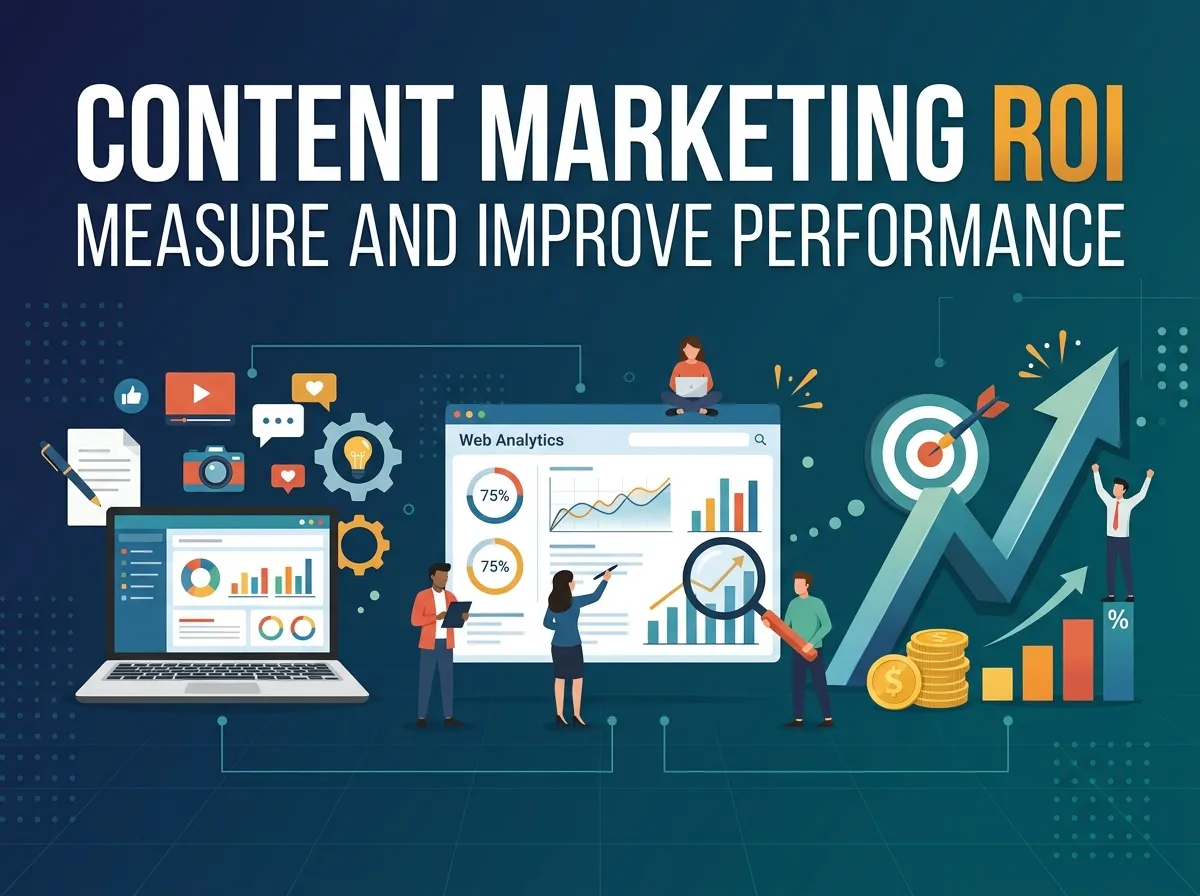
Content Marketing ROI refers to the financial value generated by content marketing compared with the cost of producing, distributing, and promoting that content. It provides a way to determine whether content investments are contributing positively to business performance.
The basic idea behind content marketing return on investment is straightforward: businesses compare the revenue or financial value attributed to content with the amount spent on content marketing.
A simple ROI calculation can be expressed as:
Content Marketing ROI = (Revenue Generated − Content Marketing Cost) ÷ Content Marketing Cost × 100
For example, if a company spends $10,000 on content creation and promotion and the content contributes $25,000 in attributable revenue, the return is calculated from the $15,000 gain compared with the original investment.
However, content marketing is not always responsible for an immediate purchase. A blog post may introduce a customer to a company, while a later email, product page, webinar, or sales conversation completes the conversion. Therefore, businesses often need to consider assisted conversions and customer journeys rather than relying only on last-click revenue.
Why Measuring Content Marketing ROI Matters
Without proper measurement, content marketing can become difficult to justify. Teams may spend substantial time producing content without knowing which activities generate meaningful results. Measuring content marketing success provides the evidence needed to make better strategic decisions.
ROI measurement also helps businesses identify high-performing content. For example, an article may attract moderate traffic but generate highly qualified leads, while another page may receive thousands of visits but produce almost no conversions. Looking only at traffic would make the second article appear more successful. Looking at business outcomes may reveal the opposite.
A clear measurement process also improves budgeting. Marketing teams can identify the content formats and topics that consistently contribute to leads, sales, customer retention, or other objectives. This makes it easier to allocate resources toward activities that produce measurable value.
Businesses can also use ROI analysis to identify weak areas. If a content campaign receives strong engagement but generates few qualified leads, the problem may involve audience targeting, messaging, calls to action, landing pages, or the overall conversion journey.
The Most Important Content Marketing Performance Metrics
Content marketing performance metrics provide the data needed to understand how content behaves throughout the customer journey. No single metric can explain content performance completely, so businesses should evaluate several indicators together.
Traffic is often one of the first metrics marketers examine. Organic search traffic, referral traffic, direct visits, and campaign traffic can show whether content is attracting visitors. However, traffic should be evaluated alongside engagement and conversion data.
Engagement metrics can include time on page, engaged sessions, scroll depth, returning visitors, and interactions with page elements. These measurements help reveal whether visitors are actually consuming the content rather than simply arriving and leaving.
Lead generation metrics are also important for businesses using content to attract potential customers. Form submissions, newsletter subscriptions, demo requests, downloads, and other actions can indicate that content is moving visitors further into the buying journey.
Conversion metrics provide an even stronger connection to business outcomes. Depending on the company, conversions might include purchases, booked appointments, sales-qualified leads, trial registrations, or completed transactions.
Revenue is ultimately one of the most important measurements when calculating financial ROI. By connecting content interactions with customer records and sales data, companies can estimate how much revenue content marketing contributes.
How to Approach Content Marketing ROI Calculation
An effective content marketing ROI calculation starts by identifying the complete cost of content production. This can include writer fees, editing, design, video production, SEO services, software, promotion, advertising, and employee time.
The next step is determining the financial outcomes associated with the content. Businesses can track direct purchases, lead values, customer acquisition, subscription revenue, or other relevant financial outcomes.
Attribution is one of the more difficult parts of the calculation. Customers may interact with several pieces of content before becoming customers. A person might discover a blog post through Google, read a case study several weeks later, subscribe to an email list, and eventually purchase a product.
Because of this, businesses should choose an attribution model that matches their sales process. First-touch attribution can help identify content responsible for initial discovery, while last-touch attribution focuses on the interaction closest to conversion. Multi-touch approaches can provide a broader view of how different content assets contribute throughout the customer journey.
Understanding Content Marketing Profitability
Content marketing profitability depends on more than the amount of revenue generated. Businesses must also consider the total cost required to create and maintain content.
Evergreen content can be particularly valuable because a single high-quality article may continue attracting organic traffic and conversions for months or years. When the initial production cost is spread across a long period of performance, the effective return can improve substantially.
Content profitability can also increase when one research project produces multiple assets. A detailed report, for example, could become a blog article, infographic, social posts, email content, video material, and sales enablement resources. This approach allows businesses to gain more value from the original investment.
Businesses should also consider content maintenance. Updating older pages, improving search visibility, refreshing statistics, strengthening internal links, and improving calls to action can sometimes produce better returns than constantly creating new content.
Tracking Revenue From Content Marketing

Content marketing revenue tracking connects marketing activity with financial outcomes. This requires businesses to establish a reliable method for identifying where leads and customers originated and which content interactions influenced their decisions.
Tracking links, campaign parameters, CRM records, conversion events, and analytics platforms can help create this connection. When these systems work together, marketers can see whether a particular article, landing page, campaign, or content series is contributing to revenue.
Revenue tracking becomes especially important for longer B2B sales cycles. A visitor may not purchase immediately after reading content. Instead, the content may influence a lead who later speaks with sales and becomes a customer.
Businesses can therefore assign value to content at different stages of the customer journey. Lead generation, opportunity creation, pipeline contribution, and closed revenue can all provide useful perspectives.
Measuring Content Marketing Conversion Metrics
Content marketing conversion metrics help marketers understand whether content encourages visitors to take valuable actions. These actions should be selected according to the business objective.
For an awareness campaign, a meaningful conversion might be a newsletter subscription or another form of audience growth. For a B2B company, it could be a demo request or consultation. For an ecommerce company, the most important conversion may be a completed purchase.
Conversion rate is particularly useful because it puts actions into context. Instead of simply counting 500 leads, marketers can determine what percentage of content visitors became leads.
It is also important to examine conversion quality. Ten highly qualified leads can be more valuable than 100 low-quality leads. Therefore, content performance should ultimately be connected with downstream outcomes such as sales acceptance, customer acquisition, and revenue.
Using Content Marketing Analytics Effectively
Content marketing analytics brings different data sources together to create a clearer picture of performance. Website analytics can reveal traffic and engagement, while CRM systems can show lead and customer information. Search data can indicate organic visibility, and marketing platforms can provide campaign performance information.
The most useful analytics approach does not focus on collecting as many numbers as possible. Instead, it focuses on selecting measurements that answer important business questions.
For example, marketers can ask which content attracts qualified visitors, which topics generate leads, which pages assist conversions, which traffic sources produce customers, and which content formats deliver the strongest return.
Analytics can also uncover content gaps. If visitors regularly enter through informational content but fail to reach commercial pages, the customer journey may need stronger internal connections and clearer calls to action.
For businesses focused on personalization, content performance can also be evaluated against audience segments. Resources such as Hyper-Personalization in Inbound Marketing can support a broader understanding of how personalized experiences can improve relevance and engagement.
Building a Strong Content Marketing ROI Strategy
A successful content marketing ROI strategy starts with clear business objectives. Content should have a defined purpose rather than being published simply to maintain a content calendar.
Businesses should determine whether their content is intended to increase organic visibility, generate leads, support sales, increase customer retention, build authority, or drive direct purchases. Once the objective is clear, relevant KPIs can be selected.
The strategy should also establish a consistent measurement period. Some content produces results quickly, while SEO-focused content may require months to reach its full potential. Evaluating every article after only a few days can result in inaccurate conclusions.
A strong strategy also requires regular optimization. High-performing content can be expanded, updated, repurposed, and promoted through additional channels. Low-performing content can be improved or consolidated when it no longer serves its intended purpose.
Trust and transparency can also affect the value of content. For organizations exploring emerging approaches, Blockchain Transparency: Building Trust in Inbound Marketing provides another perspective on how transparency can influence modern marketing relationships.
Connecting Content ROI With Customer Relationships
Content does not only support acquisition. It can also strengthen relationships with existing customers.
Educational resources, product guidance, customer stories, newsletters, and support content can improve customer experience and encourage retention. This means ROI should not always be viewed only through the lens of new customer acquisition.
A relationship-focused content strategy can help businesses increase repeat purchases, customer loyalty, referrals, and lifetime value. The Inbound Marketing Relationship Marketing Framework offers additional context around creating customer-centered relationships through inbound marketing.
Customer lifetime value can be especially useful when evaluating content profitability. A content campaign that initially generates a modest purchase but attracts customers who remain loyal for several years may ultimately deliver greater value than a campaign producing many one-time transactions.
Improving Content ROI Through Better Brand Strategy
Brand positioning also influences content performance. When content consistently communicates a clear value proposition and recognizable brand identity, audiences can more easily understand what a company represents.
A strong brand can improve the effectiveness of content because visitors are not simply consuming isolated articles. They are developing an understanding of the organization behind those resources.
Marketers can connect content themes with broader positioning, messaging, and customer expectations. Businesses interested in this connection can explore What is Digital Brand Strategy? for additional context.
Common Challenges in Content Marketing ROI Measurement
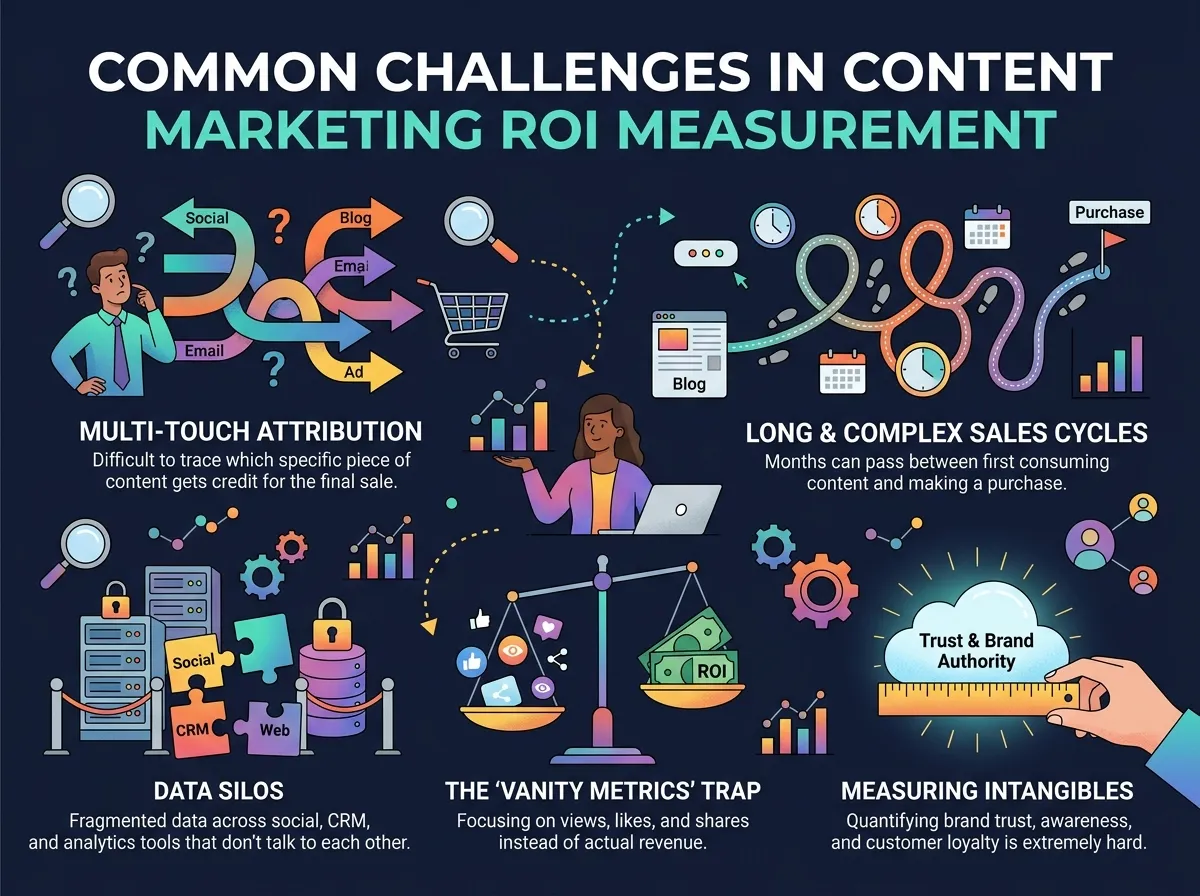
One of the biggest challenges is attribution. Multiple interactions can influence a single purchase, making it difficult to assign all revenue to one content asset.
Another challenge is delayed performance. SEO content may take months to produce meaningful traffic and conversions. Measuring it too early can make an effective investment appear unsuccessful.
Content costs can also be difficult to calculate. Businesses may account for writing costs but forget editing, design, management, promotion, technology, and employee time.
Data fragmentation is another common problem. When website analytics, CRM information, advertising platforms, and sales systems are not connected, marketers may struggle to understand the complete customer journey.
Finally, businesses sometimes focus too heavily on vanity metrics. High traffic or social engagement can be useful, but these numbers should not replace revenue, qualified leads, conversion rates, and customer value when financial performance is the goal.
How to Improve Content Marketing ROI
Improving ROI starts with producing content for a clearly defined audience. Understanding search intent, customer problems, buying motivations, and business needs helps companies create resources that are more relevant.
Content quality is equally important. Useful, original, trustworthy, and well-structured content is more likely to attract visitors and encourage them to continue exploring a website.
Internal linking can strengthen the customer journey by directing readers from informational resources toward relevant commercial or educational pages. Strong calls to action can also make it easier for visitors to take the next step.
Repurposing successful content can improve efficiency. Instead of continually starting from zero, businesses can transform strong-performing resources into new formats and distribute them through additional channels.
Regular measurement and optimization should then close the loop. The goal is not simply to measure ROI but to use the results to make future content investments more effective.
Conclusion
Content Marketing ROI provides a practical way for businesses to understand whether their content investments are producing meaningful financial and strategic results. By combining traffic, engagement, conversions, lead quality, revenue, and customer value, marketers can develop a more complete view of content performance.
Effective ROI measurement requires more than one metric. Businesses need reliable analytics, accurate cost tracking, appropriate attribution, clear objectives, and consistent optimization. When these elements work together, content marketing becomes easier to evaluate and improve.
The strongest approach is to treat content as a long-term business asset. By identifying high-performing topics, improving conversion paths, connecting content with customer relationships, and tracking revenue over time, businesses can build a sustainable content program that delivers measurable value.
Frequently Asked Questions
1. What is Content Marketing ROI?
Content Marketing ROI measures the financial return generated by content marketing compared with the costs involved in creating, managing, distributing, and promoting that content. It helps businesses understand whether their content investment is producing profitable outcomes.
2. How do you calculate Content Marketing ROI?
A basic calculation is to subtract content marketing costs from the revenue attributed to content, divide the result by the content marketing cost, and multiply by 100. Businesses may use different attribution methods depending on how customers interact with their content before converting.
3. What are the most important content marketing performance metrics?
Important metrics can include organic traffic, engagement, leads, conversion rate, qualified leads, customer acquisition, revenue, customer lifetime value, and assisted conversions. The most valuable metrics depend on the business objectives behind the content strategy.
4. Why is content marketing ROI difficult to measure?
Content often influences customers through multiple interactions. A visitor may discover a company through a blog article, return through search, read a case study, and later convert through a sales interaction. This makes attribution more complicated than simply assigning revenue to the final click.
5. What is the difference between content marketing ROI and content performance?
Content performance describes how well content achieves specific engagement or marketing objectives, while ROI focuses on the financial return generated compared with the investment. Performance metrics can support ROI analysis but do not always represent financial value directly.
6. How can businesses track revenue from content marketing?
Businesses can connect analytics platforms, CRM systems, campaign tracking, conversion events, and sales records. Using consistent tracking parameters and attribution models can help identify which content interactions contribute to leads, opportunities, and revenue.
7. Can SEO content have a high ROI?
Yes. SEO content can produce strong ROI when it continues attracting relevant organic traffic and conversions over a long period. Evergreen content can become particularly profitable because the initial production cost may be spread across many months or years of performance.
8. Which content marketing metrics should B2B companies track?
B2B companies can track qualified leads, lead-to-opportunity rates, pipeline contribution, sales-qualified leads, conversion rates, customer acquisition cost, assisted conversions, and revenue. These measurements provide more business value than traffic alone.
9. How often should Content Marketing ROI be measured?
Performance can be reviewed monthly or quarterly, while individual content assets may require longer evaluation periods. SEO-focused content often needs several months to demonstrate its full potential, so businesses should avoid making decisions based only on short-term results.
10. How can a business improve Content Marketing ROI?
Businesses can improve ROI by targeting the right audience, creating high-value content, matching content with search intent, improving conversion paths, updating existing resources, repurposing successful content, strengthening internal linking, and consistently analyzing revenue and conversion data.