

Inbound Campaign Attribution helps businesses understand how marketing channels, content, and campaign touchpoints influence conversions and revenue. By using suitable attribution models, accurate tracking, and meaningful performance metrics, marketers can evaluate campaign effectiveness, identify valuable lead sources, and make more informed marketing investment decisions.
Inbound marketing rarely follows a straight path from the first website visit to a completed purchase. A potential customer may discover a business through a search result, read an educational article, subscribe to an email newsletter, attend a webinar, and return through a branded search before becoming a customer. Each interaction contributes something to the decision, but identifying the influence of individual campaigns can be difficult.
This is where Inbound Campaign Attribution becomes valuable. It helps businesses understand which marketing activities introduce prospects, nurture their interest, and influence conversions. Rather than evaluating campaigns only through traffic or lead volume, attribution connects marketing interactions with meaningful business outcomes.
When implemented thoughtfully, attribution provides a clearer picture of marketing performance. It can reveal whether a campaign attracts qualified prospects, whether several channels work together, and where marketing resources are producing the strongest results.
For inbound teams, the goal is not simply to assign credit to a channel. It is to understand the customer journey well enough to make better decisions about content, campaign investment, and future growth.
Why Inbound Campaign Attribution Matters
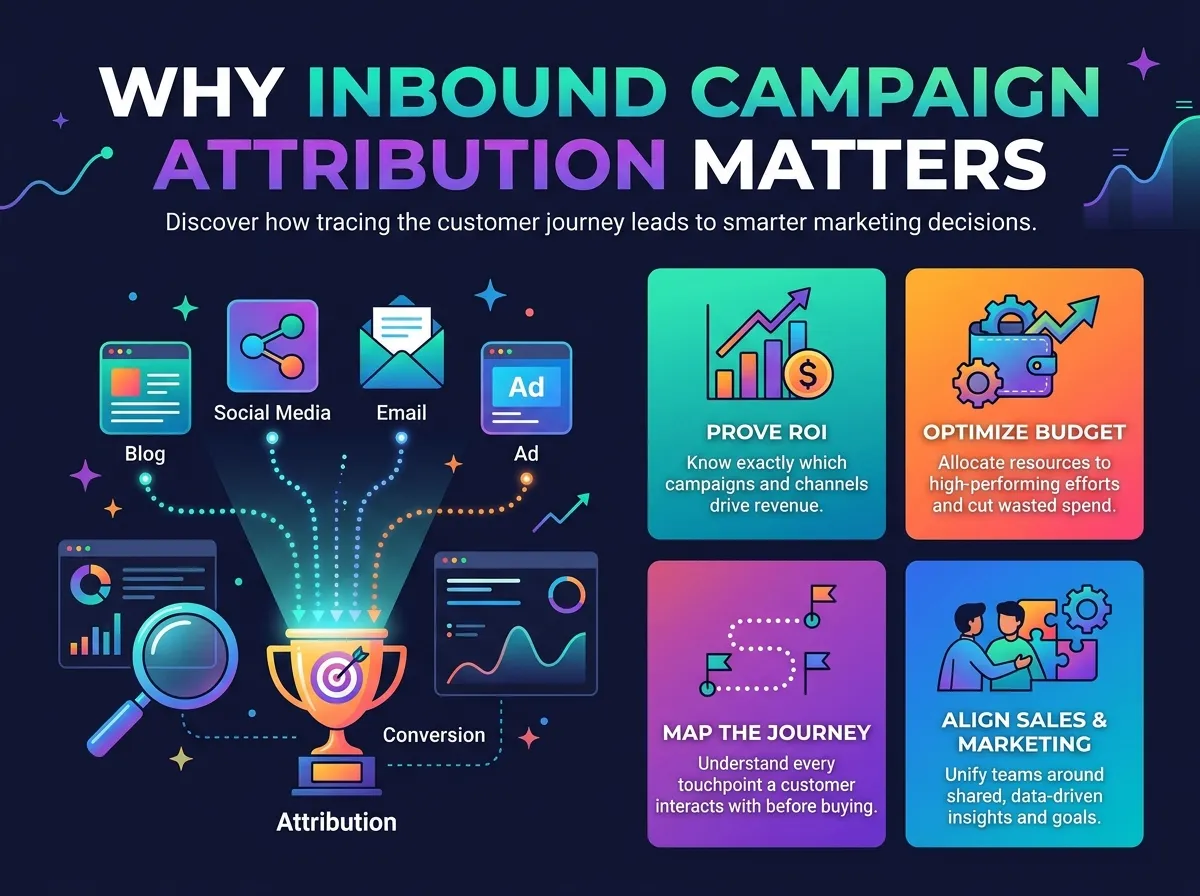
Inbound marketing is built around attracting people through relevant information and experiences. Because prospects often interact with several pieces of content before converting, a single campaign may not explain the entire outcome.
Imagine a business publishes an educational article that attracts a visitor through organic search. The visitor later downloads a resource, receives a nurture email, and eventually requests a product demonstration. If the company evaluates only the final conversion source, it may conclude that the email campaign generated the lead. That conclusion overlooks the article and resource that helped establish the relationship.
Attribution makes these connections more visible.
It allows marketing teams to distinguish between campaigns that generate initial awareness and campaigns that encourage prospects to take action. This distinction is important because a channel that rarely receives last-click credit may still contribute significantly to the pipeline.
Attribution also supports more informed budget decisions. When businesses understand how campaigns influence qualified leads and revenue, they can invest in activities that create meaningful progress rather than simply rewarding channels with the highest traffic numbers.
Inbound Marketing Attribution Models: Different Ways to Assign Credit
There is no single attribution model that explains every customer journey perfectly. Different models distribute credit according to different assumptions, and each provides a particular perspective on campaign performance.
First-Touch Attribution
First-touch attribution assigns all conversion credit to the first recorded marketing interaction.
For example, if a prospect first discovers a company through a blog article and later converts after several emails, the original article receives the credit.
This model is useful when a business wants to understand how prospects initially discover its brand. It can highlight the campaigns and channels that introduce new audiences.
However, first-touch attribution does not explain what happens after the initial interaction. It may overlook the nurture campaigns, product information, and other experiences that help prospects make a decision.
Last-Touch Attribution
Last-touch attribution gives full credit to the final recorded interaction before conversion.
If a prospect clicks an email and immediately submits a form, the email receives the conversion credit.
This approach is simple to understand and can help evaluate campaigns that encourage immediate action. Its limitation is that it may overvalue the final interaction while ignoring earlier marketing influence.
A business relying exclusively on last-touch reporting might reduce investment in educational content because that content rarely appears as the final conversion source.
Multi-Touch Attribution
Multi-touch attribution distributes credit across several interactions in the customer journey.
A prospect might discover a brand through organic search, engage with a newsletter, attend a webinar, and then request a consultation. A multi-touch model recognizes that each interaction may have contributed to the outcome.
The distribution of credit depends on the selected model. Some approaches give equal credit to every touchpoint, while others emphasize the first interaction, the final interaction, or particular stages of the journey.
Multi-touch attribution is especially useful for inbound campaigns because content, email, search, and conversion experiences often work together over time.
Position-Based Attribution
Position-based attribution gives greater weight to selected interactions, commonly the first and last touchpoints, while distributing the remaining credit among interactions in between.
This model recognizes the importance of both discovery and conversion. It can provide a practical compromise for businesses that want to understand the beginning and end of a journey without treating every interaction equally.
The most suitable model depends on the business’s sales cycle, available tracking data, and reporting objectives. Attribution should be treated as an analytical perspective, not an unquestionable statement of causation.
Campaign Conversion Tracking: Connecting Interactions With Outcomes
Attribution depends on reliable conversion tracking. Without consistent data, even a sophisticated model can produce misleading conclusions.
Campaign conversion tracking begins by defining what counts as a meaningful action. For one business, a conversion may be a newsletter subscription. For another, it may be a qualified sales inquiry, product trial, booked meeting, or completed purchase.
These actions should not all be treated as equal. A campaign that generates hundreds of low-quality downloads may contribute less business value than one that produces a smaller number of qualified opportunities.
Tracking should connect campaign interactions with the outcomes that matter to the organization. This often requires consistent campaign naming, tagged URLs, form tracking, CRM records, and conversion events.
For example, a campaign link may include tracking parameters that identify its source, medium, and campaign name. When a visitor arrives through that link and completes a form, the business can associate the conversion with the original marketing activity.
Accurate tracking also requires attention to data quality. Duplicate records, missing campaign parameters, inconsistent naming conventions, and incomplete CRM updates can weaken attribution reports.
A useful tracking system does more than count conversions. It preserves enough context to explain where those conversions originated and how prospects progressed afterward.
The Customer Journey Is More Than a Single Click
The customer journey provides the context needed to interpret attribution data.
A person searching for a general solution may be in the awareness stage. They might read an article, compare different approaches, or explore educational resources. At this point, the prospect may not be ready to speak with sales.
Later, the same person may return to the website to review a service page, download a comparison guide, or attend an online event. These interactions indicate a different level of interest.
Finally, the prospect may request a consultation or complete a purchase. The final action is important, but it does not erase the influence of earlier experiences.
Understanding this progression helps marketing teams evaluate campaigns according to their role in the journey. Awareness campaigns should not always be judged by immediate sales, while conversion-focused campaigns should be evaluated against the actions they are designed to generate.
The relationship between attribution and customer behavior becomes even clearer when teams examine Inbound Engagement Metrics. Engagement signals can provide useful context about how audiences respond to content before they convert. However, engagement alone should not be mistaken for revenue impact; it needs to be connected with downstream outcomes.
Inbound Campaign Performance Analysis: Reading Beyond Conversion Counts
Campaign performance analysis becomes more useful when it explains why results occurred, not just what happened.
A campaign may generate a high number of leads but contribute little to sales because the audience is poorly matched to the offer. Another campaign may attract fewer prospects but produce a stronger pipeline because those prospects have a genuine need and a clear path toward purchasing.
Attribution helps uncover these differences by connecting campaign activity with lead quality, opportunity creation, and revenue.
For example, a content campaign may generate leads over several months rather than producing immediate conversions. If the business measures only the first week of activity, it may underestimate the campaign’s long-term contribution.
A more complete analysis considers the time between initial interaction and conversion. It also examines whether leads progress through the sales process and whether the campaign influences existing opportunities.
This approach prevents marketing teams from making decisions based on isolated numbers. Traffic, downloads, and form submissions remain useful indicators, but their meaning becomes clearer when evaluated alongside customer progression.
Marketing Campaign Attribution Metrics That Matter
Attribution reports can contain many metrics, but the most valuable ones are those connected to business objectives.
Conversion rate helps reveal how effectively a campaign turns visitors into leads or customers. A high conversion rate may indicate that the message, audience, and landing page are well aligned.
Cost per lead provides a financial perspective by showing how much the business spends to acquire a lead through a particular campaign. Yet cost per lead should be interpreted alongside lead quality. A low-cost campaign is not necessarily efficient if its leads rarely become customers.
Marketing-qualified leads and sales-qualified leads offer another layer of insight. These measures help distinguish between people who show marketing interest and prospects who meet the criteria for sales engagement.
Pipeline contribution connects campaigns with potential business revenue. It shows whether marketing activity is influencing opportunities that may eventually close.
Customer acquisition cost and revenue attribution can provide a broader view of campaign economics. They help businesses understand whether marketing investment is producing sustainable commercial value.
No single metric should determine campaign success. A balanced measurement approach considers the relationship between acquisition, engagement, qualification, conversion, and revenue.
Inbound Lead Source Tracking Across Multiple Channels
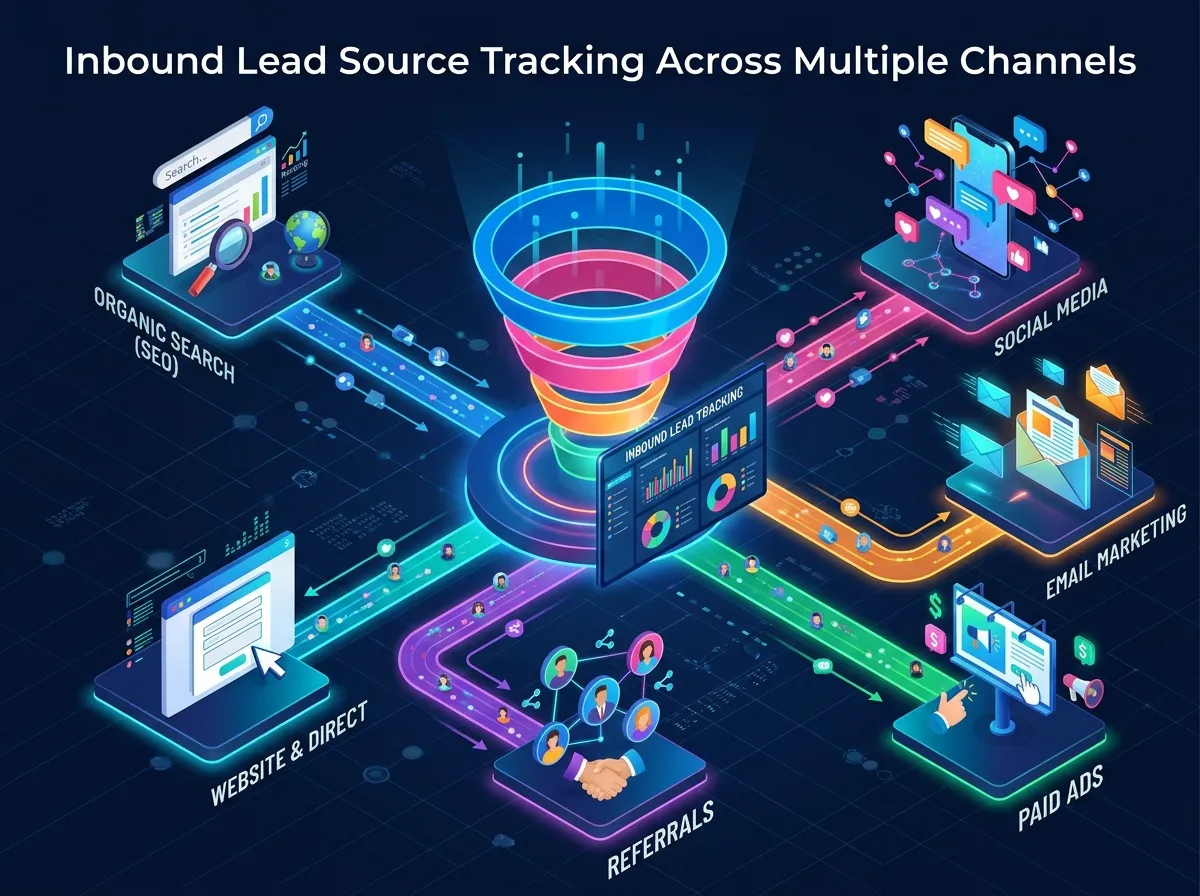
Inbound campaigns often operate across several channels at once. Search, content, email, social media, webinars, and referral traffic may all contribute to the same conversion.
Inbound lead source tracking helps identify where prospects first arrived and which campaigns influenced their subsequent activity.
Consider a company that publishes a technical article and promotes it through a newsletter. A reader may visit the article through email, return later through organic search, and eventually submit a contact form after visiting a product page.
If the company records only the most recent source, it may miss the newsletter’s original contribution. If it records only the first source, it may overlook the search campaign that brought the prospect back.
A useful attribution system preserves both perspectives whenever possible. It can record the original source, recent source, and relevant campaign interactions without forcing every conversion into a single channel category.
Channel analysis also needs consistent definitions. Organic search, paid search, direct traffic, referral traffic, and email should be classified accurately so that reports remain comparable over time.
For businesses with local audiences, attribution can also connect search activity with geographic demand. Local search campaigns may introduce prospects who later convert through phone calls, forms, or in-person interactions. SEO Services for Local Businesses can be relevant when considering how local search visibility contributes to inbound customer acquisition.
Campaign Touchpoint Tracking and the Value of Content
Every meaningful interaction can provide information about a prospect’s interests and readiness.
A visitor reading a general educational article may be exploring a problem. Someone who repeatedly visits a product page may be comparing solutions. A prospect who downloads a detailed resource or attends a demonstration may be moving closer to a purchasing decision.
Campaign touchpoint tracking makes these interactions easier to understand.
The purpose is not to collect every possible activity. Excessive tracking can create complicated reports without improving decision-making. Instead, businesses should focus on touchpoints that reveal meaningful engagement or influence a conversion.
Content plays a particularly important role in this process. An article may not directly generate a sale, but it can answer an early question and encourage a prospect to explore the brand further.
A well-developed Inbound Marketing Techniques approach helps businesses create relevant experiences at different stages of the journey. Attribution then provides a way to examine how those experiences contribute to lead generation and conversion.
This connection allows content teams to identify material that attracts qualified visitors, supports lead nurturing, and assists sales conversations.
Inbound Marketing Automation and Attribution Data
As inbound campaigns expand, manually tracking every interaction becomes increasingly difficult. Marketing automation can help organize campaign activity, record lead behavior, and connect marketing engagement with customer records.
Automation platforms may capture email interactions, form submissions, landing-page visits, and selected campaign events. When integrated with a CRM, this information can help marketing and sales teams understand how prospects move through the buying process.
The value of automation is not limited to collecting data. It can also help teams respond to meaningful behavior.
For example, when a prospect repeatedly engages with a product-related resource, the system may trigger a relevant follow-up email or notify a sales representative. The resulting interaction becomes another touchpoint that can be evaluated within the customer journey.
Businesses looking to improve these processes can explore the Inbound Marketing Automation Guide for a broader understanding of how automation supports lead management and campaign execution.
Attribution data becomes more valuable when it is accessible to the people making marketing and sales decisions. Automated reporting can reduce manual work, improve consistency, and help teams identify campaign trends earlier.
Campaign ROI Measurement: Connecting Marketing Activity With Revenue
One of the most important purposes of attribution is understanding whether marketing investment produces worthwhile business results.
Campaign ROI measurement compares the financial return generated by a campaign with the cost of running it. The calculation may include campaign spending, technology costs, creative production, and other relevant expenses.
A simplified ROI formula is:
For example, if a campaign costs $5,000 and generates $20,000 in attributable revenue, its calculated ROI is 300%.
However, the result depends on how revenue is attributed. If several campaigns influenced the same customer, assigning the entire purchase value to each campaign would inflate the total. Businesses must avoid double-counting revenue when comparing channel performance.
It is also important to distinguish between revenue and profit. A campaign may generate substantial sales but still produce a weak financial return if product costs, fulfillment expenses, or other business costs are high.
Attribution provides the connection between marketing interactions and revenue records, while financial analysis determines whether those results represent genuine business value.
Common Attribution Problems and Their Impact
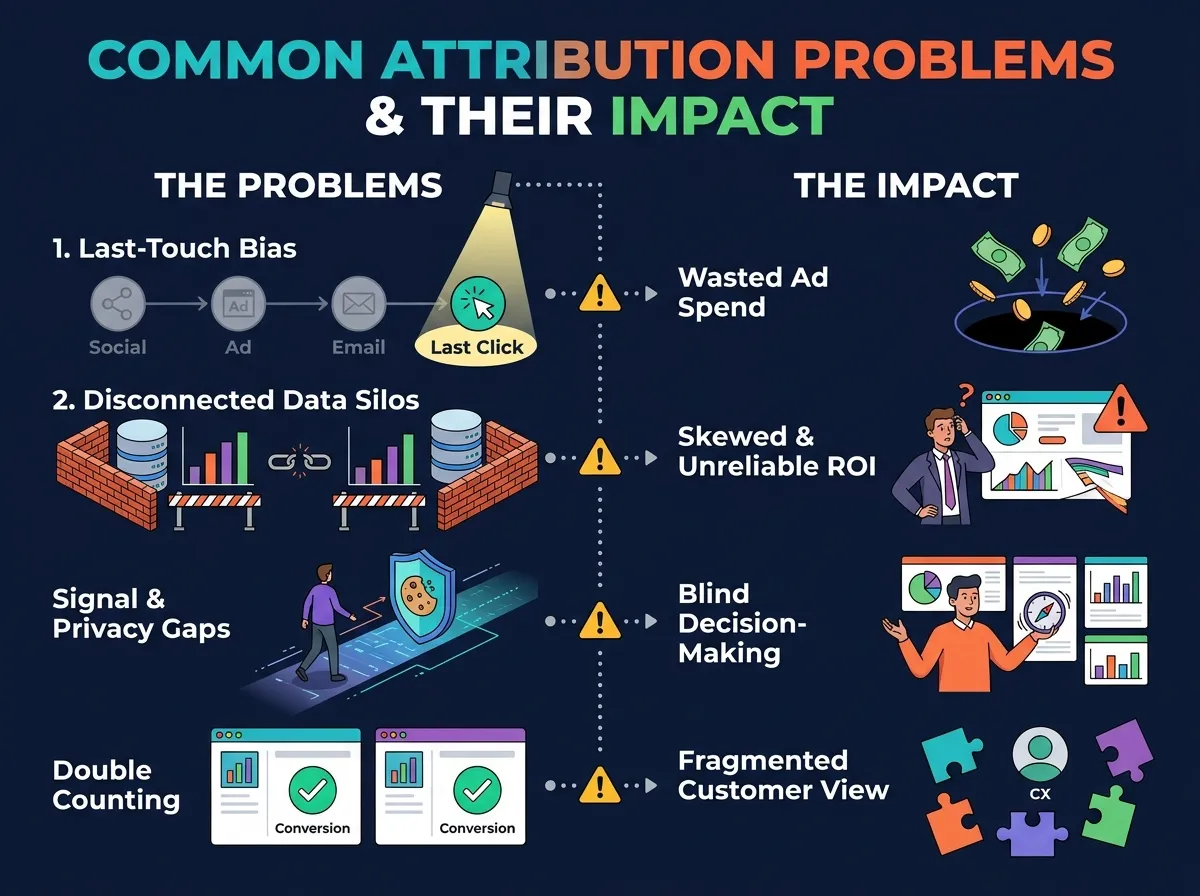
Even well-designed attribution systems have limitations. Data privacy restrictions, browser tracking changes, cross-device activity, and incomplete CRM records can make it difficult to follow every customer interaction.
Some prospects may discover a brand on one device and convert on another. Others may interact through channels that are not fully tracked, such as offline conversations or word-of-mouth recommendations.
Attribution models also rely on assumptions. A multi-touch model may distribute credit across several interactions, but that does not prove each interaction caused the conversion. A customer might have purchased even without one of the recorded touchpoints.
For this reason, attribution should be combined with other forms of analysis, including customer feedback, sales insights, campaign comparisons, and controlled experiments when appropriate.
The objective is not to create a perfectly complete record of every customer action. It is to build a reliable enough understanding of marketing influence to improve future decisions.
Building a More Meaningful Inbound Attribution Strategy
The strongest attribution approach begins with a clear business question. A company may want to understand which campaigns introduce qualified prospects, which channels support long sales cycles, or which content contributes to revenue.
Once that objective is defined, the business can select an attribution model and tracking system that fit its needs.
Consistent campaign naming, reliable conversion events, accurate lead records, and meaningful reporting are more valuable than a complicated model built on incomplete data.
Marketing teams should also review attribution regularly. Customer journeys change, campaign priorities evolve, and new channels may become important. A model that worked well for a short sales cycle may not provide the same insight for a longer, more complex buying process.
Ultimately, Inbound Campaign Attribution helps organizations move beyond surface-level marketing measurements. It reveals how campaigns interact, how prospects progress, and how marketing activity contributes to business outcomes.
When attribution is treated as a decision-making tool rather than a simple reporting exercise, businesses can create more relevant campaigns, improve resource allocation, and develop a clearer understanding of what drives sustainable growth.
10 Frequently Asked Questions
1. What is Inbound Campaign Attribution?
Inbound Campaign Attribution is the process of identifying and evaluating marketing interactions that contribute to a lead, conversion, or customer purchase.
2. Why is campaign attribution important for inbound marketing?
It helps businesses understand which campaigns introduce prospects, nurture interest, and influence conversions, allowing them to make better marketing decisions.
3. What are the main inbound marketing attribution models?
Common models include first-touch, last-touch, linear, time-decay, and position-based attribution. Each distributes conversion credit differently.
4. What is multi-touch campaign attribution?
Multi-touch attribution assigns credit to multiple interactions within a customer journey instead of giving all credit to a single touchpoint.
5. How does campaign conversion tracking work?
It records meaningful actions such as form submissions, purchases, downloads, or demo requests and connects them with relevant marketing campaigns.
6. Which metrics are useful for campaign attribution?
Important metrics include conversion rate, cost per lead, qualified lead volume, pipeline contribution, customer acquisition cost, and attributed revenue.
7. Can inbound campaign attribution measure ROI?
Yes. Attribution connects campaign interactions with revenue records, allowing businesses to compare marketing returns with campaign costs. Results depend on accurate tracking and appropriate credit allocation.
8. What is inbound lead source tracking?
It identifies the marketing channel or campaign through which a prospect first arrives or engages, such as organic search, email, social media, or referral traffic.
9. Does attribution show exactly which campaign caused a conversion?
Not always. Attribution models estimate marketing influence based on recorded interactions. They do not necessarily prove that a particular touchpoint caused the purchase.
10. How can marketing automation improve attribution?
Marketing automation can record campaign interactions, organize lead data, connect activity with CRM records, and support more consistent attribution reporting.