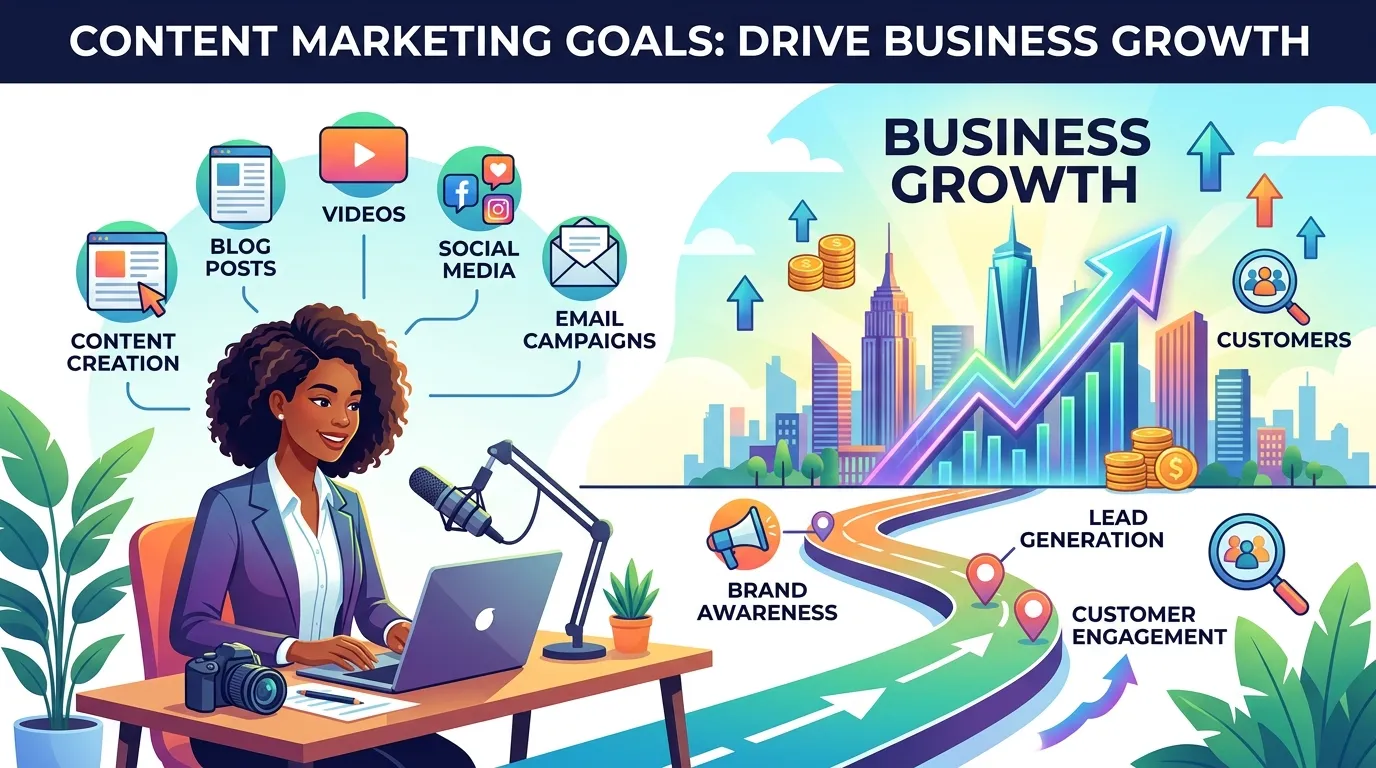
Content marketing goals give businesses a clear direction for creating, distributing, and measuring valuable content. From increasing brand awareness and engagement to generating leads, improving conversions, and supporting long-term growth, well-defined goals help turn content into a measurable business asset. By setting realistic objectives and tracking the right performance metrics, businesses can create content that attracts the right audience and contributes to meaningful results.
Content marketing has become an important part of how businesses attract audiences, build credibility, and maintain long-term relationships with potential customers. However, publishing blog posts, videos, social media content, or other resources without a clear purpose does not necessarily produce meaningful business results. Successful content marketing begins with clearly defined content marketing goals that connect content activities with broader business objectives.
Whether a company wants to increase organic traffic, strengthen its brand, generate qualified leads, or improve customer conversions, its content should have a measurable purpose. Clear content marketing objectives help marketing teams understand what they are trying to achieve and how their content contributes to the overall growth of the business.
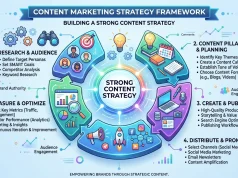
A strong content strategy is not simply about producing more content. It is about producing the right content for the right audience and creating a clear connection between content, audience needs, and business outcomes.
Understanding Content Marketing Goals

Content marketing goals are the specific results a business wants to achieve through its content. These goals can focus on visibility, audience engagement, lead generation, conversions, customer retention, or revenue growth. The most effective goals are connected to measurable outcomes rather than simply the amount of content published.
For example, a company may want to increase organic website traffic by creating search-optimized educational content. Another business may focus on generating qualified leads through downloadable resources, webinars, or email content. A B2B company could use thought leadership articles to establish authority and influence purchasing decisions.
The right goals depend on the business model, target audience, customer journey, and current marketing priorities. When content has a defined purpose, it becomes easier to decide which topics to cover, which formats to use, and which performance indicators deserve attention.
Content Marketing Objectives for Businesses
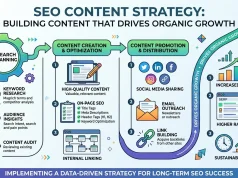
Different companies have different priorities, but several content marketing objectives for businesses are particularly valuable. One of the most common is increasing online visibility. High-quality content can help businesses appear in search results for topics that potential customers are actively researching.
Another important objective is establishing authority. When a company consistently publishes useful, accurate, and relevant information, it can become a trusted source within its industry. This is particularly valuable for businesses operating in competitive markets where customers need confidence before making purchasing decisions.
Content can also support the entire customer journey. Educational content can attract people who are just discovering a problem, comparison content can help prospects evaluate their options, and product-focused content can encourage people who are closer to making a decision.
This makes content marketing valuable beyond traffic generation. Strong content can support awareness, consideration, conversion, and retention at different stages of the customer relationship.
Building Content Marketing Strategy Goals
Content marketing strategy goals should connect directly with the wider marketing and business strategy. Instead of treating content as an isolated activity, businesses should consider how it supports objectives such as customer acquisition, brand positioning, sales growth, and customer retention.
For instance, a SaaS company may create content to attract decision-makers searching for solutions to specific business challenges. A local company may focus on content that builds visibility within its service area. An ecommerce brand might use educational and product-related content to help customers understand products and make confident purchasing decisions.
The strongest content strategies balance short-term and long-term objectives. Traffic and engagement can provide early indicators of success, while qualified leads, conversions, customer value, and revenue demonstrate the deeper business impact of content.
Businesses can strengthen this connection by developing a clear content strategy that defines target audiences, topics, formats, distribution channels, and performance expectations. A useful resource on how to create a content strategy can help businesses understand how these elements work together.
Increasing Brand Awareness Through Content Marketing
One of the most important goals for businesses is building greater visibility and recognition. Brand awareness through content marketing allows companies to introduce their expertise, values, products, and solutions to potential customers before those customers are ready to buy.
Educational articles, industry insights, research reports, videos, social media posts, podcasts, and other content formats can help a brand become more familiar to its target audience. Consistency is especially important because audiences are more likely to remember businesses that regularly provide useful information.
Brand awareness should not be measured only by the number of people who see a piece of content. Businesses can also evaluate branded search growth, website visits from new users, social mentions, content reach, direct traffic, and audience growth.
Over time, consistent content can create stronger associations between a brand and the problems it solves. When customers begin to recognize a business as a reliable source of information, that familiarity can influence future purchasing decisions.
Creating Content Engagement Goals
Traffic alone does not demonstrate that content is valuable. Content engagement goals focus on how audiences interact with the material after discovering it. Depending on the platform and format, engagement can include time spent on a page, scroll depth, comments, shares, clicks, video completion, downloads, or returning visitors.
Engagement helps businesses understand whether their content is actually connecting with the intended audience. A page may receive thousands of visitors but generate little meaningful interaction, while another page with fewer visitors may attract highly relevant prospects who spend considerable time exploring the information.
This is why engagement should be considered alongside traffic rather than treated as a standalone measure. High-quality engagement can indicate that content is relevant, useful, and aligned with audience interests.
Businesses can also use engagement data to improve future content. If certain topics consistently receive strong interaction, they may deserve additional articles, videos, case studies, or other supporting resources.
Content Marketing Lead Generation Goals

For many businesses, particularly B2B companies, lead generation is one of the most important content objectives. Content marketing lead generation goals focus on turning audience interest into identifiable prospects who may eventually become customers.
Content can support lead generation in many ways. Detailed articles can attract organic visitors, while ebooks, reports, webinars, newsletters, templates, and other valuable resources can encourage visitors to provide contact information.
The quality of leads matters just as much as the quantity. Generating a large number of contacts does not necessarily mean a campaign is successful if those contacts have little interest in the company’s products or services.
Businesses should therefore evaluate metrics such as marketing-qualified leads, sales-qualified leads, lead conversion rates, landing-page conversions, and lead-to-customer rates. These measurements provide a clearer picture of whether content is attracting the right audience.
Content should also answer the questions prospects have at different stages of the buying process. When educational content addresses genuine customer concerns and demonstrates expertise, it can make the transition from visitor to qualified prospect much more natural.
Improving Content Marketing Conversion Goals
Another important objective is turning engaged audiences into customers or taking them toward the next meaningful action. Content marketing conversion goals may include product purchases, consultation requests, demo bookings, newsletter subscriptions, account registrations, downloads, or contact-form submissions.
The type of conversion depends on the business and the stage of the customer journey. A visitor reading an introductory article may not be ready to make a purchase, but they might subscribe to an email list or download a useful resource.
This is why effective content should provide logical next steps without becoming overly promotional. A well-written article can naturally direct readers toward a relevant service page, case study, resource, or related piece of content.
Conversion performance should also be analyzed in context. If content attracts a highly relevant audience but produces few conversions, the issue may be the call to action, landing page, offer, or customer journey rather than the content itself.
Content Marketing Performance Goals
Content marketing performance goals help businesses evaluate whether their content is producing the expected results. These goals can cover visibility, engagement, lead generation, conversions, and financial performance.
Common performance indicators include organic traffic, keyword rankings, impressions, clicks, engagement rates, leads, conversion rates, customer acquisition, and revenue influenced by content.
The most useful metrics depend on the original objective. If the goal is awareness, reach and visibility may be more important. If the goal is lead generation, businesses should pay closer attention to qualified leads and conversion rates. If the goal is revenue growth, content-attributed revenue and return on investment become more important.
Businesses should avoid measuring every possible metric simply because the data is available. A focused measurement framework makes it easier to understand what is working and where improvements are needed.
Measuring Content Marketing Success
Measuring content marketing success requires more than checking website traffic once a month. Businesses need to compare performance against clearly defined objectives and evaluate whether content is contributing to meaningful outcomes.
Analytics platforms can reveal which pages attract visitors, how audiences interact with content, which channels generate traffic, and where users leave the customer journey. Search data can also show which topics and keywords are generating visibility.
For businesses that want a deeper understanding of performance, Content Marketing Analytics provides useful context around measuring content performance and interpreting important marketing data.
Another critical area is financial performance. Content can produce value over months or even years, especially when evergreen articles continue attracting organic traffic. This means businesses should consider both immediate results and the long-term contribution of their content library.
A strong measurement approach connects content metrics with actual business outcomes. Instead of asking only how many people viewed an article, businesses should also ask whether those visitors engaged with the brand, became leads, entered the sales process, or eventually became customers.
Connecting Content Goals With ROI
Return on investment is an important consideration when businesses invest time, money, and resources into content. Content marketing ROI can be difficult to measure because a customer may interact with multiple pieces of content before converting.
For example, someone might discover a company through an organic blog post, return through an email campaign, read a case study, and eventually request a sales consultation. Giving all the value to one touchpoint can provide an incomplete picture.
Businesses can improve their analysis by considering content-assisted conversions, lead quality, customer acquisition costs, and revenue generated from content-supported journeys. Content Marketing ROI offers additional insight into evaluating the financial value of content marketing.
The goal is not to assign an exact dollar value to every article. Instead, businesses should develop a consistent measurement framework that helps them understand which content investments are contributing to growth.
Using Content to Support the Customer Journey
Effective content marketing goals should reflect the different stages of the customer journey. People who are unfamiliar with a brand typically need educational information, while prospects comparing solutions may need more detailed evidence, product information, case studies, and expert insights.
Content can also support existing customers after a purchase. Tutorials, FAQs, product updates, educational resources, and customer-focused communications can improve satisfaction and encourage retention.
This broader approach ensures that content is not limited to attracting new visitors. It can help businesses build relationships throughout the entire customer lifecycle.
Different content formats can also serve different objectives. Blog articles may support search visibility, videos can increase engagement, webinars can support lead generation, and case studies can help prospects evaluate solutions.
For brands using sponsored partnerships or influencer collaborations, understanding how sponsored content fits into a broader content strategy can also be valuable. What Is Sponsored Content? explains how sponsored content can be used to reach audiences through partnerships and paid placements.
Creating Sustainable Content Marketing Growth

Long-term success depends on creating content that remains useful while adapting to changing audience expectations. Businesses should regularly review existing content to identify opportunities for updates, improvements, consolidation, or expansion.
Older articles may continue attracting visitors but contain outdated information or missed search opportunities. Refreshing those pages can improve their usefulness while allowing businesses to build on existing authority.
Sustainable content marketing also requires consistency. Publishing a large amount of content for a short period and then stopping can make it difficult to build lasting momentum. A realistic publishing process is usually more effective than an aggressive schedule that cannot be maintained.
Most importantly, every major piece of content should have a reason for existing. When content is connected to a specific objective and audience need, it becomes easier to produce valuable material and measure its contribution.
Conclusion
Effective content marketing goals give businesses a clear foundation for creating content that delivers measurable value. Whether the priority is increasing brand awareness, improving engagement, generating qualified leads, increasing conversions, or demonstrating marketing ROI, clearly defined objectives make content efforts more focused and effective.
The strongest approach combines strategic planning with consistent measurement. Businesses should understand what they want their content to accomplish, identify the metrics that reflect those objectives, and use performance data to improve future decisions.
Content marketing becomes significantly more valuable when it is treated as a long-term business investment rather than simply a publishing activity. With the right objectives, relevant content, and meaningful performance measurements, businesses can build stronger relationships with audiences while supporting sustainable growth.
Frequently Asked Questions
1. What are content marketing goals?
Content marketing goals are the specific results a business wants to achieve through its content. These may include increasing brand awareness, attracting organic traffic, generating leads, improving engagement, increasing conversions, supporting sales, or strengthening customer relationships.
2. Why are content marketing goals important?
Content marketing goals provide direction and help businesses understand what their content should accomplish. They also make it easier to select relevant topics, measure performance, allocate resources, and determine whether content is contributing to broader business objectives.
3. What are common content marketing objectives for businesses?
Common objectives include increasing website traffic, improving brand awareness, building industry authority, generating qualified leads, increasing engagement, supporting conversions, improving customer retention, and generating measurable business revenue.
4. How can content marketing increase brand awareness?
Content marketing can increase brand awareness by consistently providing useful and relevant information to a target audience. Blog posts, videos, social media content, research, podcasts, and other formats can help audiences discover and remember a brand.
5. What are content marketing lead generation goals?
Content marketing lead generation goals focus on converting interested audiences into identifiable prospects. Businesses may use educational content, downloadable resources, webinars, newsletters, and other valuable assets to encourage visitors to take a lead-generating action.
6. How do you measure content marketing success?
Content marketing success can be measured through metrics such as organic traffic, search visibility, engagement, leads, conversion rates, customer acquisition, and revenue. The most relevant metrics depend on the specific objectives of the content strategy.
7. What are content marketing performance goals?
Content marketing performance goals define the results a business expects from its content. They can include improvements in traffic, engagement, search rankings, lead generation, conversion rates, customer acquisition, and revenue contribution.
8. How can businesses improve content marketing conversions?
Businesses can improve conversions by creating content that matches audience intent, providing relevant calls to action, strengthening landing pages, addressing customer concerns, and connecting readers with logical next steps in the buying journey.
9. How does content marketing support lead generation?
Content marketing attracts potential customers by answering their questions and addressing their problems. When useful content is combined with relevant calls to action, lead magnets, forms, webinars, or subscriptions, it can turn website visitors into qualified prospects.
10. How often should businesses review their content marketing goals?
Businesses should review content marketing goals regularly to ensure they remain aligned with changing business priorities, audience behavior, and performance data. A periodic review can reveal which content is performing well and where strategy improvements are needed.