
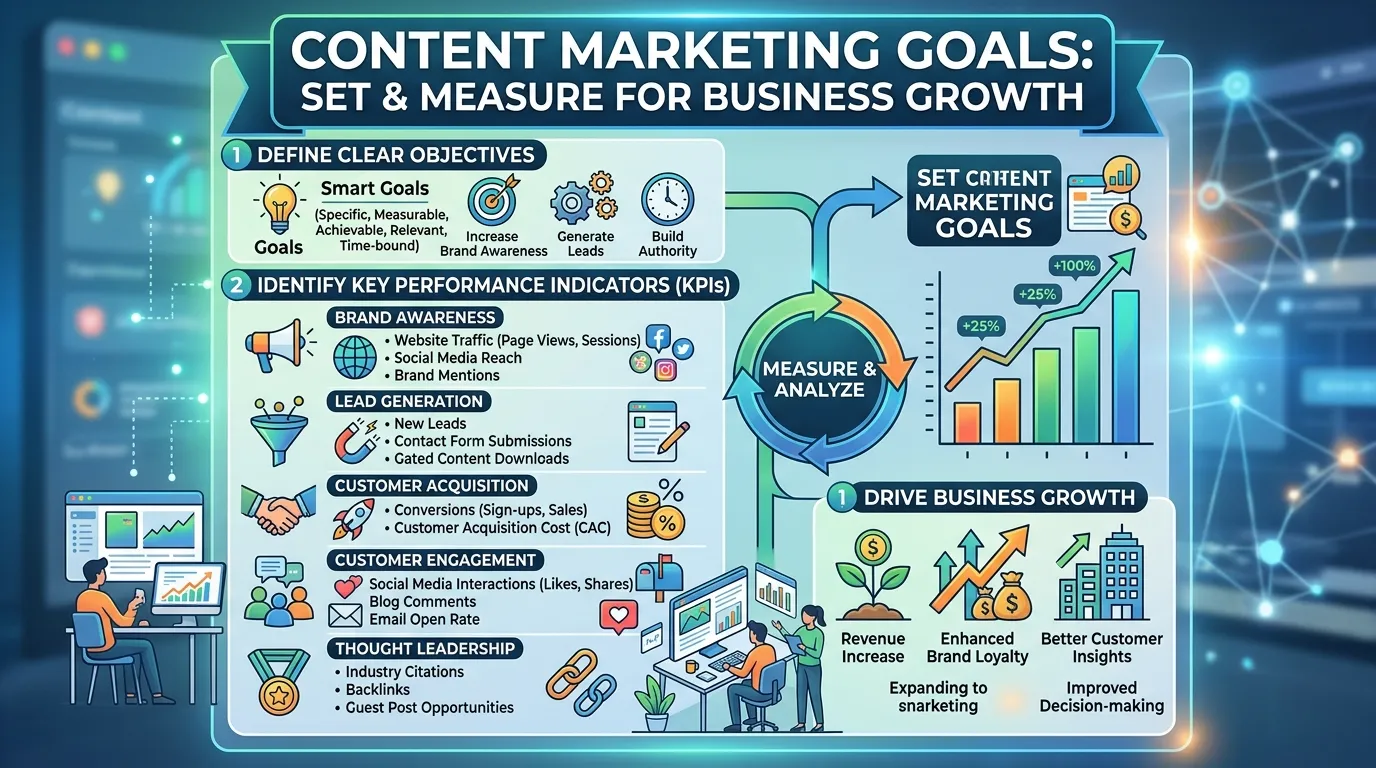
Content marketing goals help businesses connect content creation with measurable outcomes such as brand awareness, audience engagement, lead generation, conversions, and business growth. By setting clear objectives, aligning content with business priorities, selecting relevant performance metrics, and regularly reviewing results, businesses can create a more focused and measurable content marketing program.
Content marketing goals give businesses a clear direction for creating, publishing, and promoting content. Instead of producing articles, videos, social posts, emails, or other content without a defined purpose, businesses can use specific goals to connect content activities with broader marketing and business outcomes. Well-defined goals can help teams understand what they want their content to accomplish and how progress should be measured.
Content marketing can support many areas of business growth, including brand awareness, audience engagement, lead generation, website traffic, conversions, customer relationships, and revenue. However, these results are easier to achieve when content is created around clear objectives rather than simply publishing content consistently.
Why Content Marketing Goals Matter
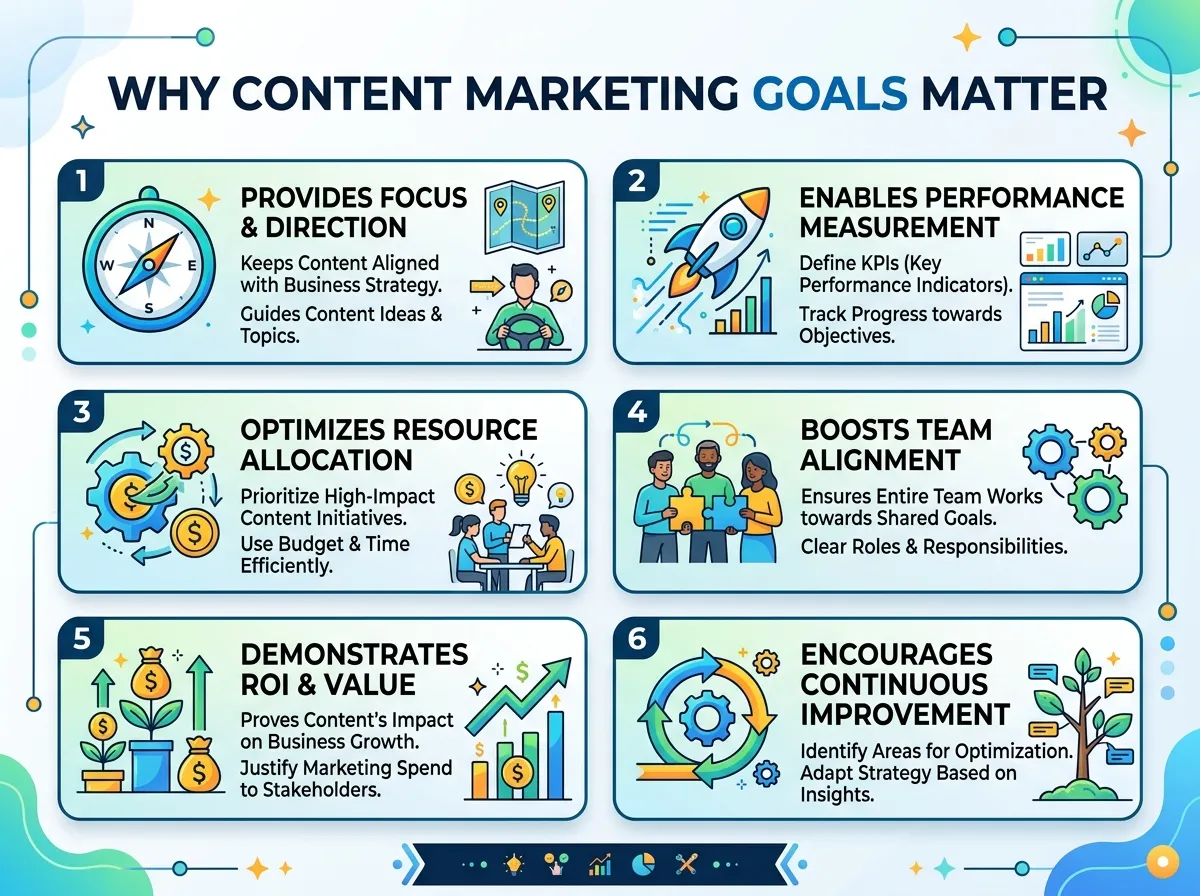
Content marketing can involve significant time and resources. Businesses may spend hours researching topics, creating articles, designing graphics, producing videos, optimizing pages, and promoting content across different channels. Without clear goals, it can become difficult to determine whether these activities are producing meaningful results.
Content marketing goals help connect individual content activities with measurable business outcomes. For example, a company may create educational blog posts to attract organic visitors, publish case studies to support potential customers during the buying process, or develop downloadable resources to generate leads.
Clear goals also help marketing teams make better decisions about content priorities. When a team knows whether it is focusing primarily on awareness, engagement, lead generation, or conversions, it becomes easier to choose appropriate topics, formats, channels, and performance metrics.
Content Marketing Objectives and Business Outcomes
Content marketing objectives describe what a business wants its content to accomplish. These objectives can vary depending on the company’s audience, industry, marketing maturity, and overall business priorities.
A business that is relatively unknown in its market may focus on increasing visibility and reaching new audiences. A company with established traffic may concentrate more heavily on generating qualified leads or increasing conversions. Another organization may use content to strengthen customer relationships and encourage retention.
These content marketing objectives should connect with broader business priorities rather than operate separately. When content objectives support business outcomes, marketing teams have a clearer reason for creating each type of content.
For example, an organization focused on increasing qualified leads might create educational resources that answer high-intent questions and encourage visitors to request additional information. A company focused on brand awareness might prioritize informative content that introduces its expertise to new audiences.
Building Content Marketing Strategy Goals
A strong content plan needs goals that fit within the wider marketing strategy. Content marketing strategy goals provide a framework for deciding what content should achieve over a particular period.
These goals can focus on increasing organic visibility, attracting a specific audience, strengthening brand recognition, improving engagement, generating leads, supporting sales, or retaining customers. A business may have several goals at the same time, but each should have a clear purpose and measurement method.
For example, a company could establish a goal of increasing organic search traffic to educational content while also working toward generating more qualified leads from those visitors. These goals are connected because improved visibility can create more opportunities for audience engagement and conversion.
A content strategy becomes easier to manage when goals are specific enough to guide decisions. Rather than simply deciding to “publish more content,” a team can define what the content should accomplish and how its success will be evaluated.
Connecting Content Marketing Goals and Objectives
The relationship between content marketing goals and objectives is important because goals provide direction while objectives can describe the specific outcomes or milestones supporting that direction.
For example, increasing brand visibility may be a broad goal, while increasing organic impressions for priority topics or expanding reach among a defined audience can serve as supporting objectives. Similarly, generating more leads can be a broader goal, while increasing conversions from content landing pages can provide a more specific measurement point.
This distinction helps teams avoid vague expectations. When goals and objectives are clearly connected, content creators can understand what they are working toward, while marketing managers can evaluate whether the content program is moving in the intended direction.
Aligning Content Marketing With Business Goals
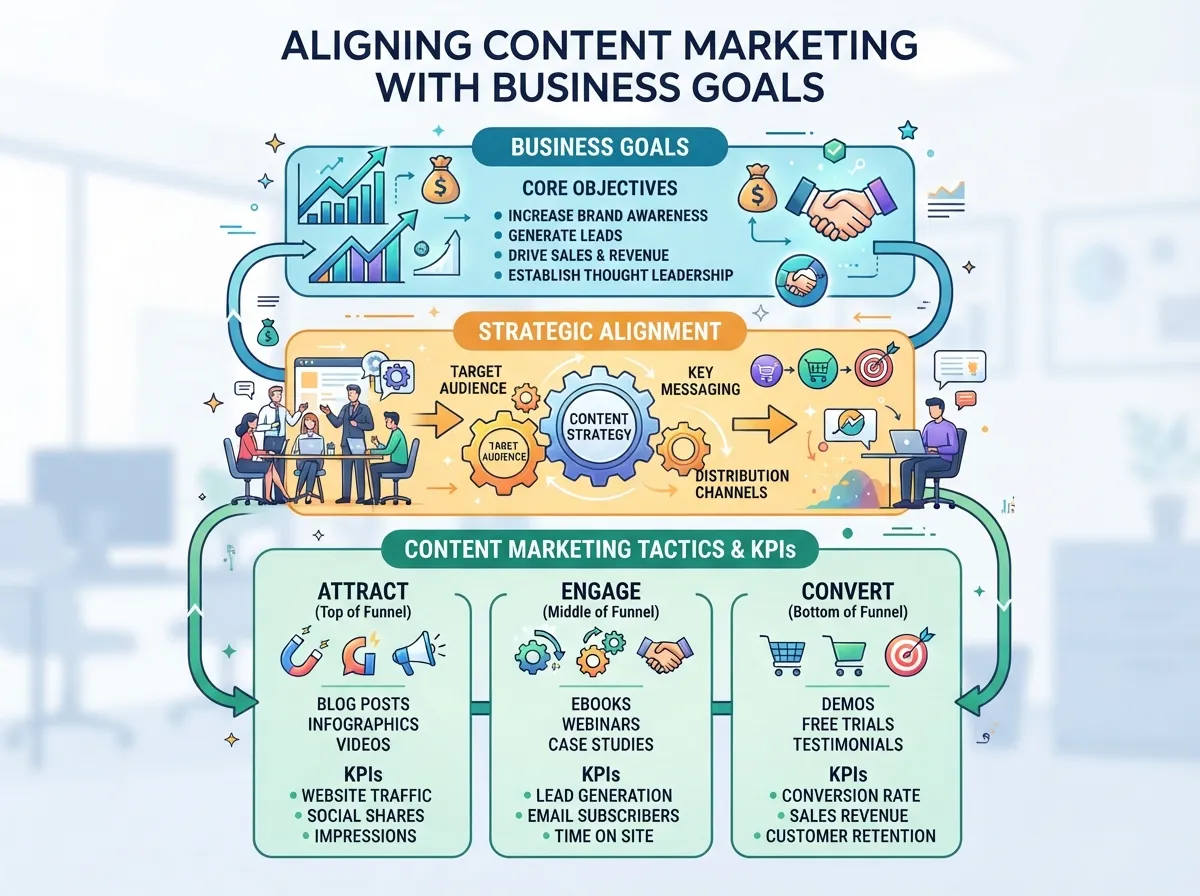
Effective content should have a connection to wider content marketing business goals. These may include revenue growth, customer acquisition, market expansion, customer retention, product adoption, or stronger brand recognition.
For instance, a software company may use educational content to attract potential users searching for solutions to specific problems. A B2B organization may use reports, case studies, and expert articles to support decision-makers during longer purchasing cycles. A local business may create location-focused content to increase visibility among customers searching for nearby services.
This alignment also prevents content teams from focusing only on surface-level metrics. Traffic can be useful, but a large increase in visitors does not automatically mean that the content is contributing to business growth. Looking at the relationship between traffic, engagement, leads, conversions, and customers provides a more complete understanding of performance.
Content Marketing Performance Goals
Content marketing performance goals help teams evaluate how effectively their content is working. Depending on the purpose of the content, performance may be measured through organic traffic, page views, engagement, average time on page, returning visitors, email subscriptions, downloads, leads, conversions, or revenue.
Different content formats may require different measurements. A top-of-funnel educational article may primarily support awareness and organic discovery, while a product comparison page may be more closely associated with conversions.
Performance goals should therefore reflect the role of each content asset. Measuring every article using exactly the same metric can hide important differences in how content contributes to the customer journey.
Regular performance analysis can also identify content that deserves improvement. If an article receives substantial search traffic but generates limited engagement, the business may examine its relevance, structure, calls to action, internal links, or alignment with search intent.
Content Marketing Conversion Goals
Content marketing conversion goals focus on actions that move visitors toward a desired business outcome. A conversion does not always mean an immediate purchase. Depending on the business model, it could include completing a contact form, downloading a resource, registering for a webinar, subscribing to an email list, requesting a demo, or making a purchase.
Content can influence conversions by answering questions, addressing concerns, demonstrating expertise, and providing useful information at different stages of the customer journey.
A blog article might introduce a problem and educate the reader, while a case study can provide evidence of how a solution works. A product-focused page can then provide more specific information and encourage the visitor to take the next step.
Businesses can also examine conversion rates across different content types to understand which topics and formats contribute most effectively to their defined objectives.
Content Marketing Engagement Goals
Audience interaction is another important area of content performance. Content marketing engagement goals focus on how audiences interact with published content and whether the material encourages meaningful participation.
Engagement can include time spent reading a page, returning to a website, watching a video, sharing an article, commenting, clicking internal links, subscribing to an email list, or interacting with social content.
However, engagement should be interpreted in context. A long time on a page can indicate strong interest, but it can also occur because a page is difficult to understand. Similarly, a high number of social interactions does not necessarily translate into leads or customers.
The most useful approach is to connect engagement metrics with the specific purpose of the content. This provides a clearer picture of whether audience behavior supports the intended goal.
Content Marketing Lead Generation Goals
Businesses that use content to attract potential customers can establish content marketing lead generation goals around acquiring and qualifying prospects.
Lead generation content may include ebooks, research reports, webinars, case studies, newsletters, comparison pages, and educational articles. These assets can attract people who are actively researching a problem or exploring potential solutions.
A strong lead generation approach also considers lead quality rather than focusing only on volume. A campaign that generates many contacts but very few relevant prospects may not provide the same business value as a smaller campaign that attracts highly relevant potential customers.
Businesses can connect content with lead-generation systems to understand which pages, topics, campaigns, or resources contribute to new leads. For a broader understanding of how inbound content can support prospect acquisition, businesses can also explore Inbound Marketing Lead Generation.
Content Marketing Brand Awareness Goals
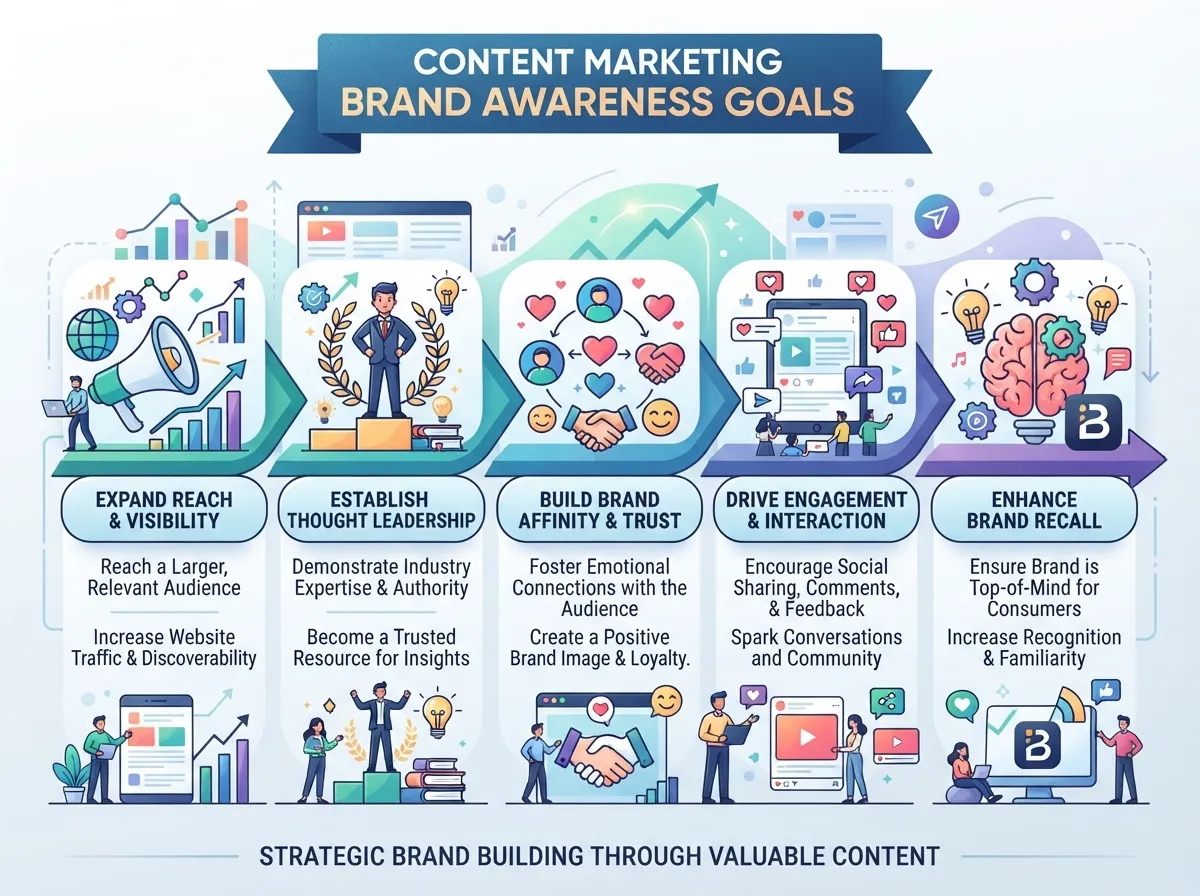
Content marketing brand awareness goals focus on increasing recognition and helping audiences understand what a business represents. Content can introduce a company to new audiences while demonstrating expertise and communicating its perspective.
Educational articles, thought leadership content, videos, social posts, research, podcasts, and other formats can all contribute to awareness. Consistency is particularly important because audiences often encounter a brand multiple times before becoming familiar with it.
Brand awareness can be evaluated through metrics such as impressions, branded search activity, reach, new visitors, social exposure, and direct traffic. Qualitative feedback can also provide useful context about how audiences perceive and remember a brand.
For businesses operating across different regions, content may also need to reflect local audience expectations. Strategies such as Global Brand Localization can help businesses adapt communication while maintaining a consistent core identity.
Using SEO to Support Content Marketing Goals
Search engine optimization can support several content objectives simultaneously. Optimized content can improve organic visibility, attract relevant visitors, answer audience questions, and create opportunities for lead generation.
Businesses should consider search intent when setting content goals. A keyword with informational intent may be suitable for an educational article, while a commercial query may require comparison or product-focused content.
Internal linking, topic relevance, useful information, clear page structure, and strong on-page optimization can also help content perform more effectively in organic search.
Businesses that want to connect content strategy with organic acquisition can explore SEO for Inbound Marketing to understand how search optimization can contribute to inbound traffic and lead generation.
Personalization and Content Marketing Goals
Personalization can make content more relevant to different audience segments. Instead of presenting exactly the same message to every visitor, businesses can adapt content based on factors such as audience interests, behavior, location, previous interactions, or stage in the customer journey.
Real-Time Personalization for Inbound can be particularly useful when businesses want content experiences to respond to visitor behavior. Personalized recommendations, dynamic messaging, relevant offers, and audience-specific content can create more meaningful experiences.
However, personalization should remain connected to a measurable objective. Businesses can evaluate whether personalized experiences improve engagement, lead generation, conversions, or another defined outcome.
Measuring Content Marketing Goals
Measuring content marketing goals requires selecting metrics that directly relate to the intended outcome. There is no single metric that can accurately measure every content program.
For awareness-focused content, businesses may examine reach, impressions, organic visibility, branded searches, and new visitors. For engagement-focused content, they may monitor interactions, returning visitors, content consumption, and time-related engagement indicators. For lead generation, businesses can examine form submissions, downloads, qualified leads, and lead conversion rates.
Conversion-focused programs can track completed purchases, demo requests, sign-ups, or other defined actions. Revenue attribution can provide additional context when reliable tracking is available.
Businesses should establish a measurement period and compare performance over time rather than relying on isolated numbers. This makes it easier to identify trends and understand whether content improvements are producing meaningful changes.
Improving Content When Goals Are Not Being Met
Not every content asset will achieve its original objective. When performance falls below expectations, the first step is to understand why rather than simply producing more content.
A page with low organic visibility may require stronger keyword targeting, better search-intent alignment, improved internal linking, or more useful information. A page with strong traffic but weak conversions may need a clearer call to action, stronger relevance, better offers, or improved user experience.
Similarly, content with strong engagement but limited lead generation may be reaching the right audience without giving visitors a clear next step. Reviewing performance data alongside the original content objective can help identify the most relevant improvement.
Content optimization should therefore be an ongoing process. Goals provide the reference point, performance data shows what is happening, and content updates can help close the gap between current results and intended outcomes.
Frequently Asked Questions
1. What are content marketing goals?
Content marketing goals are specific outcomes a business wants to achieve through its content. They can include increasing brand awareness, attracting organic traffic, improving engagement, generating leads, supporting conversions, and strengthening customer relationships.
2. Why are content marketing goals important?
Content marketing goals provide direction for content creation and make it easier to evaluate performance. They help businesses connect content activities with broader marketing and business priorities instead of measuring success only by publishing volume or website traffic.
3. What are common content marketing objectives?
Common content marketing objectives include increasing organic visibility, attracting relevant audiences, improving brand awareness, generating qualified leads, increasing engagement, supporting conversions, educating customers, and strengthening customer relationships.
4. How do content marketing goals support business goals?
Content marketing goals can support business goals by connecting content activities with outcomes such as customer acquisition, revenue generation, market awareness, lead generation, and retention. The exact connection depends on the company’s business model and marketing priorities.
5. What are content marketing performance goals?
Content marketing performance goals define how a business will evaluate the effectiveness of its content. Common measurements include organic traffic, engagement, conversions, leads, downloads, subscriptions, and revenue-related outcomes.
6. What are content marketing conversion goals?
Content marketing conversion goals identify the actions businesses want visitors to take after interacting with content. These may include completing a form, requesting a demo, subscribing to an email list, downloading a resource, registering for an event, or making a purchase.
7. How can content marketing help generate leads?
Content can attract potential customers by answering questions, addressing problems, demonstrating expertise, and offering useful resources. Businesses can connect relevant content with forms, landing pages, newsletters, webinars, and other lead-capture opportunities.
8. How can businesses measure content marketing goals?
Businesses can measure goals using metrics that match their intended outcomes. Awareness goals may use reach and visibility metrics, engagement goals may use interaction and content-consumption metrics, while lead-generation and conversion goals can use leads, conversion rates, and completed actions.
9. Can SEO help achieve content marketing goals?
Yes. SEO can help content reach relevant audiences through organic search. By aligning content with search intent, optimizing important page elements, building useful internal links, and providing valuable information, businesses can support goals related to visibility, traffic, lead generation, and conversions.
10. How often should content marketing goals be reviewed?
The appropriate review frequency depends on the business and content program. Teams can monitor important performance indicators regularly while conducting deeper reviews monthly, quarterly, or according to their campaign cycle. Regular review allows businesses to identify changes and adjust content based on actual performance.