

A content marketing content audit helps businesses understand which content is performing well, which pages need improvement, and where valuable opportunities are being missed. By examining content quality, SEO, engagement, relevance, and strategic alignment, businesses can build a stronger content strategy and make existing content more effective.
Content marketing can produce a large amount of information over time. Blog posts, landing pages, case studies, guides, product pages, videos, and other resources can gradually become a valuable content library. However, having a large amount of content does not automatically mean that the content is performing well. Some pages may attract consistent organic traffic, while others may receive little attention. Some may still be relevant to the audience, while others may contain outdated information or no longer support current business objectives.
This is where a Content Marketing Content Audit becomes valuable. A content audit provides a structured way to examine existing content and understand its quality, relevance, search performance, engagement, and contribution to broader marketing objectives. Rather than continuously creating new articles without reviewing older material, businesses can use an audit to understand what they already have and where improvements can create greater value.
A well-planned audit can reveal opportunities that are easy to overlook during everyday content production. It can uncover pages with strong traffic but weak conversion potential, useful articles that need updating, overlapping topics that compete with each other, and important subjects that have not yet been covered. The result is a clearer understanding of how content is working and where the content strategy can become stronger.
What Is a Content Marketing Content Audit?

A Content Marketing Content Audit is a detailed evaluation of the content published across a website and other relevant marketing channels. It looks beyond the simple question of whether content exists and examines whether that content is useful, relevant, discoverable, accurate, engaging, and aligned with business objectives.
The process can include blog articles, service pages, landing pages, resource pages, downloadable materials, case studies, and other forms of marketing content. Depending on the business, the audit may also consider content published through social platforms, email campaigns, or external channels.
The purpose is not simply to identify poorly performing pages. A good audit also identifies successful content and explains why certain assets continue to attract visitors, engagement, links, leads, or other valuable actions. Understanding successful content can provide useful insight for future content creation.
A content audit also creates a clearer relationship between content production and business goals. When every piece of content is evaluated according to its purpose, marketers can determine whether their existing library supports awareness, organic discovery, lead generation, customer education, or other objectives.
Why Content Audits Matter for Content Marketing
Content marketing strategies can become difficult to manage as a website grows. Older articles may continue attracting visitors even though their information is outdated. Newer pages may cover topics that are already addressed elsewhere. Some pages may have strong search visibility but provide a poor experience once visitors arrive.
A Content Performance Audit helps bring these issues into view. Instead of relying on assumptions about which content works, marketers can examine traffic, engagement, rankings, conversions, backlinks, and other relevant signals. This makes it easier to distinguish content that is genuinely contributing value from content that simply occupies space on the website.
A content audit can also strengthen decisions about future publishing. The findings may show that a website does not necessarily need more content in every topic area. It may instead need better optimization, stronger internal connections between related pages, updated information, or more focused coverage of important subjects.
For example, a company that already has extensive resources about inbound marketing may benefit more from improving existing pages than publishing several additional articles covering similar subjects. Its Content Marketing Goals can provide useful context for determining whether the current content library is actually supporting the outcomes the business wants to achieve.
Content Quality Analysis and Relevance
Quality is one of the most important areas of a content audit. A page can rank in search results and still provide a weak experience if the information is unclear, outdated, repetitive, or poorly organized.
Content Quality Analysis considers factors such as accuracy, originality, usefulness, readability, depth, organization, and relevance. It also considers whether the content genuinely addresses the questions or problems that brought the audience to the page.
Relevance is equally important. Information that was accurate several years ago may no longer reflect current products, market conditions, technologies, or customer expectations. Even evergreen topics can require periodic review because search behavior and audience expectations change over time.
During an audit, content can therefore be examined according to its current purpose rather than its original publication date. A page that once performed well may need substantial improvement, while another older page may still be valuable with only minor updates.
This evaluation also helps identify content that is too similar to other pages. When multiple articles target almost identical subjects, they may create unnecessary duplication and make it harder for users and search engines to understand which page provides the strongest resource.
Understanding Content Gaps
A strong content library is not only about what a website has published. It is also about what is missing.
Content Gap Analysis examines subjects, questions, keywords, and audience needs that are not adequately covered by existing content. These gaps can become important opportunities for improving topical coverage and serving potential customers more effectively.
For example, a website may have several introductory articles about content marketing but lack detailed resources addressing measurement, content performance, optimization, or specific audience challenges. An audit can reveal these missing areas and help marketers understand where additional content could provide meaningful value.
Content gaps can also appear between different stages of the customer journey. A website might have plenty of awareness-focused articles but very little content helping readers compare solutions or make informed purchasing decisions. In that situation, the problem is not necessarily a lack of content overall. It is an imbalance in the content ecosystem.
Examining gaps alongside existing performance makes content planning more purposeful. Instead of creating articles simply because a keyword appears attractive, marketers can focus on subjects that complement existing resources and strengthen the overall content experience.
Evaluating the Content Strategy

A Content Strategy Audit looks at the larger relationship between individual content assets and the marketing strategy behind them. Every article does not need to achieve the same objective, but the collection should work together in a meaningful way.
This evaluation can reveal whether the content library reflects the intended audience, brand positioning, topics, customer journey, and business objectives. It can also reveal whether publishing has become too focused on certain subjects while other important areas receive little attention.
A strong strategy creates connections between content pieces. One article can introduce a subject, another can explore it in greater depth, and another can address a related commercial question. Internal linking can help users move naturally between these resources while allowing the website to establish stronger topical relationships.
A Content Marketing Strategy Framework can also provide useful context when evaluating whether individual pages fit within a broader strategic structure. The audit becomes more meaningful when content performance is considered alongside the role each page is expected to play.
SEO Content Audit and Search Visibility
Search visibility is another major part of a content audit. A SEO Content Audit examines whether existing pages are positioned to perform effectively in organic search.
This can involve reviewing target keywords, search intent, titles, headings, metadata, content structure, internal links, indexing, URL structure, and other relevant SEO factors. It can also involve examining whether a page actually satisfies the intent behind the queries for which it appears.
Search performance should not be viewed only through rankings. Organic traffic, impressions, clicks, click-through rates, conversions, and engagement can provide a broader picture of how content performs in search.
For businesses using inbound marketing, SEO is closely connected with content discovery. Resources such as SEO for Inbound Marketing can complement an audit by connecting search optimization with the broader inbound marketing process.
An SEO review may also identify pages that are close to performing well but need additional optimization. Improving an existing page can sometimes be more useful than creating a completely new article on a similar topic.
Website Content Evaluation
A Website Content Evaluation considers the quality and effectiveness of content across the entire website rather than focusing only on blog posts.
Service pages, category pages, landing pages, resource sections, and other important areas all contribute to the overall content experience. A website can have excellent blog articles but still struggle if its core commercial pages are unclear, outdated, or disconnected from the information visitors need.
Evaluation can include the clarity of page messaging, relevance to user intent, readability, calls to action, internal linking, navigation, and consistency with the brand. It can also identify pages that receive significant traffic but fail to encourage visitors to continue exploring the website.
Looking at content as a connected ecosystem is especially useful for businesses that have been publishing for several years. The audit can show where the website has developed strong topic coverage and where the experience has become fragmented.
Turning Audit Findings Into Content Optimization
The purpose of an audit is not simply to create a list of problems. The findings should lead to meaningful improvements.
A Content Optimization Strategy can involve updating outdated information, improving weak introductions, expanding incomplete sections, clarifying search intent, improving internal linking, restructuring content, combining overlapping pages, or strengthening conversion opportunities.
Not every page needs the same treatment. Some pages may already perform strongly and require only occasional updates. Others may have potential but need significant improvements. Certain pages may no longer serve a useful purpose and may need to be consolidated or removed after careful evaluation.
This distinction is important because optimization should be based on evidence rather than applying the same changes to every page. A page with strong organic traffic and engagement should be evaluated differently from a page that receives almost no visibility.
The goal is to make the existing content library more useful, relevant, connected, and effective while preserving the value of content that already performs well.
Using Content Audit Tools
Modern Content Audit Tools can make the evaluation process easier by bringing different types of information together. Website crawlers, analytics platforms, search performance tools, keyword research platforms, and content management systems can all contribute useful data.
These tools can help identify URLs, page titles, traffic patterns, search queries, backlinks, rankings, broken links, indexing issues, duplicate topics, and other information relevant to an audit.
However, tools alone cannot determine whether a piece of content is genuinely valuable to an audience. Data can show that a page receives traffic, but a human review may still be needed to understand whether visitors are finding useful information or whether the page successfully supports the intended business objective.
Combining quantitative data with qualitative evaluation creates a more complete picture. Numbers explain what is happening, while content analysis helps explain why it may be happening.
Measuring Content Marketing Performance
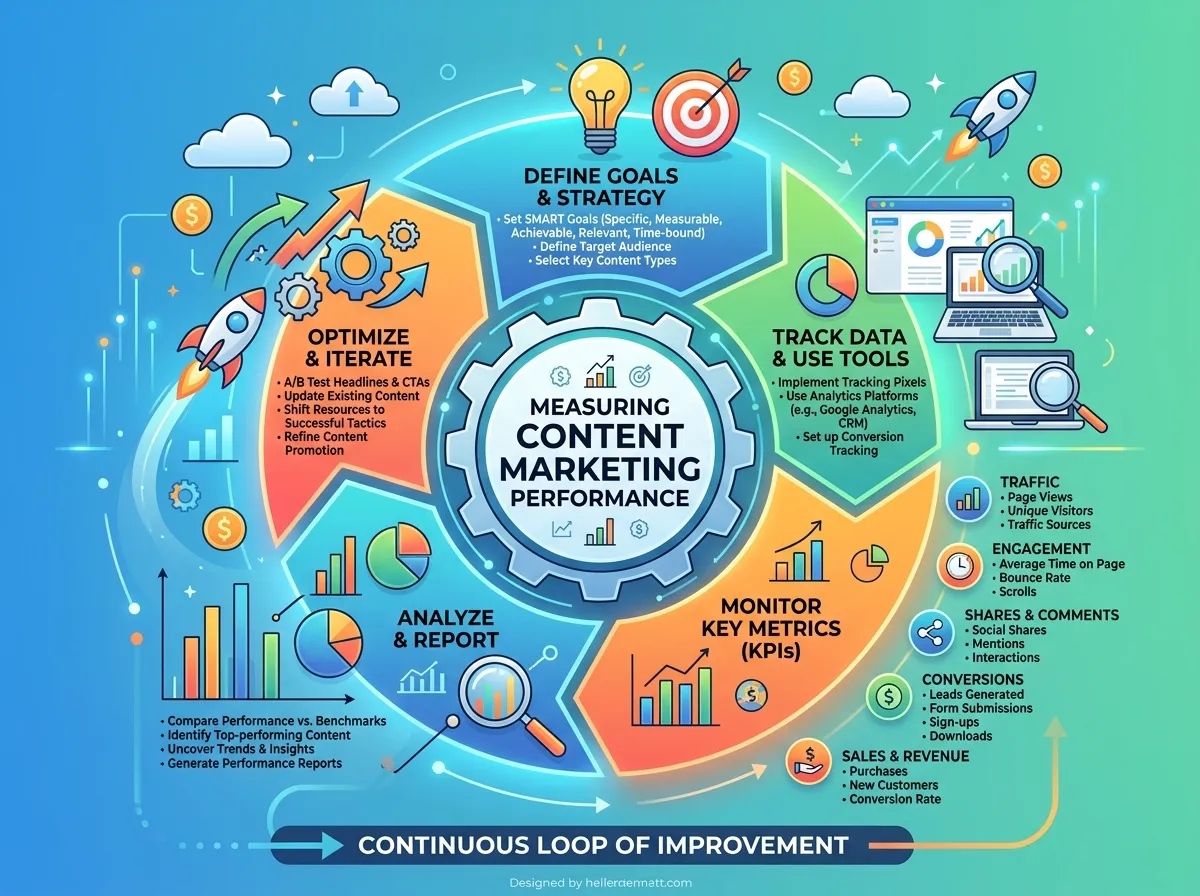
A complete audit should connect content with measurable outcomes. Content Marketing Performance Analysis can examine metrics such as organic traffic, engagement, conversions, leads, assisted conversions, backlinks, returning visitors, and other indicators relevant to the business.
Different content types may naturally have different performance goals. An awareness article may be designed primarily to attract new visitors, while a product comparison page may be more closely associated with purchase consideration. For example, an Influencer Content Creation Strategy can be evaluated through engagement, referral traffic, audience interactions, and conversions rather than traffic alone. Judging every page using the same metric can therefore produce misleading conclusions.
Performance should be considered in context. A page with modest traffic may still be valuable if it attracts highly relevant visitors who frequently convert. Conversely, a page with large traffic numbers may need improvement if visitors rarely engage with the next stage of the customer journey.
This broader perspective helps marketers understand the real contribution of content instead of focusing on a single performance indicator.
How a Content Audit Strengthens Long-Term Content Marketing
A content audit can become an important part of maintaining a healthy content ecosystem. Websites are constantly changing, and content that was relevant at one point can gradually become less effective.
Regular evaluation helps businesses keep important information current while identifying opportunities for better organization and optimization. It also creates a stronger feedback loop between publishing and performance.
The findings from one audit can influence future editorial decisions. Topics that consistently attract qualified visitors can inspire deeper related resources. Pages that fail to perform can reveal problems with subject selection, search intent, quality, or distribution. Successful content can also reveal patterns in audience interests that may not have been obvious before.
For businesses investing heavily in content marketing, this ongoing evaluation can make the content library more intentional. Instead of treating content as a collection of individual articles, marketers can develop a connected resource that supports audiences throughout their journey.
Final Thoughts
A Content Marketing Content Audit provides a clearer view of how a website’s content is performing, where quality can be improved, and where new opportunities exist. By examining content performance, quality, search visibility, strategic alignment, gaps, and audience relevance, businesses can make better-informed decisions about their existing content library.
The most valuable outcome is not simply a longer audit report. It is a stronger understanding of which content deserves to be maintained, improved, expanded, connected, consolidated, or reconsidered.
Content marketing becomes more effective when publishing and evaluation work together. New content can attract attention and address emerging needs, while regular audits ensure that existing resources continue to provide value. Over time, this approach can create a more organized, relevant, searchable, and strategically aligned content ecosystem.
Frequently Asked Questions
What is a content marketing content audit?
A content marketing content audit is a detailed evaluation of existing website and marketing content. It examines factors such as quality, relevance, search visibility, engagement, performance, strategic alignment, and opportunities for improvement.
Why is a content marketing content audit important?
It helps businesses understand how their existing content is performing and where improvements may be needed. An audit can uncover outdated information, content gaps, weak pages, overlapping topics, SEO opportunities, and high-performing resources that deserve further development.
What should be included in a content marketing audit?
A content marketing audit can include content quality, organic search performance, traffic, engagement, conversions, keyword targeting, internal links, relevance, content gaps, strategic alignment, and the overall role of each page within the website.
How often should a content audit be performed?
The appropriate frequency depends on the size and publishing activity of a website. Businesses with large and frequently changing content libraries may review content more regularly, while smaller websites may conduct comprehensive audits less often and perform smaller reviews throughout the year.
What is the difference between a content audit and an SEO audit?
A content audit focuses broadly on the quality, relevance, usefulness, performance, and strategic role of content. An SEO audit places greater emphasis on search visibility and technical or on-page factors that can affect organic performance. The two can overlap and work together.
How does content gap analysis help?
Content gap analysis identifies subjects, questions, keywords, or audience needs that are missing or insufficiently covered. It can help businesses discover opportunities to strengthen topic coverage and create content that complements their existing resources.
Can old content be improved instead of creating new content?
Yes. Older content may continue to have value even when it needs updating or optimization. Improving existing content can involve refreshing information, improving structure, addressing missing topics, strengthening internal links, and better matching current search intent.
Which metrics are useful during a content audit?
Useful metrics can include organic traffic, impressions, clicks, rankings, engagement, conversions, leads, backlinks, and returning visitors. The most appropriate metrics depend on the purpose of the individual content and the business objectives it supports.
Are content audit tools enough to evaluate content?
Tools can provide valuable data about website performance, search visibility, links, traffic, and technical issues, but they do not replace human evaluation. A strong audit combines measurable data with a review of content quality, relevance, usefulness, and strategic value.
How can a content audit improve content marketing performance?
An audit can reveal which content performs well, which pages need improvement, and where important gaps exist. Using those findings to update, optimize, connect, consolidate, or expand content can create a more useful and strategically aligned content library.