

Inbound Marketing Behavioral Data helps businesses understand how visitors interact with websites, content, and marketing campaigns. By analyzing customer behavior, tracking buyer intent signals, and segmenting audiences, marketers can personalize communication, improve lead generation, and make data-driven decisions. Combining reliable analytics with marketing automation and responsible data practices enables businesses to create more relevant customer journeys and improve marketing performance.
Inbound Marketing Behavioral Data helps businesses understand how potential customers interact with their websites, content, emails, and other digital touchpoints. By examining these interactions, marketers can identify customer interests, recognize buying signals, and create more relevant experiences throughout the buyer journey. Rather than relying only on assumptions or basic demographic information, businesses can use behavioral insights to understand what audiences need and how they respond to different marketing activities.
As customers move between blog posts, landing pages, product pages, and downloadable resources, they leave behind useful signals about their interests. A visitor who repeatedly explores a particular service may be looking for a solution, while someone who reads educational articles may still be researching a problem. Understanding these differences helps businesses deliver relevant information at the right time and develop stronger relationships with potential customers.
Understanding Inbound Marketing Behavioral Data

Inbound marketing behavioral data refers to information about the actions people take while interacting with a business’s marketing content and digital channels. These actions may include visiting specific website pages, reading articles, clicking calls to action, downloading resources, subscribing to newsletters, or returning to explore a particular topic.
The value of this information comes from its ability to reveal patterns that traditional marketing data may overlook. Demographic information can describe broad audience characteristics, but behavioral data provides additional context about what people actually do. For example, two visitors may belong to the same industry and company size category, yet one may be researching basic information while the other is comparing solutions and evaluating service options.
When marketers understand these differences, they can create more useful content experiences. Educational resources can support early research, detailed product information can help visitors compare options, and relevant follow-up communications can answer questions that arise later in the decision-making process.
Behavioral information is most effective when interpreted alongside other relevant data. A single page visit does not necessarily indicate strong buying intent, and repeated activity does not automatically mean someone is ready to purchase. Businesses need to consider context, consent, and the customer’s broader journey before making marketing decisions.
Inbound Marketing Behavior Tracking and Customer Interactions
Inbound Marketing Behavior Tracking allows businesses to observe how visitors engage with their digital experiences over time. Website analytics, campaign tracking, consent-based marketing automation, and customer relationship management systems can help connect relevant interactions to a clearer picture of customer interests.
For example, a visitor might arrive through a search engine, read an educational blog post, visit a related service page, and later download a detailed resource. Viewed together, these interactions can indicate that the visitor is exploring a particular business challenge. Marketers can use this understanding to make relevant information easier to find rather than sending unrelated promotional messages.
Tracking should focus on meaningful interactions instead of collecting every possible data point. Time spent on a page, repeated visits, content downloads, and form submissions can each provide useful context, but their significance depends on the purpose of the page and the visitor’s behavior. A long visit may indicate interest, confusion, or simply an open browser tab.
Businesses should also maintain transparent tracking practices and respect applicable privacy requirements. Clear consent mechanisms, appropriate data retention policies, and careful access controls help ensure that behavioral tracking supports the customer experience without undermining trust.
Customer Behavior Data Analysis for Better Decisions
Customer Behavior Data Analysis turns raw interaction information into insights that marketers can use to improve content, communication, and customer experiences. Instead of reviewing individual activities in isolation, businesses can examine recurring patterns across visitors, campaigns, and stages of the buyer journey.
Suppose a company publishes several articles about a specific business problem. Analytics may show that one article attracts substantial traffic, while another generates more visits to relevant service pages. The first article may be effective at attracting attention, whereas the second may be better at moving interested readers toward further research. Understanding this distinction helps marketers evaluate content according to its purpose rather than relying on traffic alone.
Behavioral analysis can also uncover friction. If visitors regularly leave a landing page without completing a form, the page may contain unclear messaging, unnecessary fields, or an offer that does not match the visitor’s expectations. If many prospects repeatedly consult the same support or pricing information, marketers may need to make that information easier to access.
Reliable analysis requires accurate measurement and sensible interpretation. Businesses should define meaningful outcomes, account for differences between traffic sources, and avoid assuming that one observed pattern proves a particular cause. Combining quantitative analytics with customer feedback often provides a more complete understanding of why people behave as they do.
Website Visitor Behavior Insights and Content Relevance
Website Visitor Behavior Insights help marketers understand which information attracts attention, which pages encourage further exploration, and where visitors encounter difficulties. These insights can guide content development, navigation improvements, and calls to action.
For example, a visitor who arrives through an educational search query may expect a clear explanation of a problem rather than an immediate sales pitch. If the landing page quickly promotes a product without answering the visitor’s question, the experience may feel disconnected from the original search. Behavioral information can help businesses identify this mismatch and provide content that better satisfies the visitor’s needs.
Businesses can also compare engagement across different content formats. Some audiences may prefer detailed articles, while others respond more positively to comparison pages, short videos, case studies, or downloadable resources. The goal is not simply to produce more content, but to make useful information accessible in the formats that support customer understanding.
Content relevance also depends on distribution. A valuable article cannot serve its intended audience if potential readers cannot discover it. Businesses can strengthen their approach through Inbound Marketing Content Distribution, connecting relevant resources with the channels and audiences most likely to benefit from them.
Behavioral Data for Lead Generation
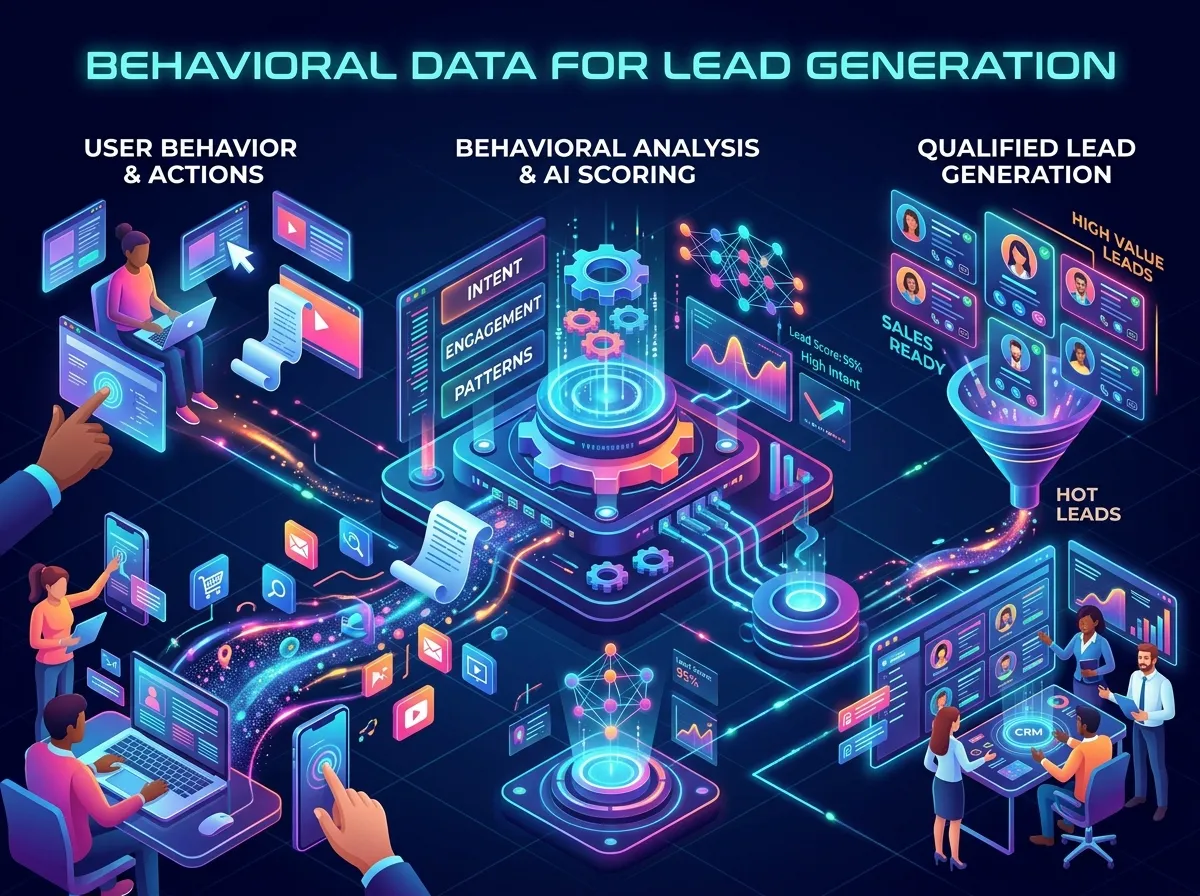
Behavioral Data for Lead Generation helps businesses understand which prospects are engaging with their content and what information may be useful as those prospects consider a solution. Instead of treating every new contact as equally interested, marketers can examine relevant interactions to determine whether someone may benefit from further educational material, a product demonstration, or a conversation with a sales representative.
A prospect who downloads an introductory guide may still be exploring a problem, while another who repeatedly reviews service details and requests a consultation may be showing stronger interest in evaluating a solution. These patterns can help marketing teams decide which resources to offer and when a direct follow-up may be appropriate.
Behavioral data becomes particularly useful when connected to lead management processes. Marketing teams can provide sales teams with relevant context about a prospect’s stated needs, requested information, and interactions with key resources. This makes conversations more informed and reduces the risk of approaching prospects with generic messages.
Businesses can strengthen this process through effective Inbound Lead Management, helping teams organize prospects, understand their progress, and maintain more consistent communication throughout the customer journey.
However, lead generation should not depend on activity volume alone. A person who visits many pages may be conducting research for professional reasons without intending to purchase. Marketers should consider explicit requests, the relevance of the content explored, and the prospect’s stated requirements before deciding how to proceed.
Understanding Inbound Marketing User Behavior Across the Buyer Journey
Inbound Marketing User Behavior changes as people move from recognizing a problem to researching possible solutions and evaluating available options. Understanding these changes helps marketers deliver content that matches the customer’s current questions rather than forcing every visitor into the same promotional sequence.
During early research, people often seek definitions, explanations, and practical information about a challenge. They may visit educational blog posts or explore broad industry topics. At this stage, useful content can build credibility and help visitors understand their options without requiring them to make an immediate commitment.
As research progresses, visitors may compare methods, investigate service features, or examine potential outcomes. Their interactions may suggest that they are trying to determine which approach best fits their needs. Detailed comparisons, relevant case studies, and explanatory product pages can help answer these questions.
Later, some prospects may request pricing, ask for a demonstration, or explore implementation details. These actions can indicate a more immediate interest in evaluating a solution, although marketers should still account for individual circumstances.
Behavioral data helps businesses recognize these differences and provide suitable information at each stage. It also helps prevent overcommunication, such as sending sales-focused messages to people who have only begun researching a topic. A responsive inbound marketing experience respects the pace of the customer while making the next useful step clear.
Customer Journey Behavior Analysis and Connected Experiences
Customer Journey Behavior Analysis examines how people move between marketing touchpoints and how their interactions relate to their overall experience with a business. A customer journey may include search results, blog content, email communication, landing pages, product information, and conversations with sales or support teams.
Looking at these touchpoints separately can hide important connections. A blog post may introduce a visitor to a brand, an email may provide additional information, and a later website visit may indicate renewed interest. When businesses can responsibly connect these interactions, they gain a better understanding of how different marketing activities contribute to customer progress.
Journey analysis can reveal where people lose interest or encounter unnecessary obstacles. For instance, visitors may engage with educational content but rarely continue to the related service page. This could suggest that the next step is difficult to find or that the service page does not answer the questions raised by the article. Improving the connection between these resources may create a smoother experience.
Accurate journey analysis requires consistent measurement across channels and careful handling of identity data. Businesses should not assume that every interaction belongs to the same person unless there is a reliable, appropriate basis for connecting it. Recognizing the limits of available information helps teams avoid overstating what their data can prove.
Behavioral Data Segmentation and Personalized Marketing
Behavioral Data Segmentation groups audiences according to meaningful interaction patterns, interests, or expressed needs. Rather than relying exclusively on broad demographic categories, businesses can use behavioral segments to make content and communication more relevant to what people are exploring.
For example, one segment might include visitors who regularly read educational content, while another may consist of prospects who have requested detailed information about a specific service. A business could provide the first group with additional learning resources and offer the second group more focused information about features, implementation, or pricing.
Segmentation also helps marketers identify different content preferences. Some prospects may engage with technical explanations, while others are more interested in practical outcomes or customer experiences. When these differences are supported by sufficient evidence, businesses can adjust their content and communication accordingly.
Segments should remain flexible because interests change. A prospect who initially explores introductory content may later become interested in detailed comparisons, while an existing customer may return to research an entirely different need. Regularly reviewing segment definitions helps prevent outdated assumptions from shaping the customer experience.
Personalization should also be proportionate. Using a visitor’s stated interest to recommend a related article may feel helpful, whereas making intrusive assumptions based on limited browsing activity can feel uncomfortable. Transparent practices and relevant messaging help maintain the balance between personalization and customer trust.
Marketing Behavior Analytics and Automation
Marketing Behavior Analytics helps businesses understand how customers respond to campaigns, content, and digital experiences. When these insights are connected to appropriate marketing automation systems, businesses can use meaningful actions to support timely communication and reduce repetitive manual work.
For example, a visitor who requests a downloadable resource may receive a relevant follow-up containing additional information on the same topic. If the visitor later asks for a consultation, the communication process can respond to that explicit request instead of continuing to send introductory material. These interactions make automation more responsive to customer needs.
Automation is most effective when it follows clear rules and meaningful signals. A single page visit should not automatically trigger a series of aggressive sales messages, and an inactive contact should not continue receiving irrelevant communications indefinitely. Frequency controls, preference management, and clear exit conditions help ensure that automated communication remains useful.
Businesses exploring these capabilities can learn more from the Inbound Marketing Automation Guide, which discusses how automation can streamline marketing processes and support lead development.
Behavioral automation also depends on accurate data. Duplicate records, incomplete tracking, and outdated preferences can cause messages to be sent at the wrong time or to the wrong audience. Regular data maintenance and performance reviews help organizations keep automated workflows aligned with real customer behavior.
Buyer Intent Behavior Signals and Marketing Priorities
Buyer Intent Behavior Signals are actions that may suggest a person is actively evaluating a product, service, or solution. These signals can include repeated visits to relevant service pages, engagement with comparison content, requests for pricing information, or direct inquiries about implementation.
Such activities can help marketers prioritize communication, but they should not be interpreted as definitive proof of purchase intent. A person might revisit a pricing page to gather information for a colleague, conduct market research, or compare options without planning an immediate purchase. The strongest conclusions usually come from several relevant signals combined with explicit information supplied by the prospect.
Businesses can use these signals to determine which resources may be most helpful next. Someone comparing different solutions may benefit from a clear comparison or case study, while someone who requests a consultation should receive an appropriate response to that request. The aim is to reduce friction and provide useful information rather than pressure every engaged visitor into a sale.
Sales and marketing teams should also agree on how behavioral signals influence follow-up. Clear definitions of qualified leads, relevant activities, and response expectations help prevent inconsistent decisions and create a smoother transition between marketing engagement and sales conversations.
Improving Data Quality and Operational Efficiency

Behavioral insights are only as useful as the information behind them. Missing tracking events, inconsistent campaign labels, duplicated contact records, and poorly defined metrics can distort analysis and lead to ineffective decisions. Businesses should establish consistent measurement practices so that interactions can be interpreted accurately across relevant channels.
Data entry also affects the reliability of marketing records. When customer information is entered manually, mistakes and inconsistencies may make it harder to connect interactions or maintain useful records. Where suitable, automation can reduce repetitive administrative work and improve consistency. For example, businesses can explore Automate Data Entry with Voice Recognition AI to understand how voice recognition technology may support data entry processes.
Any automation involving customer records should be reviewed for accuracy, security, and suitability. Voice recognition and other automated systems can introduce errors, so important fields may require validation before the information is used for marketing or customer decisions.
Reliable data practices also include defining which events matter, documenting how metrics are calculated, and removing or correcting information when appropriate. These foundations make it easier to distinguish meaningful customer patterns from tracking errors or incomplete records.
Data-Driven Inbound Marketing Decisions
Data-Driven Inbound Marketing Decisions connect behavioral insights to practical improvements in content, customer communication, and marketing performance. Instead of assuming that a campaign is successful because it generates clicks, businesses can evaluate whether visitors find useful information, continue exploring relevant resources, complete intended actions, and progress toward meaningful outcomes.
A company might discover that a blog attracts many visitors but rarely leads to engagement with related resources. Another article may attract a smaller audience but encourage more visitors to explore a service or request additional information. Both articles may have value, but their roles in the customer journey are different. Understanding these differences helps marketers allocate resources according to clear objectives.
Businesses should combine behavioral metrics with conversion data, customer feedback, and business outcomes. This broader view helps teams identify opportunities without relying on a single indicator. Regular testing can then establish whether changes to content, page structure, messaging, or calls to action produce measurable improvements.
Privacy and customer trust should remain part of every decision. Behavioral information should be used for clear, appropriate purposes, with suitable safeguards and respect for customer preferences. When data collection is transparent and insights are applied thoughtfully, inbound marketing becomes more relevant, measurable, and responsive.
Conclusion
Inbound Marketing Behavioral Data gives businesses a deeper understanding of how customers discover content, explore solutions, and interact with digital marketing experiences. Through behavior tracking, customer data analysis, journey analysis, segmentation, and intent signals, marketers can improve content relevance, identify promising leads, and create smoother customer journeys.
The strongest results come from combining accurate data with careful interpretation and responsible practices. Rather than collecting information for its own sake, businesses should focus on behavioral insights that help answer customer questions, improve communication, and support meaningful marketing outcomes. This approach creates a more effective inbound marketing experience while protecting the trust that long-term customer relationships depend on.
Frequently Asked Questions
1. What is inbound marketing behavioral data?
Inbound marketing behavioral data is information about how people interact with a business’s digital content and marketing channels. It can include website visits, article engagement, content downloads, email interactions, and form submissions. Businesses use these signals to understand customer interests and improve marketing experiences.
2. Why is behavioral data important for inbound marketing?
Behavioral data helps marketers understand what visitors are interested in, which resources they find useful, and where they may encounter difficulties. These insights can improve content relevance, lead qualification, customer communication, and the overall buyer journey.
3. How can businesses track inbound marketing behavior?
Businesses can use website analytics, campaign tracking, consent-based marketing automation, and customer relationship management systems. These tools help monitor relevant interactions and identify patterns, provided that tracking is configured accurately and follows applicable privacy requirements.
4. How does customer behavior data analysis improve marketing performance?
Customer behavior data analysis helps businesses identify which content attracts attention, which pages encourage further engagement, and where visitors abandon the journey. These findings can guide improvements to content, landing pages, messaging, and calls to action.
5. What is behavioral data segmentation?
Behavioral data segmentation groups audiences according to their interactions, interests, and relevant actions. For example, businesses may distinguish between visitors researching a topic and prospects exploring service details so each group can receive more relevant information.
6. How does behavioral data support lead generation?
Behavioral data can reveal which prospects are engaging with relevant resources and may need additional information. By considering these activities alongside explicit inquiries and stated needs, businesses can prioritize appropriate follow-up and improve the transition from marketing to sales.
7. What are buyer intent behavior signals?
Buyer intent behavior signals are actions that may suggest someone is evaluating a solution. Examples include revisiting service pages, reviewing pricing information, exploring comparison content, and requesting a consultation. These signals provide context but do not independently confirm that someone is ready to purchase.
8. How does marketing automation use behavioral data?
Marketing automation can use relevant customer actions to trigger timely and useful communications. For example, someone who downloads a resource may receive related educational content. Effective automation should respect customer preferences, avoid excessive messaging, and use accurate data.
9. What challenges can businesses face when using behavioral data?
Common challenges include inaccurate tracking, incomplete records, duplicated data, misleading interpretations, disconnected systems, and privacy concerns. Consistent measurement, data validation, responsible data handling, and regular performance reviews can help address these issues.
10. How can businesses make data-driven inbound marketing decisions?
Businesses can combine behavioral analytics with conversion metrics, customer feedback, and business goals. By evaluating content engagement, lead quality, task completion, and customer journey patterns, marketers can identify useful improvements and test whether those changes deliver meaningful results.