The inbound marketing process helps businesses attract prospects, engage audiences, nurture leads, support sales, and build lasting customer relationships. By combining content marketing, SEO, automation, lead nurturing, and the attract engage delight methodology, businesses can create a customer-focused marketing system that supports sustainable growth.
The inbound marketing process is a customer-focused approach that helps businesses attract potential customers through valuable content, meaningful interactions, and relevant experiences. Instead of relying primarily on disruptive advertising, inbound marketing focuses on creating useful information that helps people discover a business, understand its offerings, and eventually become customers.
Modern buyers often research products and services extensively before contacting a company. They may search Google, read articles, compare solutions, watch videos, review social media content, and look for customer experiences before making a purchasing decision. The inbound marketing process supports this behavior by providing helpful information throughout the customer journey.
A successful inbound approach connects content, search engine optimization, social media, email marketing, marketing automation, sales communication, and customer experience. Each part contributes to moving prospects from initial awareness toward engagement, conversion, purchase, and long-term loyalty.
Understanding how the inbound process works is therefore important for businesses that want to build sustainable customer relationships rather than depending entirely on short-term promotional campaigns.
What Is the Inbound Marketing Process?
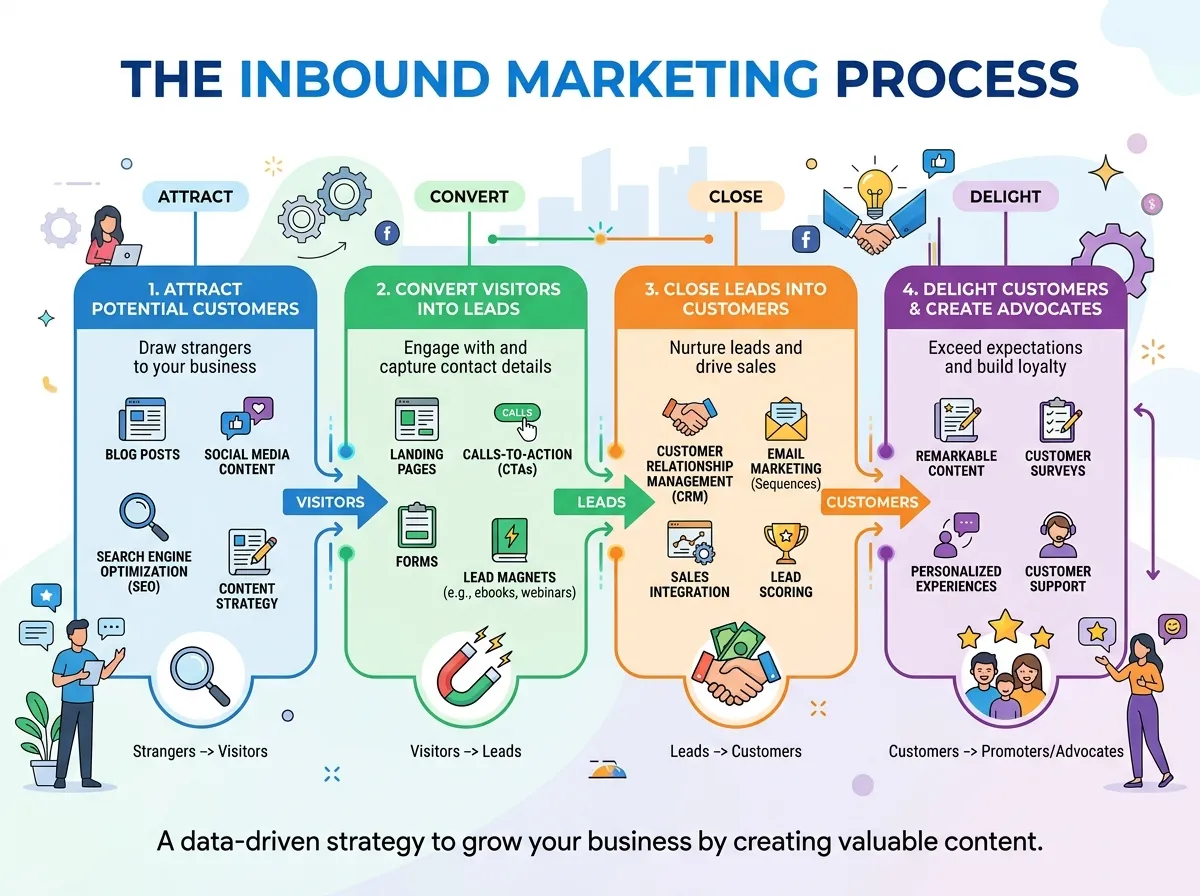
The inbound marketing process describes the sequence through which a business attracts potential customers, engages them with relevant information, converts interested prospects into leads, nurtures those leads, supports the sales process, and continues providing value after a purchase.
The process is based on the idea that customers should be attracted through useful experiences rather than interrupted with irrelevant promotional messages.
A person searching for a solution to a problem may discover a company’s blog article through organic search. After reading the article, they may download a resource, subscribe to an email list, or explore a product page. The business can then continue communicating with that person through relevant content and personalized messages.
Over time, the prospect may become sufficiently informed and confident to request a consultation, start a trial, or make a purchase.
The process does not necessarily end with the sale. Existing customers can continue receiving helpful resources, product support, personalized recommendations, and educational content. This can encourage retention, repeat purchases, and advocacy.
Inbound Marketing Strategy
An inbound marketing strategy provides the overall framework for attracting and converting the right audience. It connects business objectives with customer needs and determines what types of content and experiences should be created throughout the buying journey. A well-planned strategy can also incorporate content marketing, influencer partnerships, marketing automation, and conversion optimization to create a more complete customer acquisition process.
The strategy begins with understanding the target audience. Businesses need to know what potential customers are searching for, what challenges they experience, what questions they ask, and what factors influence purchasing decisions.
This information can shape content topics, landing pages, email campaigns, social media communication, and sales messaging. Working with relevant creators can also expand reach and credibility, particularly when businesses use an effective influencer content creation strategy to connect with audiences through trusted voices.
Search engine optimization is often an important part of the strategy because search engines can introduce prospects to a business when they are actively looking for information. Content can target informational searches at the awareness stage and more commercially focused searches as prospects move closer to purchasing.
An effective strategy also connects marketing and sales. Marketing may generate and nurture leads, while sales can engage prospects who demonstrate stronger purchase intent. When both teams work from shared information and objectives, the customer experience becomes more consistent.
Inbound Marketing Methodology
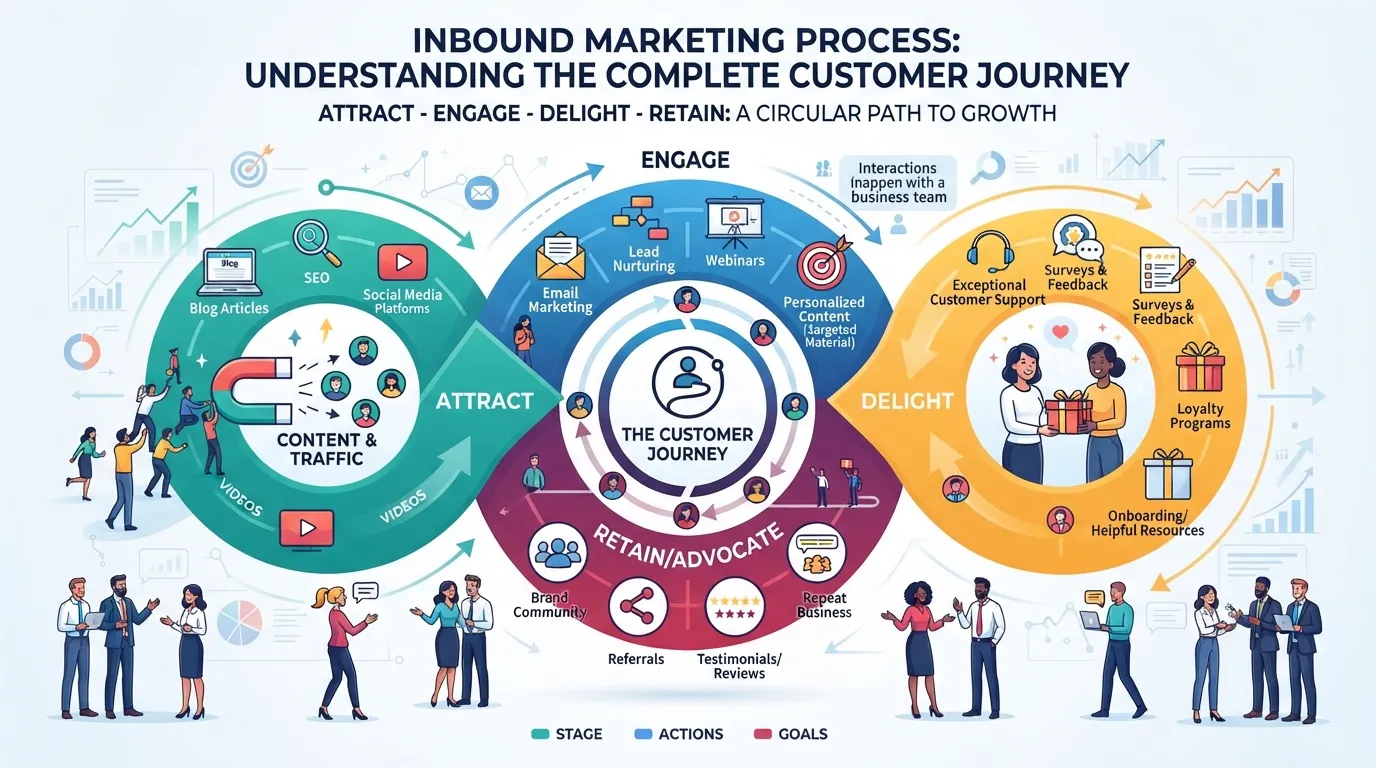
The inbound marketing methodology traditionally focuses on attracting, engaging, and delighting customers. These stages represent an ongoing relationship rather than a simple linear path toward a transaction.
The attract stage is designed to bring relevant visitors to a company’s digital properties. Search-optimized articles, educational resources, videos, social media content, podcasts, and other useful materials can introduce potential customers to the brand.
The engage stage focuses on developing relationships with visitors and leads. Personalized content, email communication, product information, consultations, and relevant offers can help prospects evaluate their options.
The delight stage focuses on creating positive experiences for customers after conversion. Helpful support, educational resources, personalized communication, and proactive customer service can encourage satisfaction and loyalty.
The methodology recognizes that customers can influence future prospects. A satisfied customer may leave a positive review, recommend the company, share content, or become an advocate for the brand.
Inbound Marketing Funnel
The inbound marketing funnel represents the movement of prospects from initial awareness toward consideration and conversion. Although modern customer journeys are often more complex than a traditional funnel suggests, the concept remains useful for understanding how content and communication should change according to customer intent.
At the awareness stage, prospects may not yet know which company or product can solve their problem. Educational content can help them understand the issue and explore possible solutions.
During consideration, prospects have generally become more informed. They may compare providers, evaluate features, research pricing, and look for evidence that a particular solution can meet their needs. Case studies, comparison content, webinars, detailed product pages, and expert resources can support this stage.
At the decision stage, prospects may be ready to contact sales, request a demonstration, start a free trial, or purchase a product. Strong calls to action and clear information can reduce friction. Improving these elements is an important part of inbound marketing conversion rate improvement, particularly when businesses analyze landing pages and user behavior to identify conversion barriers.
After conversion, the relationship continues through onboarding, customer support, educational content, and retention campaigns.
Inbound Lead Generation
Inbound lead generation focuses on turning interested website visitors and audience members into identifiable prospects. Valuable content is often the foundation of this process.
A business might offer an ebook, checklist, research report, webinar, template, free consultation, product trial, or other useful resource in exchange for contact information.
The value of the offer should match the audience’s needs and stage in the buying journey. Someone researching a general business problem may be more interested in educational content than a sales consultation.
Landing pages play an important role because they provide focused environments for lead conversion. A clear value proposition, relevant information, simple forms, and persuasive calls to action can make it easier for visitors to take the desired action.
Once someone becomes a lead, the business can use additional content and communication to understand their interests and purchasing intent. Marketing automation can make this process more efficient by helping businesses segment leads, trigger personalized communications, and nurture prospects based on their behavior. A structured inbound marketing automation approach can therefore support lead nurturing while reducing repetitive manual tasks.
Content Marketing Strategy
A strong content marketing strategy supports nearly every stage of inbound marketing. Content provides the information prospects need to understand problems, evaluate solutions, and make informed decisions.
Blog articles can attract organic search traffic, while videos can explain complicated concepts visually. Case studies can demonstrate results, white papers can provide detailed research, and webinars can create opportunities for deeper engagement.
Content should not be created solely to fill a publishing calendar. It should address real customer questions and connect naturally with the products or services offered by the business.
Search intent is particularly important. Someone searching for “what is marketing automation” has a different intent from someone searching for “best marketing automation software for small business.” The first query may require educational content, while the second may require comparison or product-focused content.
By aligning content with intent, businesses can create more relevant experiences and attract visitors who are more likely to become qualified leads. Measuring the performance of these efforts is equally important, which is why businesses should evaluate content marketing ROI using metrics such as organic traffic, engagement, leads, conversions, customer acquisition, and revenue.
Customer Journey Marketing
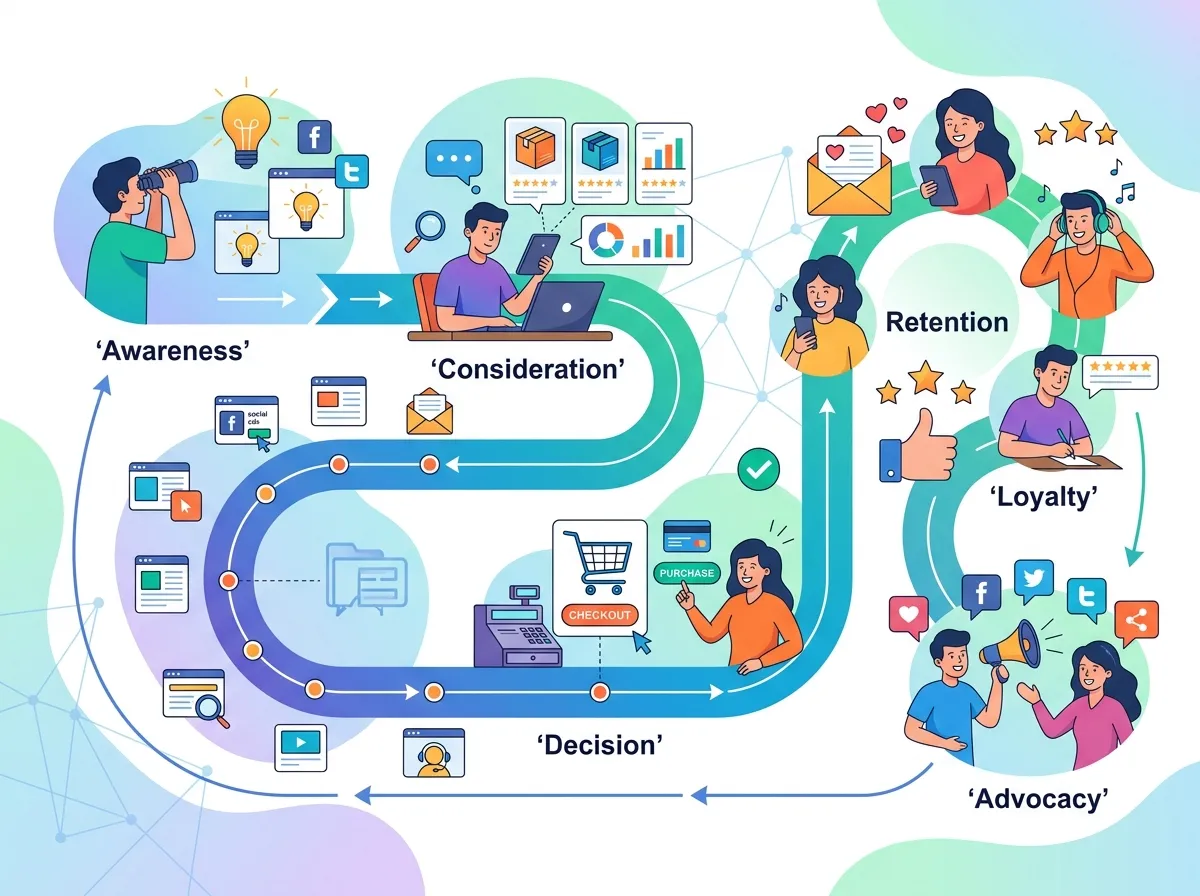
Customer journey marketing recognizes that buyers can interact with a company through many different channels before making a decision.
A potential customer might first discover a brand through Google, visit its website, follow the company on social media, read several articles, subscribe to an email newsletter, attend a webinar, speak with sales, and eventually purchase.
Each interaction contributes to the overall perception of the brand.
Customer journey marketing attempts to make these interactions connected and relevant. Instead of treating every channel as an independent activity, businesses can use customer information to create more consistent communication.
For example, someone who downloads an introductory guide should not necessarily receive the same messaging as an existing customer. Their needs and expectations are different.
Understanding the customer journey also helps businesses identify friction. If many prospects visit a pricing page but fail to request a consultation, the company may need to improve the information, trust signals, user experience, or conversion process.
Marketing Automation Process
The marketing automation process allows businesses to manage repetitive marketing activities using software and predefined workflows. Automation can help deliver relevant communication at the appropriate stage of the customer journey.
For example, a visitor may download an educational resource and automatically receive a confirmation email. Several days later, they may receive another piece of relevant content. If they continue engaging with the company’s website and emails, the system can adjust future communication based on their behavior.
Automation can also help identify highly engaged leads. A prospect who repeatedly visits product pages, attends webinars, and interacts with emails may demonstrate stronger purchase intent than someone who downloaded a single article.
Automation should not mean sending the same message to everyone. Effective automation combines behavioral data, customer information, segmentation, and relevant content to create more personalized experiences.
Lead Nurturing Strategy
A lead nurturing strategy develops relationships with prospects who are not yet ready to purchase. Many leads require time to research, compare options, obtain approval, or understand the value of a product before making a decision.
Lead nurturing keeps the business connected with these prospects without overwhelming them with constant sales messages.
Educational emails, case studies, industry research, product information, customer stories, webinars, and personalized recommendations can gradually increase confidence.
Segmentation makes nurturing more effective. Leads can be grouped according to industry, interests, company size, previous interactions, buying stage, or other relevant characteristics.
A prospect who has shown interest in one service can receive information related to that service rather than generic marketing content. This makes communication more useful and increases the likelihood of meaningful engagement.
Inbound Sales Process
The inbound sales process connects marketing-generated interest with direct sales conversations. Instead of approaching completely unfamiliar prospects, sales teams can focus on people who have already demonstrated some level of interest.
Marketing data can provide useful context for sales representatives. A lead may have attended a webinar, downloaded several resources, visited pricing pages, or interacted with product content.
This information can help sales teams understand what the prospect may be interested in before starting a conversation.
The sales process should remain consultative. Prospects often appreciate representatives who understand their challenges and provide relevant information rather than immediately pushing for a purchase.
Marketing and sales alignment is therefore essential. Both teams should have a shared understanding of lead quality, customer needs, messaging, and conversion goals.
Attract Engage Delight Methodology
The attract engage delight methodology emphasizes the idea that inbound marketing continues throughout the customer relationship.
Attracting people requires valuable content and experiences that answer their questions. Engaging them requires relevant communication, personalization, and interactions that help them make decisions. Delighting them requires excellent customer experiences after conversion.
This approach changes the role of marketing from simply generating transactions to building relationships.
A customer who receives useful support and relevant educational content may become more satisfied with the company’s products. That satisfaction can lead to renewals, repeat purchases, positive reviews, referrals, and social advocacy.
The delight stage can therefore contribute to future acquisition as existing customers become another source of brand visibility and credibility.
The Role of Data in the Inbound Marketing Process
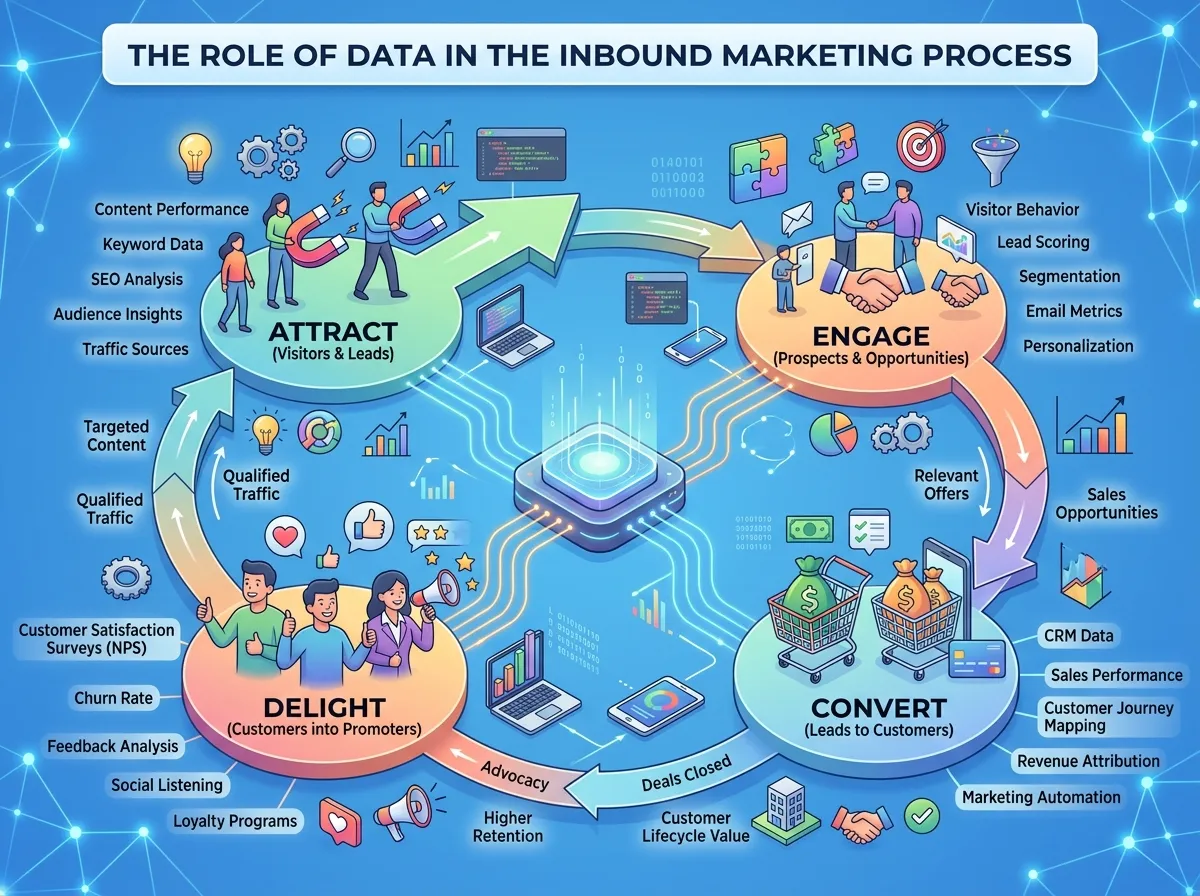
Data helps businesses understand how people interact with inbound marketing campaigns. Website analytics can show which content attracts visitors, while conversion data can reveal which pages generate leads.
Email engagement can provide insight into which subjects and topics resonate with subscribers. CRM data can help connect marketing activity with sales outcomes.
Businesses can use this information to identify high-performing content and improve weaker areas of the customer journey.
For example, if an article receives significant organic traffic but generates few leads, the business may evaluate whether the content offers an appropriate next step. If a landing page receives many visitors but has a low conversion rate, its messaging or user experience may need improvement.
Data therefore helps turn inbound marketing into an ongoing optimization process rather than a fixed campaign.
Inbound Marketing and Long-Term Business Growth
The inbound marketing process can support long-term growth because useful content can continue attracting prospects after publication. A well-optimized article may generate organic traffic for months or years, while a valuable resource can continue generating leads through search and referrals.
This creates a cumulative effect. As a business publishes more high-quality content and builds stronger visibility, it can develop a larger library of resources that supports customers at different stages of the buying journey.
Inbound marketing can also strengthen brand authority. Consistently answering customer questions and demonstrating expertise can make a company more recognizable and trustworthy within its industry.
The result is a marketing ecosystem where content, search visibility, lead generation, automation, sales, and customer experience work together.
Conclusion
The inbound marketing process provides a structured way for businesses to attract potential customers, develop relationships, generate qualified leads, support purchasing decisions, and create long-term customer loyalty.
An effective inbound marketing strategy combines the inbound marketing methodology, content marketing, search optimization, lead generation, customer journey marketing, automation, nurturing, and sales alignment.
The inbound marketing funnel helps businesses understand changing customer needs, while the attract engage delight methodology emphasizes that the relationship should continue beyond the initial purchase.
Rather than focusing entirely on immediate sales, inbound marketing creates value throughout the customer journey. When businesses consistently provide useful information, personalized communication, and positive experiences, they can build stronger relationships and create a sustainable foundation for long-term growth.
Frequently Asked Questions
1. What is the inbound marketing process?
The inbound marketing process is a customer-focused approach that attracts prospects through valuable content, engages them with relevant communication, converts them into leads and customers, and continues supporting them after purchase.
2. What are the main stages of inbound marketing?
The main stages are commonly described as attract, engage, and delight. These stages represent how businesses attract potential customers, develop relationships with prospects, and create positive experiences for existing customers.
3. What is an inbound marketing strategy?
An inbound marketing strategy is a plan for attracting and converting customers through useful content, search engine optimization, social media, email marketing, lead generation, automation, and customer-focused experiences.
4. How does the inbound marketing funnel work?
The inbound marketing funnel describes how prospects move from awareness to consideration and eventually toward a purchasing decision. Different types of content and communication support prospects at each stage.
5. What is inbound lead generation?
Inbound lead generation involves attracting interested prospects through valuable content and experiences and encouraging them to provide contact information or take another meaningful conversion action.
6. Why is content important in inbound marketing?
Content gives prospects useful information that helps them understand problems, evaluate solutions, and make purchasing decisions. It can also improve search visibility, generate traffic, establish authority, and support lead nurturing.
7. What is lead nurturing in inbound marketing?
Lead nurturing is the process of developing relationships with prospects who are not yet ready to buy. Businesses use relevant content, email communication, educational resources, and personalized interactions to maintain engagement and build purchase confidence.
8. How does marketing automation support inbound marketing?
Marketing automation helps businesses manage repetitive activities such as email sequences, lead segmentation, follow-ups, and behavioral communication. It can make inbound campaigns more consistent and personalized.
9. What is the difference between inbound marketing and inbound sales?
Inbound marketing focuses primarily on attracting, educating, engaging, and nurturing prospects, while inbound sales focuses on helping interested prospects evaluate a solution and move toward a purchasing decision.
10. Why is the attract engage delight methodology important?
The attract engage delight methodology emphasizes that customer relationships continue after acquisition. By attracting the right audience, providing relevant engagement, and delivering excellent customer experiences, businesses can encourage loyalty, retention, referrals, and long-term growth.