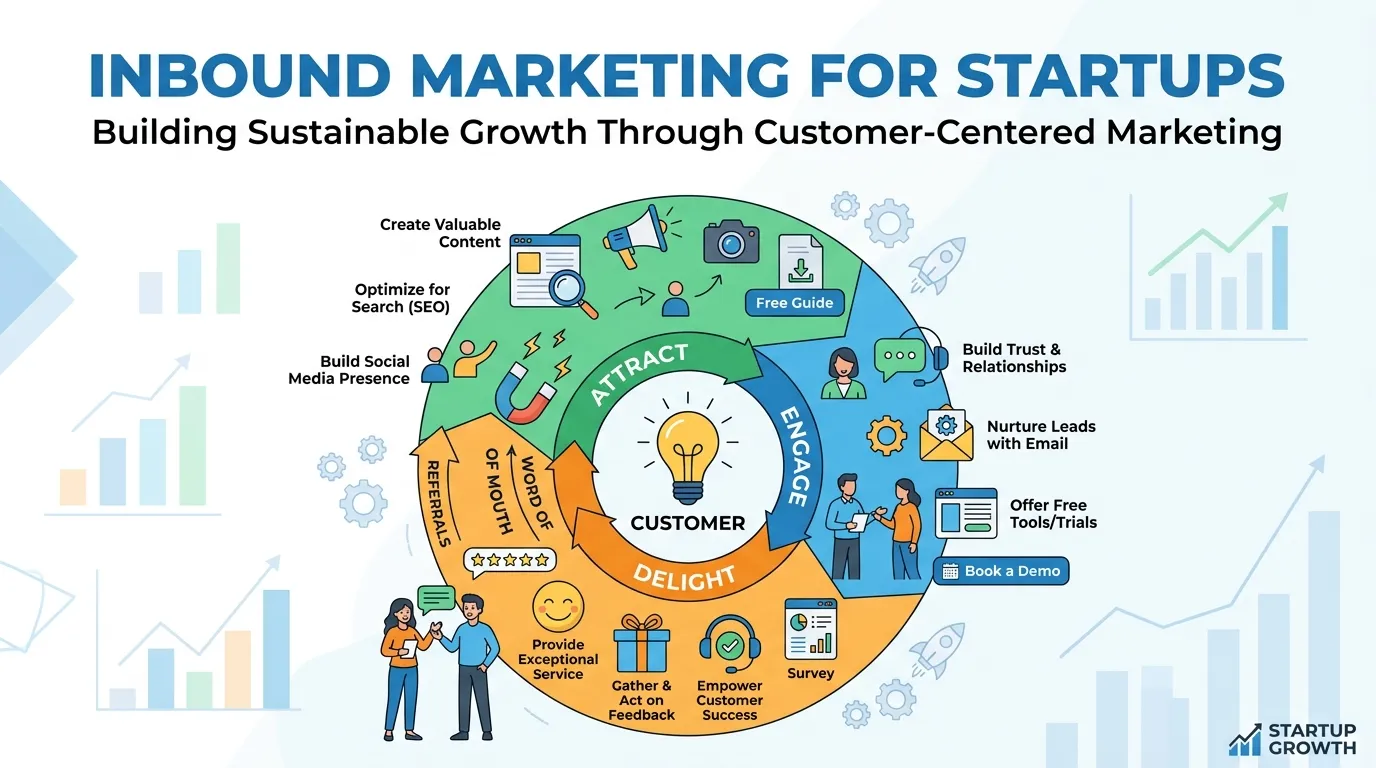
Inbound marketing for startups helps new businesses attract qualified customers through valuable content, SEO, lead generation, automation, and customer-focused communication. A strong inbound strategy can reduce dependence on paid advertising, support lead nurturing, improve customer acquisition, and create sustainable long-term growth.
Starting a new business often means working with limited budgets, small teams, and ambitious growth targets. Unlike established companies, startups usually cannot depend on large advertising budgets or extensive brand recognition to attract customers. They need marketing strategies that create visibility, generate qualified leads, build trust, and support long-term growth without requiring excessive spending.
This is where inbound marketing for startups becomes particularly valuable. Instead of relying primarily on disruptive advertising, inbound marketing focuses on creating useful content and experiences that attract potential customers when they are actively searching for information, solutions, or products.
For startups, this approach can create a foundation that continues producing value over time. A well-written article can attract organic traffic months after publication, an informative webinar can generate leads, and an optimized landing page can convert visitors without requiring a new advertising campaign every day.
Inbound marketing also allows startups to understand their audiences more deeply. By analyzing search behavior, content engagement, website interactions, and customer questions, businesses can develop marketing experiences that are more relevant to the people they want to reach.
Why Inbound Marketing Matters for Startups
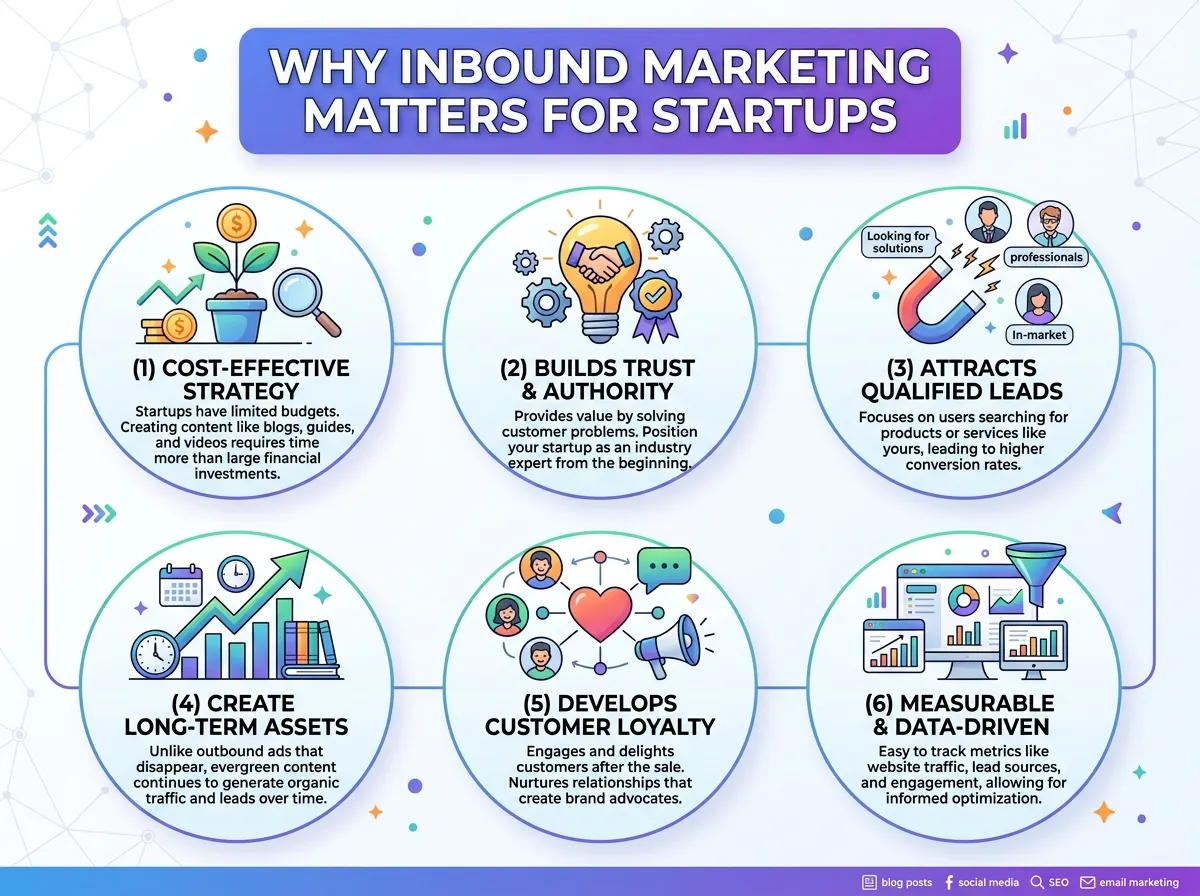
Startups face a unique marketing challenge. They need to establish credibility while simultaneously generating demand and acquiring customers. Many potential customers may not know the company exists, making awareness an important part of the process.
Traditional advertising can provide visibility, but continuously paying for exposure can become expensive for a startup with limited resources. Inbound marketing takes a different approach by investing in assets that can continue attracting and educating potential customers.
A strong startup inbound marketing strategy can connect brand awareness, search engine optimization, content creation, social media, email marketing, lead generation, and sales into a connected customer acquisition system.
The goal is not simply to increase website traffic. The objective is to attract the right audience, provide meaningful information, develop trust, and gradually move interested prospects toward becoming customers.
This makes inbound marketing especially useful for startups operating in competitive markets where trust and expertise influence purchasing decisions.
Creating a Strong Startup Inbound Marketing Strategy
A successful startup inbound marketing strategy begins with understanding the audience rather than immediately choosing marketing channels. Startups need to know who their ideal customers are, what problems they are experiencing, what questions they ask, and what factors influence their buying decisions.
Audience research can reveal valuable opportunities for content and search visibility. For example, a software startup may discover that its target customers are searching for solutions to specific operational problems rather than searching directly for the company’s product category.
Creating content around those problems can introduce the startup to potential customers earlier in their buying journey.
The strategy should also establish a clear brand message. Startups often have limited recognition, so every interaction should communicate what the company does, who it serves, and why its solution is valuable.
When content, website messaging, social communication, and sales conversations consistently reinforce the same value proposition, the startup can develop a stronger market identity.
Inbound Lead Generation for Startups
nbound lead generation for startups focuses on attracting potential customers through valuable experiences instead of depending entirely on outbound prospecting or paid advertising.
Search-optimized blog content is one of the most accessible ways for startups to generate inbound leads. Educational articles can target questions and problems that potential customers are already researching. Over time, this content can attract organic visitors and introduce them to the company’s products or services.
Lead magnets can further support the process. A startup might offer a useful checklist, research report, template, calculator, webinar, or industry resource in exchange for contact information.
The quality of the offer matters because visitors are more likely to provide their information when they believe the resource provides genuine value.
Landing pages also play an important role. A visitor who arrives through an article should have a clear path toward learning more, requesting a demonstration, subscribing to email updates, or accessing another relevant resource.
Effective inbound lead generation therefore combines visibility, useful content, conversion opportunities, and a clear understanding of the customer journey. Startups should also consider how chat commerce in inbound marketing can create conversational paths between initial interest and conversion.
Content Marketing for Startups
Content marketing for startups can become one of the strongest long-term assets for a growing company. Startups can use content to demonstrate expertise, answer customer questions, explain complex products, and differentiate themselves from competitors.
Content should not exist simply to fill a publishing calendar. Every piece should have a meaningful purpose.
Educational blog posts can address informational searches, while comparison articles can help prospects evaluate solutions. Case studies can demonstrate real-world results, and product-focused content can explain how a solution addresses specific customer problems.
Video, webinars, podcasts, newsletters, and social media content can expand the reach of these ideas across different channels.
A startup can also repurpose high-performing content. A detailed article can become a series of social posts, an email newsletter, a short video, or a webinar topic. This allows small teams to maximize the value of their content investment.
Strong content can also contribute to brand authority. When potential customers repeatedly encounter useful and accurate information from a startup, the company becomes more familiar and credible.
Startup Customer Acquisition Strategy
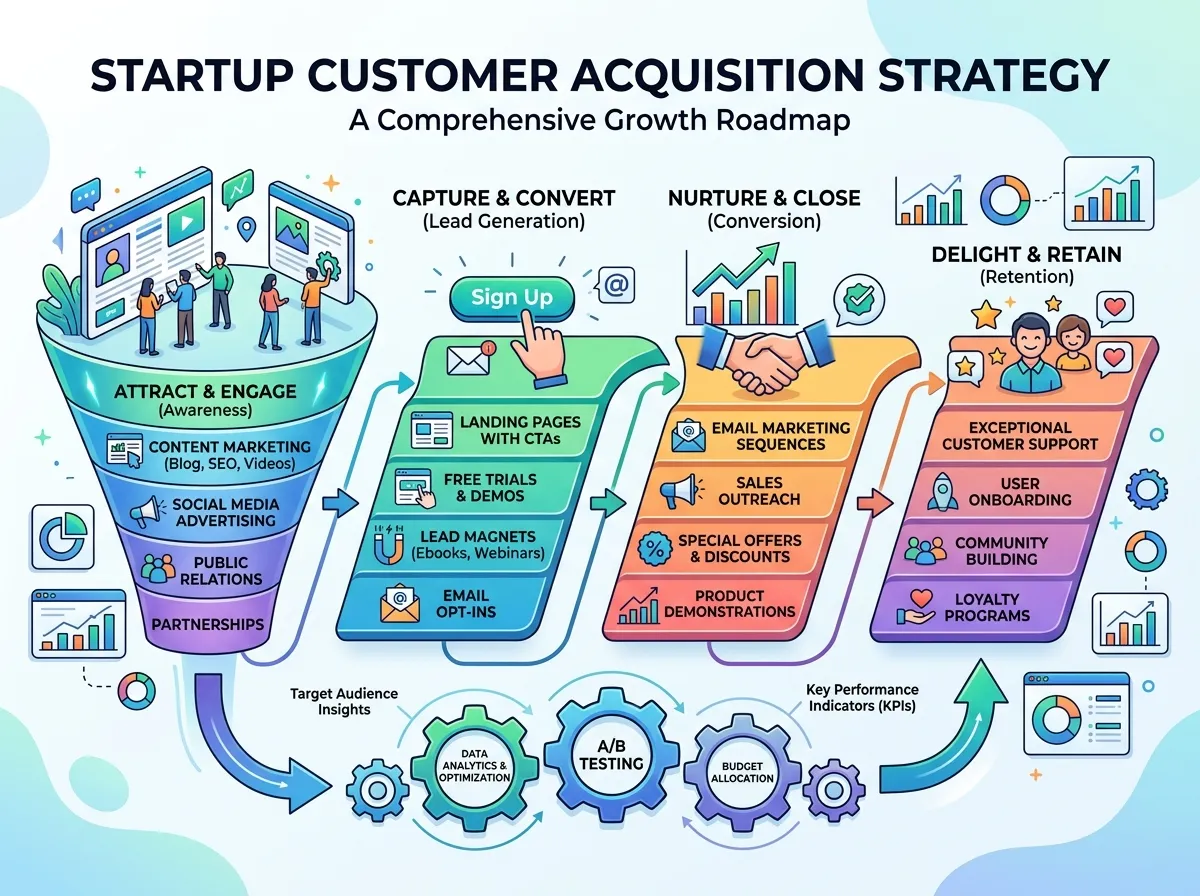
A successful startup customer acquisition strategy should balance immediate opportunities with long-term marketing assets.
Startups often need customers quickly, but focusing exclusively on short-term acquisition can create dependency on paid channels. Inbound marketing provides an opportunity to develop organic and owned channels that become increasingly valuable over time.
Search visibility, email subscribers, educational resources, and returning website visitors can create a growing marketing ecosystem. A structured inbound marketing content distribution approach can help startups extend the reach of valuable content across the channels where potential customers are most likely to discover it.
Customer acquisition also becomes more efficient when startups understand which audiences are most valuable. Not every website visitor or lead has the same commercial potential. Marketing teams should pay attention to customer fit, buying intent, engagement, and eventual revenue contribution.
This information can help startups focus resources on audiences that are more likely to become profitable customers.
Inbound marketing can therefore support customer acquisition while simultaneously improving the startup’s understanding of its market.
Inbound Sales for Startups
Inbound sales for startups works closely with marketing because leads generated through inbound channels often arrive with different levels of awareness and intent.
Some prospects may only be researching a problem, while others may already understand their requirements and be comparing providers. Treating both groups identically can result in poor customer experiences.
Marketing content can help educate prospects before they speak with a sales representative. Product comparisons, pricing information, FAQs, case studies, and implementation resources can address common concerns before a sales conversation takes place.
Sales teams can then use information about a prospect’s content interactions and interests to create more relevant conversations.
This relationship between marketing and sales can make the overall acquisition process more efficient. Instead of starting every conversation from the beginning, sales representatives can build on the information prospects have already explored.
Startup Marketing Automation
As a startup grows, manually managing every lead, email, follow-up, and customer interaction becomes increasingly difficult. Startup marketing automation can help teams manage repetitive activities while maintaining consistent communication.
Automation can be used for email sequences, lead notifications, segmentation, form responses, content delivery, and customer follow-ups.
For example, someone downloading an educational resource could automatically receive a series of relevant emails. Those messages might provide additional information, answer common questions, and eventually introduce a product or consultation.
Automation should not make communication feel impersonal. The strongest systems use customer information and behavioral signals to make communication more relevant. Hyper-personalization in inbound marketing can further support this approach by adapting content and messaging to individual customer interests and behaviors.
For startups with small marketing teams, automation can also free employees to spend more time on strategy, creative work, customer research, and optimization.
Lead Nurturing for Startups
Not every inbound lead is ready to purchase immediately. Lead nurturing for startups helps maintain relationships with prospects who need additional information before making a decision.
Nurturing is particularly important for products with longer buying cycles or higher price points. Prospects may need to understand the product, compare alternatives, secure internal approval, or evaluate potential business outcomes.
Relevant educational content can keep the startup visible throughout this process.
Email is often an important nurturing channel, but nurturing can also involve webinars, case studies, product demonstrations, retargeting, personalized website experiences, and sales communication.
The objective is to provide useful information rather than repeatedly pushing for a purchase. When prospects receive content that corresponds to their needs and stage of consideration, the company can remain relevant without becoming overly promotional.
Startup Growth Marketing Strategy
A startup growth marketing strategy combines experimentation, customer data, content, acquisition, conversion, and retention.
Inbound marketing provides a strong foundation for growth because it generates data that can be analyzed. Startups can identify which topics attract visitors, which pages generate leads, which emails receive engagement, and which sources produce customers.
These insights can guide future investment.
Growth marketing also encourages startups to test different messages, content formats, offers, landing pages, and conversion experiences. Successful approaches can receive greater investment, while weaker activities can be improved or discontinued.
This creates a continuous marketing cycle in which customer behavior informs strategy.
Rather than assuming that one marketing campaign will solve growth challenges, startups can build a system that evolves as they learn more about their audience. Tools such as live chatbot support can also complement this growth process by giving prospects another way to ask questions and engage with a business during the customer journey.
Cost-Effective Startup Marketing
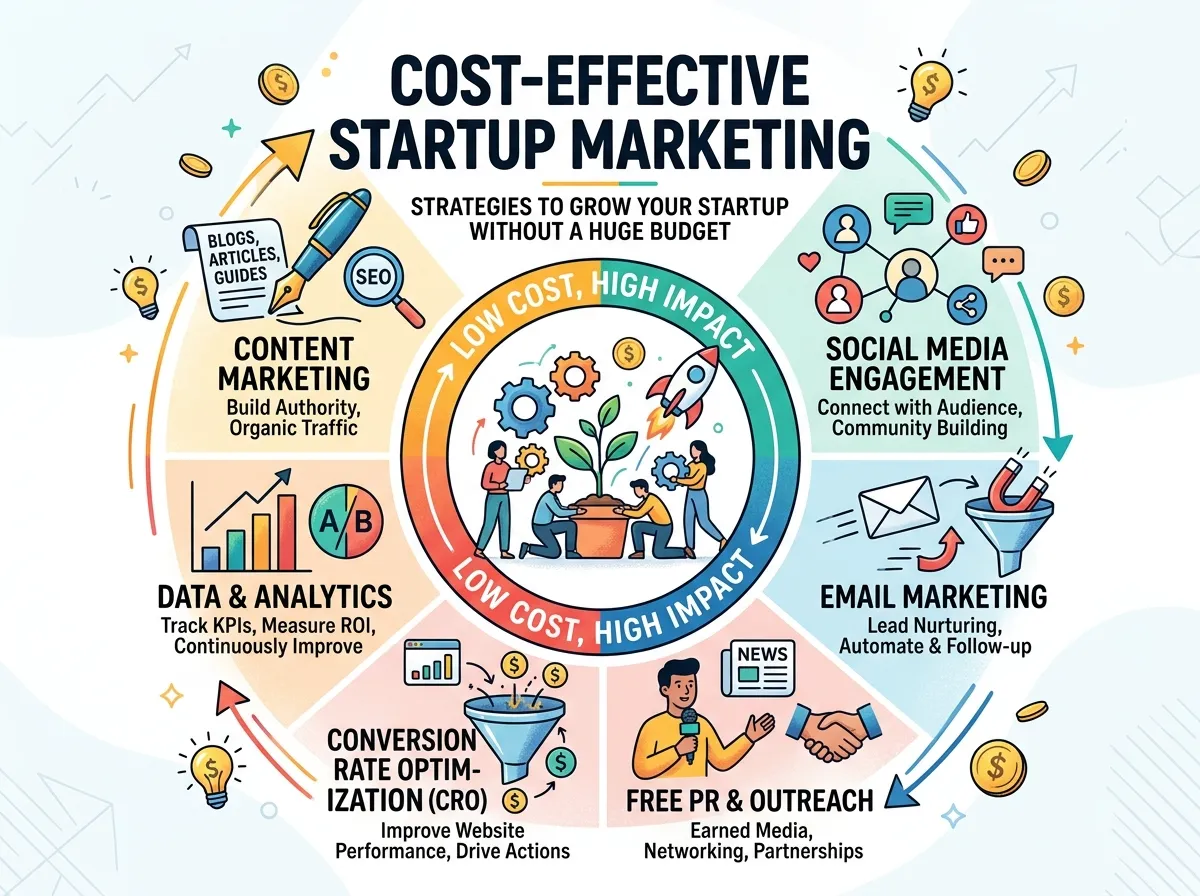
One of the biggest advantages of inbound marketing is its potential to support cost-effective startup marketing.
Cost-effective does not mean free. Creating high-quality content, optimizing websites, producing videos, and managing marketing technology all require time and resources. However, inbound assets can continue generating value after the initial investment.
An evergreen article can attract search traffic for an extended period. A strong email list can provide an owned communication channel. A comprehensive resource can generate leads repeatedly.
This long-term value makes inbound marketing particularly attractive to startups that need to use limited resources carefully.
Startups can also prioritize channels according to their audience. A business-to-business software company may gain more value from search content, LinkedIn communication, webinars, and email than from investing heavily in unrelated channels.
The key is to focus resources where customer intent and business opportunity overlap.
B2B Inbound Marketing for Startups
B2B inbound marketing for startups often requires a strong emphasis on education and trust because B2B purchases can involve multiple decision-makers and longer evaluation periods.
A potential buyer may need to convince managers, finance teams, technical staff, or other stakeholders before making a purchase. Inbound content can provide the evidence and information necessary to support that process.
Detailed product pages, case studies, industry research, implementation guides, comparison content, webinars, and customer stories can all contribute to B2B decision-making.
B2B startups can also use content to establish thought leadership. Publishing informed perspectives on industry challenges can help a young company compete with larger organizations that already have stronger brand recognition.
When combined with targeted SEO and lead nurturing, B2B inbound marketing can create a sustainable pipeline of potential customers.
Measuring the Success of Inbound Marketing
Inbound marketing should be measured against business objectives rather than traffic alone.
Website traffic can indicate whether content is attracting attention, but startups should also examine engagement, lead conversion rates, qualified leads, sales opportunities, customer acquisition costs, and revenue.
Content performance can reveal which subjects attract valuable audiences. Conversion data can identify whether landing pages effectively turn visitors into leads. Sales information can show whether marketing-generated leads are becoming customers.
Over time, these measurements help startups understand the relationship between marketing activity and commercial outcomes.
It is also important to evaluate performance over an appropriate timeframe. Some inbound channels, particularly organic search and content marketing, can take time to build momentum. Expecting every article or campaign to produce immediate revenue can lead startups to abandon valuable strategies too early.
The Long-Term Value of Inbound Marketing for Startups
The greatest strength of inbound marketing for startups is its ability to build an interconnected marketing foundation.
Content attracts visitors. SEO helps potential customers discover that content. Conversion opportunities turn interested visitors into leads. Email and automation support nurturing. Sales teams engage qualified prospects. Customer experiences create retention and advocacy.
Each part can strengthen the others.
As the startup publishes more valuable content and learns more about its audience, its marketing system can become increasingly efficient. The company develops a library of resources, a growing audience, stronger search visibility, and deeper customer insights.
Inbound marketing therefore goes beyond individual campaigns. It can become part of the startup’s overall growth infrastructure.
Conclusion
Inbound marketing for startups provides a customer-centered approach to building awareness, generating leads, nurturing prospects, and supporting sustainable growth. By combining a strong startup inbound marketing strategy with content marketing, SEO, automation, lead nurturing, and inbound sales, startups can build marketing assets that continue creating value over time.
The approach is particularly valuable for companies working with limited budgets because it emphasizes relevance, expertise, trust, and long-term customer relationships. Whether a company focuses on B2B or consumer markets, inbound marketing can help create a more consistent path from discovery to conversion.
For startups willing to invest in useful content, customer understanding, and continuous optimization, inbound marketing can become a powerful foundation for sustainable customer acquisition and business growth.
Frequently Asked Questions
1. What is inbound marketing for startups?
Inbound marketing for startups is a customer-focused approach that attracts potential customers through useful content, search visibility, social media, email, and other relevant experiences rather than relying entirely on disruptive advertising.
2. Why is inbound marketing important for startups?
It can help startups build brand awareness, attract qualified prospects, establish credibility, generate leads, and develop long-term marketing assets without depending entirely on large advertising budgets.
3. What is a startup inbound marketing strategy?
A startup inbound marketing strategy connects audience research, content marketing, SEO, lead generation, conversion optimization, email marketing, automation, and sales activities around the needs of a startup’s target customers.
4. How does content marketing help startups?
Content marketing can help startups answer customer questions, demonstrate expertise, improve organic visibility, attract website visitors, generate leads, and build trust with potential customers.
5. How can startups generate inbound leads?
Startups can generate inbound leads through SEO content, landing pages, lead magnets, webinars, educational resources, newsletters, case studies, social media content, and other valuable experiences designed around customer needs.
6. Is inbound marketing cost-effective for startups?
Inbound marketing can be cost-effective because content and other marketing assets may continue generating traffic and leads after their initial creation. However, successful inbound marketing still requires investment in people, technology, content, and optimization.
7. How does marketing automation help startups?
Startup marketing automation can reduce repetitive manual work by automating email sequences, lead notifications, segmentation, follow-ups, content delivery, and other marketing activities.
8. What is lead nurturing for startups?
Lead nurturing involves maintaining meaningful communication with prospects who are not yet ready to purchase. Educational emails, case studies, webinars, product information, and other resources can help prospects move toward a purchasing decision.
9. Is inbound marketing effective for B2B startups?
Yes. B2B inbound marketing for startups can be particularly useful because B2B buyers often require detailed information, comparisons, evidence, and educational content before making purchasing decisions.
10. How long does inbound marketing take to produce results?
The timeframe varies depending on the industry, competition, website authority, content quality, distribution, and marketing resources. Some channels can generate early results, while SEO and content marketing often require consistent investment before producing significant long-term growth.