

Content marketing analytics helps businesses measure content performance by tracking traffic, engagement, conversions, leads, rankings, and ROI. These insights help marketers identify what works, improve their strategy, reach the right audience, and achieve better results.
Content marketing analytics is the process of collecting, analyzing, and interpreting data to understand how well your content performs. It helps businesses discover which content attracts visitors, engages audiences, generates leads, and contributes to revenue.
Creating blog posts, videos, guides, social media posts, and other content is only one part of a successful content marketing strategy. Without measuring the results, it can be difficult to know whether your content is actually helping your business achieve its goals.
With the right analytics approach, marketers can identify their best-performing content, understand audience behavior, improve future campaigns, and demonstrate the value of content marketing.
What Is Content Marketing Analytics?
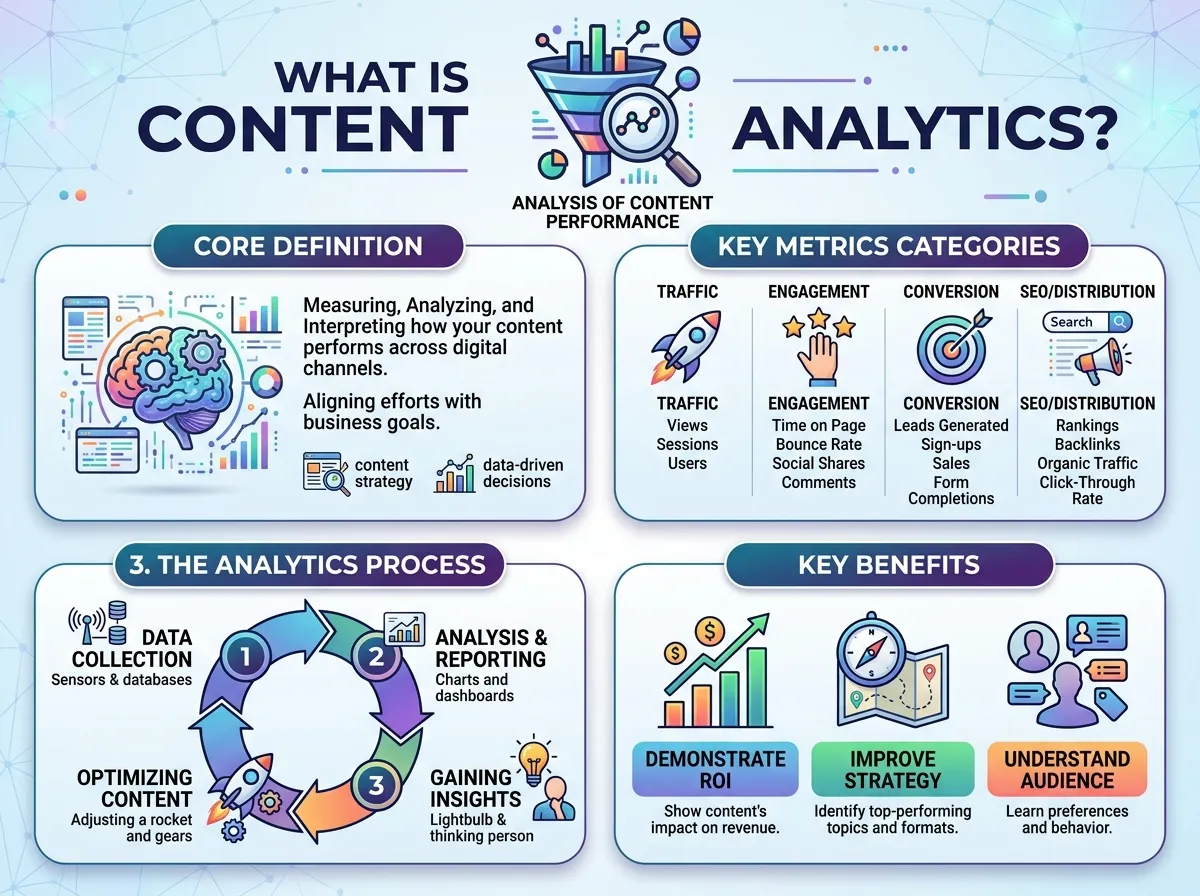
Content marketing analytics involves using data to evaluate the performance of content across different channels. It can include website traffic, search rankings, engagement, conversions, leads, social interactions, and revenue.
The goal is not simply to collect numbers. The real purpose is to understand what those numbers mean and use the insights to make better marketing decisions.
For example, if a blog post receives thousands of visitors but generates very few leads, traffic alone does not indicate success. On the other hand, a smaller article that attracts highly targeted visitors and generates several qualified leads may be more valuable.
This is why businesses need to look at multiple content marketing metrics instead of focusing on a single number.
Why Is Content Marketing Analytics Important?
Content requires time, resources, and investment. Analytics helps businesses determine whether that investment is producing meaningful results.
By analyzing content performance, marketers can understand what their audience wants and which topics deserve more attention. Analytics can also reveal content gaps, weak pages, and opportunities for improvement.
For example, analytics may show that:
- Certain blog topics consistently attract organic traffic.
- Some pages have high traffic but low engagement.
- Specific articles generate more leads than others.
- Visitors leave particular pages quickly.
- Search engines send valuable visitors to specific content.
- Certain content formats produce better conversions.
These insights allow marketers to move away from guesswork and build a more data-driven content strategy.
Important Content Marketing Metrics to Track
The right metrics depend on your marketing objectives. A brand focused on awareness may prioritize traffic and reach, while a B2B company focused on lead generation may care more about conversions and qualified leads.
Website Traffic
Website traffic is one of the most common metrics used to evaluate content. It shows how many people visit your website and which content attracts them.
Organic traffic is particularly important for businesses investing in SEO. Increasing organic visitors can indicate that your content is becoming more visible in search engines.
However, traffic should not be considered a success by itself. High traffic is useful only when those visitors are relevant to your business.
Engagement Metrics
Content engagement metrics help marketers understand how visitors interact with their content. These can include engagement rate, average engagement time, scroll depth, comments, shares, and other interactions.
Engagement provides more context than traffic alone. If visitors spend time reading an article, explore other pages, or interact with the content, it may indicate that the material is relevant and useful.
Low engagement can suggest that the content needs a stronger introduction, better formatting, clearer messaging, or more relevant information.
Conversion Rate
Conversions are among the most valuable measurements in content marketing. A conversion occurs when a visitor completes a desired action, such as submitting a form, downloading a resource, signing up for a newsletter, requesting a demo, or making a purchase.
A page with fewer visitors can still outperform a high-traffic page if it generates more conversions.
Lead Generation
For B2B companies, content often plays an important role in generating leads. Analytics can help identify which articles, landing pages, ebooks, webinars, or other resources contribute to lead generation.
Tracking leads by content allows marketers to understand which topics attract potential customers and move them further through the buying journey.
Understanding Content Performance Analytics

Content performance analytics goes beyond basic traffic reporting. It examines how individual pieces of content perform against specific marketing objectives.
For example, marketers can compare several blog posts based on organic traffic, engagement, conversions, backlinks, and revenue contribution.
This comparison helps identify content that deserves to be updated, promoted, expanded, or replicated.
A useful approach is to divide content into different performance categories. High-traffic content with strong conversions can be considered a major business asset. Content with high traffic but poor conversions may need stronger calls to action. Content with low traffic but strong engagement may benefit from additional SEO optimization and promotion.
This approach makes analytics more actionable.
Content Marketing KPIs
Content marketing KPIs are measurable indicators used to determine whether content is supporting business goals.
The most important KPIs depend on your objectives. For brand awareness, marketers may monitor impressions, reach, organic traffic, and social engagement. For lead generation, conversion rates, leads, marketing-qualified leads, and form submissions may be more important.
For sales-focused campaigns, marketers may track revenue, customer acquisition cost, assisted conversions, and pipeline contribution.
The key is to connect every KPI to a meaningful business objective. Tracking dozens of numbers without understanding their purpose can make reporting complicated without providing useful insights.
Content Analytics Tools
Several platforms can help marketers collect and analyze content data.
Google Analytics can provide information about website traffic, user engagement, conversions, and acquisition channels. Google Search Console is useful for understanding organic search performance, queries, impressions, clicks, and search visibility.
SEO platforms such as Semrush and Ahrefs can help analyze rankings, keywords, backlinks, and competitors. Marketing automation and CRM platforms can connect content interactions with leads and customers. Businesses that want to connect content activity with automated lead nurturing can also explore this Inbound Marketing Automation Guide for additional insights.
The best content analytics tools are not necessarily the ones with the largest number of features. The right tool is one that provides accurate data and helps your team make practical decisions.
How to Measure Content Marketing Performance
Content performance measurement should begin with clearly defined objectives. Before publishing content, determine what you want it to achieve.
If the goal is organic visibility, monitor rankings, impressions, and organic traffic. If the goal is lead generation, focus on conversions and qualified leads. If the goal is customer retention, analyze content engagement among existing customers.
After establishing goals, create a measurement framework. Connect each content asset to the metrics that matter most.
For example, a product comparison article might be measured by organic traffic, engagement, demo requests, assisted conversions, and revenue.
Regular analysis then allows marketers to determine whether performance is improving and where changes are needed.
Measuring Content Marketing ROI
One of the biggest challenges for marketers is demonstrating content marketing ROI.
Content can influence customers at multiple stages of the buying journey, making it difficult to assign revenue to one article or campaign. A customer might first discover a brand through a blog post, return through an email, attend a webinar, and eventually become a customer.
Instead of evaluating content only through direct conversions, marketers should consider assisted conversions and the broader customer journey.
A simple ROI calculation can compare the revenue generated or influenced by content with the total cost of producing and promoting that content.
For example, if a content campaign generates $20,000 in attributable revenue and costs $5,000 to produce and promote, the campaign has generated a positive return.
The exact calculation will depend on your business model and attribution approach.
Building a Content Analytics Strategy
A successful content analytics strategy should connect content activities with business outcomes. Start by defining your goals. Next, identify the KPIs that demonstrate progress toward those goals. Then determine which tools will collect the required data.
A well-planned content strategy also makes it easier to organize topics, publishing schedules, and performance goals. Businesses looking to build a structured approach can explore this Content Marketing Strategy for B2B to learn how content can support lead generation and business growth.
Once your tracking system is established, create a regular reporting process. Monthly reporting can help identify broader trends, while weekly monitoring can highlight major performance changes.
It is also important to segment your data. Compare organic and paid traffic, new and returning visitors, different content formats, and different audience groups.
Using a Free Content Calendar Template can also help marketers organize content topics, publishing schedules, and performance tracking in a more consistent way.
Over time, these comparisons can reveal patterns that are difficult to see when looking at overall website numbers.
Using Content Marketing Data Analysis to Improve Strategy

Content marketing data analysis turns raw information into useful insights.
Suppose your analytics show that long-form educational articles generate significant organic traffic and consistently produce leads. This could indicate that your audience values detailed educational resources.
You can use this insight to create additional content around related topics, strengthen internal linking, update older articles, and develop downloadable resources.
Analytics can also identify underperforming content. Instead of immediately deleting a weak article, investigate why it is struggling. It may have poor search visibility, outdated information, weak headlines, limited internal links, or an unclear call to action.
Data should guide the decision about whether to update, consolidate, repurpose, or remove the content.
Content Performance Tracking
Content performance tracking should be an ongoing process rather than a one-time activity.
Content can change significantly after publication. An article may initially receive little traffic but gain visibility after ranking for important search terms. Another article may perform well for several months before becoming outdated.
Regular tracking helps marketers identify these changes.
A content dashboard can bring important information into one place, including traffic, engagement, rankings, conversions, leads, and revenue. This makes it easier to identify trends and prioritize optimization work.
Best Practices for Content Marketing Analytics
The most effective analytics programs focus on quality rather than quantity. Avoid tracking every available metric simply because a tool provides it.
Instead, focus on metrics connected to your objectives. Make sure tracking is consistent across campaigns and platforms so that results can be compared accurately.
It is also important to analyze trends rather than isolated results. A single month of lower traffic may not indicate a serious problem. Seasonal changes, algorithm updates, industry trends, and promotional activity can all affect performance.
Most importantly, turn analytics into action. Data is valuable only when it helps you make better decisions.
Conclusion
Content marketing analytics helps businesses understand whether their content is attracting the right audience, creating engagement, generating leads, and contributing to business growth.
By tracking important content marketing metrics, analyzing performance, measuring ROI, and using the right analytics tools, marketers can build a stronger and more effective content strategy.
The goal is not simply to create more content. It is to create content that performs.
When businesses consistently measure results and use those insights to improve their strategy, content marketing becomes more predictable, measurable, and valuable.
Frequently Asked Questions
What is content marketing analytics?
Content marketing analytics is the process of collecting and analyzing data to measure how effectively content attracts, engages, converts, and retains an audience.
What are the most important content marketing metrics?
Important metrics include organic traffic, engagement rate, average engagement time, conversions, leads, search rankings, backlinks, and revenue. The best metrics depend on your marketing goals.
Why is content performance analytics important?
Content performance analytics helps marketers understand which content performs well and why. These insights can be used to improve existing content and guide future content creation.
What are content marketing KPIs?
Content marketing KPIs are measurable indicators used to evaluate progress toward content marketing objectives. Common KPIs include traffic, conversions, leads, engagement, rankings, and revenue.
How do you measure content marketing ROI?
Content marketing ROI can be measured by comparing the revenue generated or influenced by content with the total cost of creating and promoting that content.
Which content analytics tools should marketers use?
Google Analytics and Google Search Console are useful starting points. SEO platforms and CRM or marketing automation tools can provide additional information about rankings, leads, conversions, and customer journeys.
How often should content performance be measured?
Performance should be monitored regularly. Weekly checks can identify major changes, while monthly or quarterly analysis is useful for understanding trends and making strategic decisions.
What is content performance tracking?
Content performance tracking is the ongoing process of monitoring metrics such as traffic, engagement, rankings, conversions, and revenue to understand how content changes over time.
How can analytics improve a content strategy?
Analytics can identify successful topics, underperforming pages, audience preferences, content gaps, and conversion opportunities. Marketers can use these insights to optimize and create more effective content.
What is the difference between content analytics and content marketing analytics?
Content analytics generally focuses on analyzing content performance and audience behavior. Content marketing analytics takes a broader view by connecting content performance with marketing goals such as leads, conversions, customer acquisition, and revenue.